May 06, 2021

“About one-fifth of the people are against everything all of the time.”

robert-f-kennedy one-fifth quote May 1964 WM
Some observers have expressed surprise that two populist, anti-establishment candidates who many people view as “extremists” won sizeable percentages of the votes in the 2016 presidential primary elections.

But in the past there have been other high profile populist presidential candidates who based their campaigns on disdain for “the establishment” and passionate opposition to something.

In 1964, U.S. Attorney General Robert F. Kennedy uttered a oft-cited political quotation that is a reference to this phenomenon, though the connection is not widely known.

Speaking to a group of law students at the the University of Pennsylvania on May 6, 1964, Kennedy observed:

      “About one-fifth of the people are against everything all of the time.”

This quote (often given without the word “About”) is found in many books and on many websites, usually without any explanation of the context. 

Unfortunately, as far as I know, the speech is not posted anywhere online.

However, there is an old news story in the Google News Archive that sheds light on why Kennedy made the remark.

It’s a brief Associated Press article about the speech that ran in newspapers later that week.

The article notes that Kennedy was commenting on the fact that a sizeable percentage of U.S. voters had recently voted for Alabama Governor George Wallace in the 1964 Democratic Presidential primary elections.

Wallace was among the most prominent opponents of racial desegregation and efforts to secure equal rights for African Americans in the 1960s.

In his inaugural address as Governor on January 14, 1963, he famously committed himself to “segregation today, segregation tomorrow, segregation forever.”

On June 11, 1963, Wallace took his infamous “Stand in the Schoolhouse Door” at the University of Alabama. He literally stood in front of the door of the traditionally segregated school to try to block the entry of two black students, Vivian Malone and James Hood.

That and other highly publicized anti-integration antics and statements by Wallace made him the darling of pro-segregation whites in Southern and Northern states.

Buoyed by his notoriety, Wallace ran for the Democratic presidential nomination in 1964 against incumbent President Lyndon Baines Johnson, who had succeeded John F. Kennedy after Kennedy was assassinated on November 22, 1963.

Like JFK, President Johnson was supportive of the Civil Rights movement and committed to enforcing court-mandated desegregation of schools and other public facilities.

As Attorney General, Robert Kennedy was in the forefront of that battle. He was also helping Johnson push for enactment of landmark civil rights legislation in Congress, which had initially been proposed by his brother in 1963.

During the Democratic primary race, George Wallace waged a fiery populist campaign against Johnson, the Democratic and Washington establishment and desegregation.

Editorial writers, church leaders, trade unions, Democratic Party leaders and many other people and groups denounced him as an extremist, a right-wing racist and kook.

George Wallace 1968 campaign brochure coverNonetheless, thousands of cheering supporters showed up at his campaign events. And, he did surprisingly well in many primary elections—including those in some Northern states.

He won a third of the votes in Wisconsin, 43% in Maryland and nearly 30% in Indiana.

Robert F. Kennedy’s May 6th speech at the University of Pennsylvania came one day after the Indiana primary.

Kennedy decided to comment on it.

Here’s how the Associated Press story summarized what he said:

     PHILADELPHIA (AP) – Atty. Gen. Robert F. Kennedy says he “was not surprised” at the strong vote for Gov. George C. Wallace of Alabama in the Indiana presidential primary.
     Kennedy, speaking to 300 law students at the University of Pennsylvania Wednesday, said “there is a revolution now in the United States over civil rights and people don’t like to have their lives disturbed.”
     “It’s not surprising then,” he added, “that one-third of the people in Indiana voted for Wallace. About one-fifth of the people are against everything all the time.”
     Wallace, who campaigned against the civil rights bill pending in the Senate, got more than 29 per cent of the votes in losing to Democratic Gov. Matthew E. Welsh.

Of course, Johnson went on to win the Democratic nomination and the presidential election of 1964.

On that same election night in 1964, Robert F. Kennedy was elected U.S. Senator for New York.

Four years later, his own run at the presidency was cut short when he was assassinated by Sirhan Sirhan.

Would Kennedy have won the 1968 presidential election if he’d lived? Possibly.

Republican Richard Nixon won with less than a 1% margin in the popular vote over Democratic nominee Hubert H. Humphrey, who was less well known and less popular than Kennedy.

George Wallace ran for president again in 1968 as a third party candidate.

His policy positions appealed to independent, anti-establishment voters. The majority were angry white men.

They felt the federal government and courts were trying to force things down their throats that they totally disagreed with and the politicians were wasting their tax dollars on welfare and foreign aid. And, they agreed with Wallace’s claim that “there's not a dime's worth of difference between the two major parties.”

Wallace pledged to address many of the key things they were against. He pledged to end federal efforts at desegregation, reduce spending on welfare programs, slash foreign aid, stop the “tyranny” of the U.S. Supreme Court and block gun control proposals.

In the November 1968 election he received 13.5% of the popular vote.

As in 1964, most of the people who voted for Wallace in 1968 clearly fit the demographics of the “antis” Robert Kennedy had in mind when he made his famous observation.

*     *     *     *     *     *     *     *     *     *

Comments? Corrections? Post them on the Famous Quotations Facebook page

Related reading…

April 07, 2021

The origins of the “The Domino Effect”…


Contrary to what
many sites on the Internet say, President Dwight D. Eisenhower did not coin the famous Cold War term “the Domino Effect.” 

He did use the phrase “falling domino principle” in a famous press conference on April 7, 1954.

Journalists at the time dubbed this “The Domino Theory,” which later came to be referred to as “the Domino Effect.”

The political concept encapsulated by those terms — the idea that if one country fell to the control of Communists, then nearby countries could follow — was a major foundation of America’s foreign policy during the Cold War years, which lasted from 1947 until the dissolution of the Soviet Union in 1991.

This concern was initially raised by President Truman’s Undersecretary of State, Dean Acheson.

In 1947, the government of Greece faced threats from Communist insurgents and Turkey seemed to be falling under the sway of the Soviet Union. Acheson warned in various public statements that, if the “Reds” took over in Greece and Turkey, Communism would likely spread south to Iran and as far east as India.

To counter this threat, President Truman asked Congress to approve $400 million in military and economic assistance for Greece and Turkey and proposed an anti-Communist policy eventually referred to as “The Truman Doctrine.” 

“It must be the policy of the United States,” Truman explained in a high-profile speech to Congress, “to support free peoples who are resisting attempted subjugation by armed minorities or by outside pressures.”

President Eisenhower, Truman’s successor, agreed with the Truman Doctrine’s goal of containing the spread of Communism. And, early  in his first term in office, he was forced to consider the need to apply that doctrine to Southeast Asia.

By 1954, France was on the verge of losing control of its colony Indochina (later called Vietnam) to Communist insurgents led by Ho Chi Minh. Eisenhower and his administration worried that if Indochina fell to Communist control, other Southeast Asian countries would follow.

During a White House press conference on April 7, 1954, reporter Robert Richards of the Copley Press asked Eisenhower: “Mr. President, would you mind commenting on the strategic importance of Indochina for the free world? I think there has been, across the country, some lack of understanding on just what it means to us.”

Eisenhower famously responded:

“You have, of course, both the specific and the general when you talk about such things. First of all, you have the specific value of a locality in its production of materials that the world needs.

Then you have the possibility that many human beings pass under a dictatorship that is inimical to the free world.

Finally, you have broader considerations that might follow what you would call ‘the falling domino principle.’ You have a row of dominoes set up, you knock over the first one, and what will happen to the last one is the certainty that it will go over very quickly. So you could have a beginning of a disintegration that would have the most profound influences.”

Eisenhower said this disintegration would lead to the “loss of Indochina, of Burma, of Thailand, of the Peninsula, and Indonesia following.”

In many news stories, reporters referred to Eisenhower’s falling domino principle as “the Domino Theory” or as “the Domino Effect.” The latter was a term that journalists Joseph and Stewart Alsop used in their popular syndicated newspaper column and claimed to have coined.

A month after Eisenhower made his famous remarks in 1954, Vietminh forces under General Vo Nguyen Giap defeated French troops at the Battle of Dien Bien Phu.

France soon ceded control of its former colony. And, under an agreement hammered out in Geneva, Indochina was partitioned into Communist-controlled North Vietnam and non-Communist South Vietnam.

In the following years, Eisenhower provided economic assistance and weapons to the fledgling South Vietnamese government and sent in a small number of American military advisors.

During the early 1960s, President John F. Kennedy significantly expanded U.S. economic and military assistance to South Vietnam and increased the number of military advisors there to more than 16,000.

These decisions by Eisenhower and Kennedy set in motion a political and military domino effect that ultimately led to the Vietnam War.

*     *     *     *     *     *     *     *     *     *

Comments? Corrections? Questions? Email me or post them on my Famous Quotations Facebook page.

Related reading and viewing…

April 02, 2021

“Open the pod bay doors, HAL.”

Open the pod bay doors Hal
On April 6, 1968, director Stanley Kubrick’s visionary science fiction film 2001: A Space Odyssey was released to movie theaters nationwide in the United States.

The film, developed from the short story “Sentinel” by Arthur C. Clarke, had its initial premiere in Washington, D.C. on April 2nd, followed by local premieres in New York City and Los Angeles.

On April 6th, with the film’s general release, movie audiences throughout the country first heard several memorable lines that are cited by many books and websites as being among the most famous movie quotes of all time.

The most widely-known (and spoofed) line from 2001 is spoken by astronaut David Bowman (actor Kier Dullea).

He says it to HAL, the sentient HAL 9000 computer on the US space craft Discovery One, which is on a mysterious mission to Jupiter. (The name HAL is short for “the H-euristically programmed AL-gorithmic computer.”)

It comes near the end of the movie, after HAL begins killing off the ship’s crew.

Bowman takes a small space pod outside to retrieve the body of fellow astronaut Frank Poole (Gary Lockwood).

As Bowman returns to the ship, he asks HAL to let him back inside with the famous line: “Open the pod bay doors, HAL.”

This leads to one of most chilling exchanges in movie history:

2001 A Space Odyssey (1968) poster by Robert McCallDAVE:  Open the pod bay doors, Hal.
HAL:  I’m sorry, Dave. I’m afraid I can’t do that.
DAVE:  What’s the problem?
HAL:  l think you know what the problem is just as well as l do.
DAVE:  What are you talking about, Hal?
HAL:  This mission is too important for me to allow you to jeopardize it.
DAVE:  I don’t know what you're talking about, Hal.
HAL:  l know that you and Frank were planning to disconnect me, and I’m afraid that's something I can’t allow to happen.
DAVE:  Where the hell’d you get that idea, Hal?
HAL:  Although you took very thorough precautions in the pod against my hearing you, I could see your lips move.
DAVE:  All right, Hal. I’ll go in through the emergency air lock.
HAL:  Without your space helmet, Dave, you’re going to find that rather difficult.
DAVE:  Hal, I won’t argue with you anymore. Open the doors!
HAL:  Dave...This conversation can serve no purpose anymore. Goodbye.

Dave uses a desperate maneuver to get back into the spaceship, without the helmet he’d left behind. He then heads determinedly to the room that houses HAL’s “brain,” and begins to shut down the rogue AI computer.

During the shutdown process, HAL senses what’s happening and utters one of the other famous lines from the film:

       “Dave, my mind is going. I can feel it.”

As HAL’s mind goes, he begins singing the old song “Daisy Bell,” which he was taught by his programmers:

       “Daisy, Daisy, Give me your answer do.
        I’m half crazy, all for the love of you.”

After HAL’s mind is fully gone, the minds of the movies’ viewers are blown away by the final scenes.

First comes the psychedelic “star gate” sequence, then a series of scenes showing Dave Bowman aging, dying, and finally being reborn as a shining “space baby.”

Would you like me to tell you what it all means?

I’m sorry, folks, I’m afraid I can’t do that.    

*     *     *     *     *     *     *     *     *     *

Comments? Corrections? Questions? Email me or post them on my Famous Quotations Facebook page.

Further reading and viewing:


March 25, 2021

The story behind the famous movie misquote: “Me Tarzan, you Jane.”


On March 25, 1932, the classic film Tarzan the Ape Man, starring former Olympic swimmer
Johnny Weissmuller as Tarzan, premiered in New York City.

The famous movie misquote associated with this movie is “Me Tarzan, you Jane.”

It’s a misquote because Weissmuller didn’t actually say the line in that film or any of the other Tarzan movies he starred in between 1932 and 1948.

Nor does the line “Me Tarzan, you Jane” appear in any of the original Tarzan stories or books written by Edgar Rice Burroughs.

But Weissmuller did say it, jokingly, in an interview published in the June 1932 issue of Photoplay magazine.

He told the Photoplay reporter:

     “I didn’t have to act in Tarzan, the Ape Man — just said, ‘Me Tarzan, you Jane.’”

After that, his quip became an oft-used comic catchphrase that many people mistakenly assume came from one of Weissmuller’s Tarzan movies.

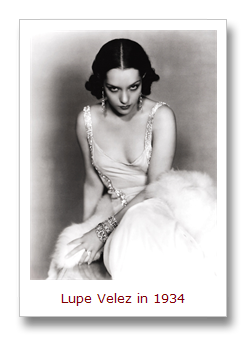
Another Hollywood star who used the line for humorous effect was Weissmuller’s second wife, the exotic Mexican dancer and actress Lupe Velez, the “Mexican Spitfire.

Velez was married to Weissmuller for five tempestuous years in the 1930s, at the height of his fame and hers. Their fights were legendary.

After their divorce, Velez joked that she spoke English poorly because “I was married to a guy who can only say, ‘Me Tarzan, you Jane.’”

When Weissmuller died in 1984, the Associated Press obituary for him noted that a reporter once asked him to explain his movie success, given his lack of acting skills.

Weissmuller responded, this time seriously: “How can a guy climb trees, say ‘Me, Tarzan, you, Jane,’ and make a million? The public forgives my acting because they know I was an athlete. They know I wasn’t make-believe.”

Of course, if you’re a true Tarzan fan, you probably know that Weissmuller’s “Me Tarzan, you Jane” quip is a take-off on a humorous scene in his 1932 film Tarzan the Ape Man.

In that scene, Tarzan learns the words me, you, Jane and Tarzan, though he doesn’t put them together in the famous formulation.

After Tarzan saves Jane (actress Maureen O’Sullivan) from a leopard, she tries to communicate with him.

The resulting conversation is almost like an Abbott and Costello comedy routine.

JANE: “Thank you for protecting me.”

TARZAN: “Me?”

JANE: “I said, thank you for protecting me.”

TARZAN: (Pointing at her.) “Me?”

JANE: “No. I’m only ‘Me’ for me.”

TARZAN: (Pointing at Jane again.) “Me.”

JANE: “No. To you, I’m ‘You.’”

TARZAN: (Pointing at himself.) “You.”

JANE: “No. I’m Jane Parker. Understand? Jane. Jane.”

TARZAN: (Pointing at her.) “Jane. Jane. Jane.”

JANE: “Yes, Jane! (She points at him.) And, you? (She points at herself again.) Jane.”

TARZAN: (Pointing at her) “Jane.”

JANE: “And you? (Pointing at him.) You?”

TARZAN: (Jabbing himself in the chest.) “Tarzan! Tarzan!”

JANE: “Tarzan!”

TARZAN: (Pointing at her and them himself.) “Jane. Tarzan.”

At this point, Weissmuller begins repeatedly poking her chest, then his own, saying “Jane. Tarzan. Jane. Tarzan.” — faster and faster — until O’Sullivan finally begs him to stop.

Of course, in the original Tarzan stories by Edgar Rice Burroughs, Tarzan spoke a number of languages fluently — including grammatically correct English.

*     *     *     *     *     *     *     *     *     *

Comments? Corrections? Post them on my Famous Quotations Facebook page or send me an email.

More related reading…

March 14, 2021

“I'll make him an offer he can't refuse.”


I'm a big fan of the Mario Puzo’s 1969 novel The Godfather and the movie that was made from it in 1972.

I am also a big fan of vintage men’s adventure magazines. In fact, I write a blog about them (MensPulpMags.com).

I also co-edit anthologies of classic men’s adventure magazine stories for the Men’s Adventure Library book series published by New Texture Books.

If you’re not a fan of those venerable periodicals from the 1950s, 1960s and 1970s, you may not know that Mario Puzo made his living writing wild action and adventure stories for them before The Godfather made him famous.

Puzo wrote some of his men’s adventure yarns under his own name. But the majority were written under the pseudonym “Mario Cleri.”

And he wrote a lot of them. I’d guesstimate around 200. (An example of a men’s adventure yarn Puzo wrote under the pen name Mario Cleri, featuring artwork by Gil Cohen, is shown below.)

Most of those stories appeared in men’s adventure magazines published by subsidiaries of Magazine Management, the publishing company owned by Martin Goodman.

Magazine Management put out some of the best men’s adventure mags, such as Action for Men, For Men Only, Male, Man’s World, Men and Stag. (It also launched Marvel Comics.)

Puzo was hired as a Magazine Management writer around 1959 by Bruce Jay Friedman, another talented writer who worked for the company before he became a world famous novelist (and playwright and scriptwriter). At the time, Friedman was the editor of several of the company’s men’s adventure magazines and its Playboy competitor, Swank

Mario Puzo Godfather in MALE, August 1969Puzo had written one novel before joining the Magazine Management staff. He wrote several others in his spare time while working for the company in the 1960s.

But he didn’t become successful as a novelist until 1969, when his fifth novel, The Godfather, was published on March 10 of that year by Putnam’s.

The iconic cover of the novel with the hand holding the marionette control bar (later used for the movie posters) was designed by S. Neil Fujita.

Not long after The Godfather was published, Puzo stopped writing for men’s adventure magazines. But he maintained warm relations with Magazine Management.

In August 1969 an abridged version of The Godfather was featured in the August 1969 issue of Male, along with an outstanding Godfather-themed cover painting by Mort Kunstler (shown at right) and equally cool interior illustrations by Earl Norem (shown below).

Puzo didn’t reach the height of his fame until a few years later, after the movie became a critical smash and box office blockbuster.

Although the movie is a fairly faithful adaptation of the novel by Hollywood standards, largely because Puzo co-wrote the script with director Francis Ford Coppola, there are some differences. One is related to the movie’s best known line.

Early in the novel, the Italian singer and actor Johnny Fontane tells Mafia “Godfather” Don Vito Corleone that a Hollywood movie executive had refused to give him a role he wanted in an upcoming film.

Don Corleone tells Johnny he’ll convince the studio executive to change his mind. When Johnny seems skeptical, Corleone gives a simple explanation of why he’s confident:

“He’s a businessman,” the Don said blandly. “I’ll make him an offer he can't refuse.”

Corleone sends his consigliere, Tom Hagen, to visit the studio exec and make a seemingly polite request to have Johnny reconsidered for the movie role.

The studio exec refuses, haughtily and hotly.

Soon after that, he finds the severed head of his prized stud racehorse in his bed—and quickly decides to give Johnny the role.

Mario Puzo story as Mario Cleri, MALE, Feb 1967Mario Puzo's The Godfather in MALE August 1969

Later in the novel, after Vito’s son Michael Corleone takes over the family business, Michael predicts that another mobster who had declined the family’s offer to buy his casino will change his mind.

Echoing his father, Michael says simply: “I’ll make him an offer he can’t refuse.”

Soon, that mobster is dead and Michael’s family owns the casino.

As you probably know, these same events are played out in the movie version of The Godfather, which was released in the USA on March 15, 1972.

In the movie, the famous “offer” line used by Marlon Brando, as Don Vito Corleone, is not quite the same as in the book.

Brando says: “I’m gonna make him an offer he can’t refuse.”

Later in the film, Al Pacino, as Michael, says the same line that Vito and Michael say in Puzo’s novel: “I’ll make him an offer he can’t refuse.”

When The Godfather debuted in movie theaters, it was an immediate hit. It was soon a huge one that broke multiple box office records.

Almost overnight, “an offer he can’t refuse” became a national catchphrase.

Of course, in the novel and film the “offer” is a veiled threat used with chilling effect.

As part of our language, mentions of offers that can’t be refused are now typically used more for humorous effect.

One mob-related example is in HBO’s mob family series The Sopranos.

In Episode 4, the character Uncle Junior (played by Dominic Chianese) tells what he views as a funny joke:

“You hear about the Chinese Godfather? He made them an offer they couldn’t understand.”

If any members of a Chinese Tong are reading this, please don’t send me any offers.

I admit Junior’s quip did make me chuckle a little when I watched that episode. But I know it’s not funny at all and I promise never repeat it again. I swear.

*     *     *     *     *     *     *     *     *     * 

Comments? Corrections? Post them on the Famous Quotations Facebook page.

Related reading…

Copyrights, Disclaimers & Privacy Policy


Copyright © Subtropic Productions LLC

All original text written for the This Day in Quotes quotations blog is copyrighted by the Subtropic Productions LLC and may not be used without permission, except for short "fair use" excerpts or quotes which, if used, must be attributed to ThisDayinQuotes.com and, if online, must include a link to http://www.ThisDayinQuotes.com/.

To the best of our knowledge, the non-original content posted here is used in a way that is allowed under the fair use doctrine. If you own the copyright to something posted here and believe we may have violated fair use standards, please let us know.

Subtropic Productions LLC and ThisDayinQuotes.com is committed to protecting your privacy. For more details, read this blog's full Privacy Policy.