Showing posts with label Literature quotes. Show all posts

December 12, 2023

“Our American professors like their literature clear and cold and pure and very dead.”


In the 1920s, Sinclair Lewis became one of the most successful writers in America.

During that decade he penned a series of five hugely popular novels: Main Street, Babbitt, Arrowsmith, Elmer Gantry and Dodsworth.

In 1930, Lewis became the first American writer to be awarded the Nobel Prize in Literature by the Swedish Academy that makes decisions about that award. He was given the award not for one specific book but in recognition of “his vigorous and graphic art of description and his ability to create, with wit and humour, new types of characters.”

When Lewis gave his official acceptance address to the Swedish Academy in Stockholm on December 12, 1930, he made a remark that would become a famous, widely-cited quotation:

       “Our American professors like their literature clear and cold and pure and very dead.”

The story behind that quote involves some now little-known facts about America’s literary and academic history.

In the culture war of recent decades, the most common criticism of college professors as a group has been the claim that they are mostly left-leaning, “effete intellectual,” anti-American liberals.

But in the early decades of the Twentieth Century, America’s academic establishment seemed stuffily conservative to boundary-pushing writers like Lewis.

The members of the nation’s top official organization dedicated to fostering “excellence” in American literature, the American Academy of Arts and Letters, was largely composed of hidebound academics and celebrities who were almost all elderly, White and male.

And, through most of the 1920s, the guidelines for awarding America’s annual Pulitzer Prize for fiction stated that the prize was intended to be “for the American novel published during the year which shall best present the wholesome atmosphere of American life, and the highest standard of American manners and manhood.”

Lewis’ first widely-read novel, Main Street (1920), satirized the typical close-minded society of small towns in America. His second, Babbitt (1922), skewered middle-class American businessmen and families. Both titles became symbolic terms for social conformity.

Main Street and Babbitt were huge bestsellers, praised by many critics and suggested as nominees for the Pulitzer Prize. But they clearly bumped up against the outdated guidelines for that award and neither won.

In 1926, the Pulitzer Prize Committee finally did decide to give Lewis a Pulitzer for his third bestseller, Arrowsmith, a novel that focused on an idealistic doctor. However, at that point Lewis decided to thumb his nose at them and refused to accept it.

The letter he wrote to the Committee foreshadows his later Nobel Prize address.

Lewis said the “wholesome” guideline language for the Pulitzer meant that “the appraisal of the novels shall be made not according to their actual literary merit but in obedience to whatever code of Good Form may chance to be popular at the moment.”

“Between the Pulitzer Prizes, the American Academy of Arts and Letters...amateur boards of censorship, and the inquisition of earnest literary ladies,” he added, “every compulsion is put upon writers to become safe, polite, obedient, and sterile. In protest...I must decline the Pulitzer Prize.”

Four years later, when Lewis won the Nobel Prize in Literature, one tight-assed member of the American Academy of Arts and Letters attacked the decision publicly. By awarding the prize to a writer who had scoffed at American institutions, he sniffed, the Nobel Committee and the Swedish Academy had insulted America.

Lewis reflected on all this in the acceptance address he gave in Sweden on December 12, 1930.

He titled it “The American Fear of Literature.” And, in it, he aimed some pointed barbs at America’s academic and literary establishment.

He criticized the American Academy of Arts and Letters saying, among other things: “It does not represent the literary America of today, it represents only Henry Wadsworth Longfellow.” 

He also took another poke at the Pulitzer Committee and others who tried to make literature conform to rah-rah, politically-correct standards.

In America, he said:

“…even writers are still afraid of any literature which is not a glorification of everything American...To be not only a best seller in America but to be really beloved, a novelist must assert that all American men are tall, handsome, rich, honest, and powerful at golf; that all country towns are filled with neighbors who do nothing from day to day save go about being kind to one another; that although American girls may be wild, they change always into perfect wives and mothers.”

Then, Lewis took some shots at the typical professors of literature at America’s universities, in a section of the speech that ends with his famous quotation:

“To a true-blue professor of literature in an American university, literature is not something that a plain human being, living today, painfully sits down to produce. No; it is something dead; it is something magically produced by superhuman beings who must, if they are to be regarded as artists at all, have died at least one hundred years before the diabolical invention of the typewriter. To any authentic don, there is something slightly repulsive in the thought that literature could be created by any ordinary human being, still to be seen walking the streets, wearing quite commonplace trousers and coat and looking not so unlike a chauffeur or a farmer. Our American professors like their literature clear and cold and pure and very dead.

Lewis’ Nobel Prize address caused a huge uproar when it was reprinted in newspapers in the United States.

But as Liberace once put it, Lewis laughed all the way to the bank.

Recipients of the Nobel Prize receive a large monetary award; hundreds of thousands in Lewis’ time, now nearly $1 million.

When reporters asked what was he going to do with all that money, Lewis quipped that he would use it to support a young American author — himself.

*     *     *     *     *     *     *     *     *     *

Comments? Corrections? Questions? Email me or post them on my Famous Quotations Facebook page.

Related reading and listening…

September 24, 2023

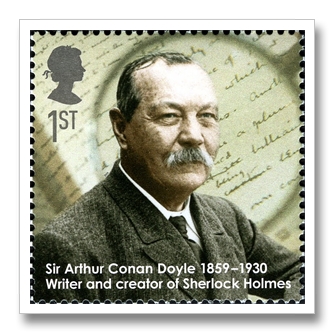
Sherlock Holmes quotes that Arthur Conan Doyle’s Sherlock did and didn’t say…


Naturally, some of the best known Sherlock Holmes quotations and catchphrases come from the classic detective stories written by Sherlock’s creator, British author Sir Arthur Conan Doyle (1859-1930).    

For example, there’s the famed sleuthing maxim that’s cited by thousands of quotation books and websites: “When you have eliminated the impossible, whatever remains, however improbable, must be the truth.”

Versions of that Holmesian principle are used in several Sherlock Holmes stories. The first is spoken by Sherlock in Chapter 6 of Doyle’s story “The Sign of Four” (1890).

The full sentence in which he used it, in a conversation with his mystery-solving partner Dr. John H. Watson, is: “How often have I said to you that when you have eliminated the impossible, whatever remains, however improbable, must be the truth?”

Doyle also used variations of it in two other stories: “The Beryl Coronet” (1892) and “The Blanched Soldier” (1926).

In “The Beryl Coronet” Holmes says to a banker named Mr. Alexander Holder: “It is an old maxim of mine that when you have excluded the impossible, whatever remains, however improbable, must be the truth.”

Early in the story “The Blanched Soldier,” Holmes explains to some concerned clients that his investigation process “…starts upon the supposition that when you have eliminated all which is impossible, then whatever remains, however improbable, must be the truth.”

Another famous Sherlockian catchphrase is “a three-pipe problem.” It comes from the story “The Red-Headed League” (1891). In that, when Dr. Watson asks Holmes what he will do to begin to solve a new case they’d been presented with, Holmes says he will start by smoking his pipe. He explains: “It is quite a three pipe problem, and I beg that you won’t speak to me for fifty minutes.”

One of the best-known phrases that comes from Doyle’s stories about the adventure of Sherlock Holmes is “the game is afoot.” It’s so well known you’d think it was some repeated line of Sherlock’s. But in the Doyle stories it is used in only one, “The Adventure of the Abbey Grange” (1904).

In that story, Holmes rousts Dr. Watson out of bed and says: “Come, Watson, come!…The game is afoot. Not a word! Into your clothes and come!”

The famous quotations from Doyle stories noted above have all been used in later radio, movie and TV adaptations.

However, two of the most widely-quoted Sherlock Holmes quotations used in those mediums don’t come from the stories penned by Sir Arthur Conan Doyle.

For example, Doyle’s Sherlock never said “Elementary, my dear Watson.”

In the story “The Crooked Man” (1893), Doyle’s Sherlock does say the word “Elementary” to his friend Doctor Watson, after Watson expresses surprise that Holmes had correctly guessed the doctor had had a busy day. But Holmes does NOT say “Elementary, my dear Watson” in that story or in any other Sherlock Holmes story written by Doyle.

As noted in a definitive post by Garson O’Toole on his Quote Investigator site, the phrase “Elementary, my dear Watson” was floating around in the early 1900s, but Sherlock Holmes movies probably deserve the credit for making it a widely known catchphrase.

The first movie to use it was The Return of Sherlock Holmes (1929). It starred Clive Brook as Sherlock and was released in the USA on October 26, 1929.

The line was then reused in several other Sherlock Holmes films, including: Sherlock Holmes' Fatal Hour (1931), The Sign of Four: Sherlock Holmes' Greatest Case (1932), Sherlock Holmes and the Voice of Terror (1942), Pursuit to Algiers (1945), The Hound of the Baskervilles (1959).

Another line often cited as a Sherlock Holmes quote which does not appear in Doyle’s stories is “Quick, Watson, the needle.” 

That originated in a comedic operetta titled The Red Mill (1906), which premiered on Broadway on September 24, 1906.

Ironically, the operetta is not a Sherlock Holmes story. The “needle” line is a quip by a con man who is impersonating Sherlock as part of a scam.

The Sherlock Holmes film Hound of the Baskervilles, released on March 31, 1939, further confused the facts about whether it was “real” Sherlock quotation.

In that film — one of the best of a series Holmes films that starred Basil Rathbone as the great sleuth — Basil says: “Oh, Watson, the needle.”

There’s no such quote about a needle in Doyle’s stories, though Doyle did tell us that Sherlock was a user of both cocaine and morphine.

In Doyle’s story “A Study in Scarlet” (1887), Watson comments that he often found Sherlock in a dreamlike state and “suspected him of being addicted to the use of some narcotic.”

Three years later, in Doyle’s “The Sign of Four,” fans of Sherlock first read about the “seven-percent-solution.”

As that story begins, Watson sees Sherlock injecting himself with a needle and notices ugly track marks on his arm.

“Which is it today,” Watson asks, “morphine or cocaine?”

“It is cocaine,” Sherlock replied, “a seven-per-cent solution. Would you care to try it?”

Since then, the drug habit of the world’s greatest detective has sparked continuing controversy, articles, books and a great movie, Nicholas Meyer’s film The Seven-Per-Cent Solution (1976), adapted from his novel of the same name.

Sherlock’s use of cocaine and versions of various Sherlock quotes continue to show up in recent Sherlock Holmes movies, TV series and books. Indeed, the great detective seems to be more popular than ever. And, if you’re a fan (like me), it’s no mystery why.

*     *     *     *     *     *     *     *     *     *

Comments? Corrections? Questions? Email me or post them on my Famous Quotations Facebook page.

Related reading, listening and viewing…


April 17, 2023

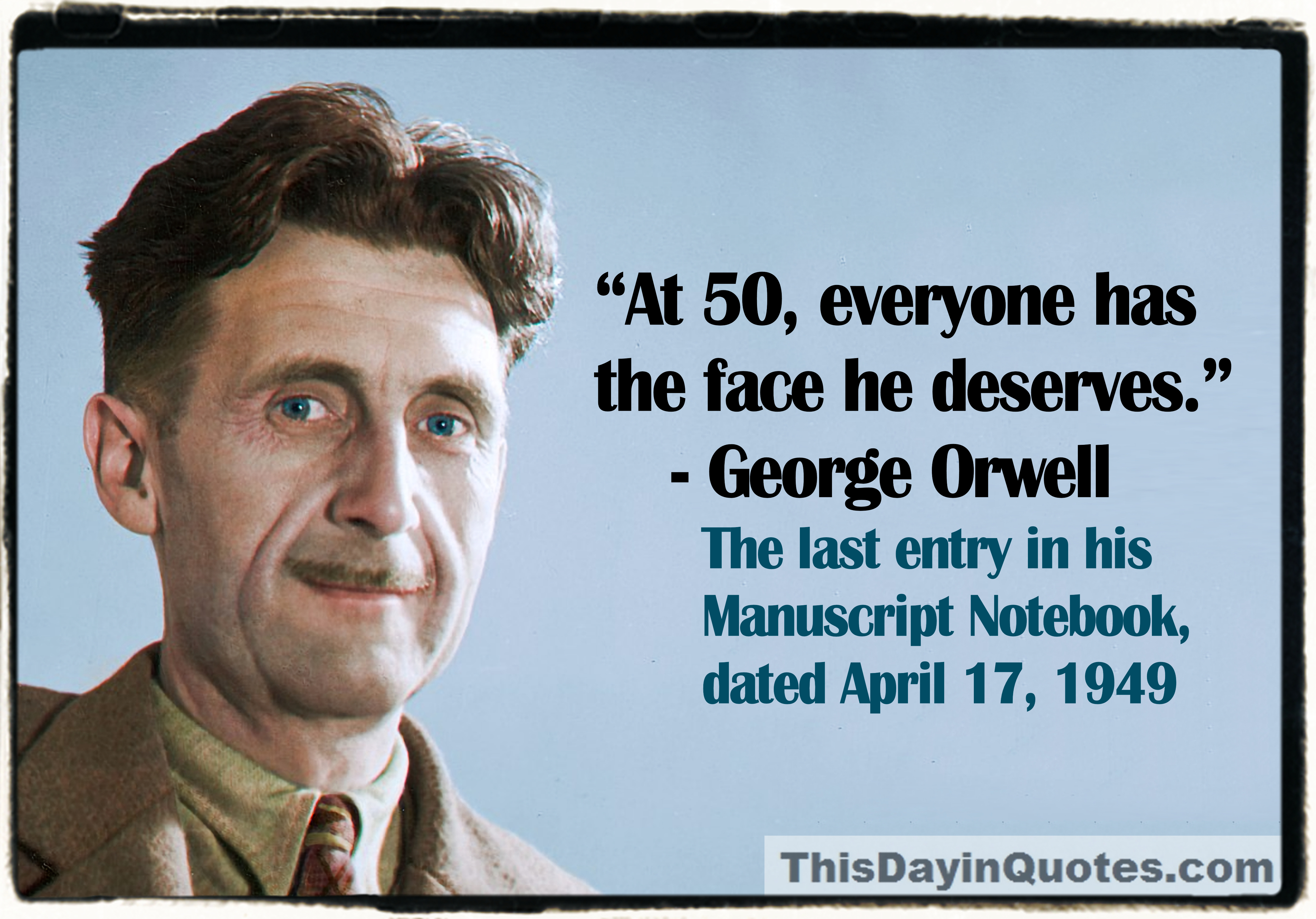
“At 50, everyone has the face he deserves.”


You may not recall the name Eric Blair, but you’re almost certainly aware of his pen name, George Orwell. His novels Animal Farm and 1984 have sold tens of millions of copies—more than any other two books by any other 20th century author.

Those novels also embedded a number of famous quotations into our language.

Among the best known from Animal Farm are:
     - “All animals are equal, but some animals are more equal than others;” and,
     - “Four legs good, two legs bad.”

Orwell’s 1984 coined several potent political terms we still use today, such as Big Brother, Doublethink, and thought police.

It also contains famous quotations like:
     - “Who controls the past controls the future. Who controls the present controls the past.” 
     - “War is peace. Freedom is slavery. Ignorance is strength.”
     - “If you want a picture of the future, imagine a boot stamping on a human face—forever.”

Throughout his writing career, Orwell kept diaries and manuscript notebooks. The notebook he was using in 1949, as he was working to finish 1984, includes notes that became some of those famous terms and quotes in the novel.

The last entry in his final notebook, dated April 17, 1949, is probably Orwell’s most cited quote outside of lines from his novels.

It says, “At 50, everyone has the face he deserves.”

The idea that we have facial karma is a not an idea Orwell created, though his version is the one that is most often quoted. As noted by a number of books of quotations and websites that provide background on quotations, other versions of the saying go back to at least the mid-1800s.

For example, in a post on his great Quote Investigator site, Garson O’Toole (author of Hemingway Didn’t Say That: The Truth Behind Familiar Quotations) traces precursors of Orwell’s line to the mid-1800s.

During the American Civil War, Edwin M. Stanton, President Abraham Lincoln's Secretary of War, said about an ugly man he disliked: “A man of fifty is responsible for his face!”

In the decades since, variations on the saying have been used by other celebrities and writers, including Albert Camus, Coco Chanel, Ingrid Bergman and many others. One probably apocryphal variation has even been attributed to Abe Lincoln: “Every man over forty is responsible for his face.”

Sometimes Orwell’s quote or versions of it are applied in a way that suggests what we think as we grow older affects how our face looks. Supposedly, consistently ugly thoughts will lead to an ugly face, and someone who usually thinks beautiful thoughts will look good when they’re older.

More often, the “face he deserves” aphorism is used to suggest that if a person is a mean-spirited and does bad things, their face will reflect the ugliness of what they did in their life.

In June 1949, not long after Orwell wrote his line about faces in the notebook, 1984 was published. Unfortunately, he didn’t make it to age 50. On January 21, 1950, he died at age 46.

Orwell’s novels and the often biting opinion pieces, news articles, and reviews he wrote reflect the thoughts of a man who was deeply concerned about the dark side of humanity and politics. Those grim thoughts may have aged his face. But in his final months, it was affected far more by the tuberculosis that ravaged his body and ultimately killed him.

*     *     *     *     *     *     *     *     *     *

Comments? Corrections? Questions? Email me or post them on my Famous Quotations Facebook page.

Related reading and listening…

July 12, 2022

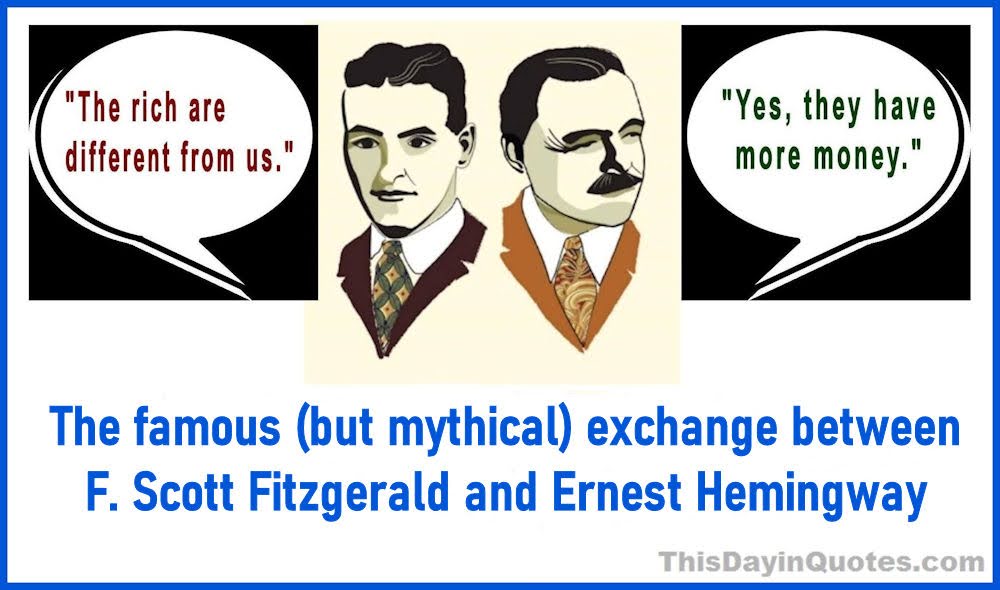
“The rich are different”… The legendary “exchange” between F. Scott Fitzgerald and Ernest Hemingway…


If you’re a quotation buff, you’ve probably heard of a legendary exchange about “rich people” that supposedly took place between the American novelists F. Scott Fitzgerald (1896-1940) and Ernest Hemingway (1899-1961).

Fitzgerald is usually quoted as saying either “The rich are different from you and me” or “The rich are different from us.”

Hemingway is quoted as responding: “Yes, they have more money."

In fact, this quote-counterquote repartee never actually occurred. But it is based on things written by Fitzgerald and Hemingway.

Here’s how it became a legend…

In 1925, Fitzgerald wrote a short story titled “The Rich Boy.” In 1926, it was published in Red Book magazine and included what became a very popular collection of Fitzgerald's early short stories, titled All the Sad Young Men.

The third paragraph of the story says:

     "Let me tell you about the very rich. They are different from you and me. They possess and enjoy early, and it does something to them, makes them soft where we are hard, and cynical where we are trustful, in a way that, unless you were born rich, it is very difficult to understand. They think, deep in their hearts, that they are better than we are because we had to discover the compensations and refuges of life for ourselves. Even when they enter deep into our world or sink below us, they still think that they are better than we are. They are different."

Clearly, that’s not a favorable view of rich people.

But years later, Ernest Hemingway, who had a sometimes-warm, sometimes-acrimonious relationship with Fitzgerald, decided to mock those lines from “The Rich Boy” in his short story “The Snows of Kilimanjaro.”

Hemingway’s original version of “The Snows of Kilimanjaro” was printed in the August 1936 issue of Esquire magazine. In a passage in that original version, Hemingway wrote:

     “The rich were dull and they drank too much, or they played too much backgammon. They were dull and they were repetitious. He remembered poor Scott Fitzgerald and his romantic awe of them and how he had started a story once that began, ‘The very rich are different from you and me.’ And how some one had said to Scott, Yes, they have more money. But that was not humorous to Scott. He thought they were a special glamorous race and when he found they weren't it wrecked him as much as any other thing that wrecked him.”

Understandably, Fitzgerald was shocked and offended.

He expressed his dismay to Hemingway in a letter. He also complained to Maxwell Perkins, the editor who oversaw publication of both writers’ novels and story collections at the Charles Scribner’s Sons book company. Hemingway responded with what Fitzgerald described as a “crazy letter,” a rambling diatribe that offered no real explanation or apology.

Perkins tried to smooth things over between his two prized writers and used his editorial power to fix the source of the problem when Scribner’s reprinted “The Snows of Kilimanjaro” in the 1938 anthology of Hemingway stories, The Fifth Column and the First Forty-Nine Stories.

In the version of the story in that book, the name “Scott Fitzgerald” was changed to “Julian.” It has appeared that way in most subsequent reprintings.

Unfortunately for Fitzgerald, he made the mistake of writing a cryptic entry in a personal notebook that cemented the legendary version of his “exchange” with Hemingway into literary history.

The entry said simply: “They have more money. (Ernest’s wisecrack.)”

After Fitzgerald died in 1940, his friend, the noted critic and book reviewer Edmund Wilson, compiled a collection of his essays and unpublished writings in a book titled The Crack-Up. It was published in 1945. Wilson included various entries from Fitzgerald’s notebooks in the anthology.

One of them was the brief note about “Ernest’s wisecrack.”

Wilson decided to add an explanatory footnote for that entry in the book. He wrote:

     “Fitzgerald had said, ‘The rich are different from us.’ Hemingway had replied, ‘Yes, they have more money.’”

Then, the famous literary critic Lionel Trilling repeated what he called this “famous exchange” that “everyone knows” in a review and essay about The Crack-Up, published in The Nation.

After that, many other articles and books cited this “exchange” as if it were an actual conversation between Fitzgerald and Hemingway.

And thus a famous quote-counterquote myth was born.

*     *     *     *     *     *     *     *     *     *

Comments? Corrections? Questions? Email me or post them on my Famous Quotations Facebook page.

Related reading and listening…


March 07, 2022

The awful origin of “The pen is mightier than the sword.”


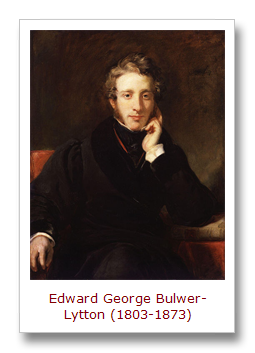
On March 7, 1839 the play Richelieu: or, the Conspiracy, by the British politician and author, Edward George Bulwer-Lytton, premiered at the Covent Garden Theatre in London.

Few people today have heard of this play. But everyone knows one of the lines in it: “The pen is mightier than the sword.”

The basic meaning of this famous quote — that the written word can be mightier than physical force or military power — was not originated by Bulwer-Lytton. There are similar lines in earlier works by various authors.

But Bulwer-Lytton’s play Richelieu is the origin of the version that became a familiar saying.

Edward George Bulwer-Lytton, a.k.a. the 1st Baron of Lytton, is renowned as a writer, but not for being a good writer. He’s renowned for being one of the worst writers in history.

His novels and plays — including Richelieu — are infamously pompous, long-winded and full of badly-constructed language.

The most notorious example is the oft-quoted opening line of his historical novel Paul Clifford (1830), which begins: “It was a dark and stormy night...”

The complete opening line of Paul Clifford is:

“It was a dark and stormy night; the rain fell in torrents-except at occasional intervals, when it was checked by a violent gust of wind which swept up the streets (for it is in London that our scene lies), rattling along the housetops, and fiercely agitating the scanty flame of the lamps that struggled against the darkness.”

That line and the novel are so memorably bad that “It was a dark and stormy night...” became a cliché and joke, even though most people don’t know what it came from.  

It has even inspired an annual contest, The Bulwer-Lytton Fiction Contest, in which entrants compete to submit the most convoluted and inane opening sentence for a fictional work of fiction.

Bulwer-Lytton’s “dark and stormy night” is his most famous bad sentence. But he wrote plenty of others that are equally odd, contorted and hard to fathom.

For example, here’s the full quotation in Act II, Scene II of Richelieu that includes the “pen is mightier” line:

“Beneath the rule of men entirely great,
The pen is mightier than the sword. Behold
The arch-enchanter’s wand — itself a nothing,
But taking sorcery from the master-hand
To paralyze the Caesars, and to strike
The loud earth breathless! Take away the sword,
States can be saved without it!”

If that strikes you as amazingly confusing and pretentious, then you’re not alone.

However, we have to give Bulwer-Lytton his due. He did create several famous quotes, including “the pen is mightier than the sword” — words that are still used and repurposed today.

Of course, as you probably know, his pen and sword aphorism is also the basis for a popular nudge-nudge, wink-wink pun.

If you don’t know the pun I’m talking about, never mind. It’s not actually that funny, even though a lot of us sniggered at it when we were kids.

*     *     *     *     *     *     *     *     *     *

Comments? Corrections? Questions? Email me or post them on my Famous Quotations Facebook page.

Related reading…

March 14, 2021

“I'll make him an offer he can't refuse.”


I'm a big fan of the Mario Puzo’s 1969 novel The Godfather and the movie that was made from it in 1972.

I am also a big fan of vintage men’s adventure magazines. In fact, I write a blog about them (MensPulpMags.com).

I also co-edit anthologies of classic men’s adventure magazine stories for the Men’s Adventure Library book series published by New Texture Books.

If you’re not a fan of those venerable periodicals from the 1950s, 1960s and 1970s, you may not know that Mario Puzo made his living writing wild action and adventure stories for them before The Godfather made him famous.

Puzo wrote some of his men’s adventure yarns under his own name. But the majority were written under the pseudonym “Mario Cleri.”

And he wrote a lot of them. I’d guesstimate around 200. (An example of a men’s adventure yarn Puzo wrote under the pen name Mario Cleri, featuring artwork by Gil Cohen, is shown below.)

Most of those stories appeared in men’s adventure magazines published by subsidiaries of Magazine Management, the publishing company owned by Martin Goodman.

Magazine Management put out some of the best men’s adventure mags, such as Action for Men, For Men Only, Male, Man’s World, Men and Stag. (It also launched Marvel Comics.)

Puzo was hired as a Magazine Management writer around 1959 by Bruce Jay Friedman, another talented writer who worked for the company before he became a world famous novelist (and playwright and scriptwriter). At the time, Friedman was the editor of several of the company’s men’s adventure magazines and its Playboy competitor, Swank

Mario Puzo Godfather in MALE, August 1969Puzo had written one novel before joining the Magazine Management staff. He wrote several others in his spare time while working for the company in the 1960s.

But he didn’t become successful as a novelist until 1969, when his fifth novel, The Godfather, was published on March 10 of that year by Putnam’s.

The iconic cover of the novel with the hand holding the marionette control bar (later used for the movie posters) was designed by S. Neil Fujita.

Not long after The Godfather was published, Puzo stopped writing for men’s adventure magazines. But he maintained warm relations with Magazine Management.

In August 1969 an abridged version of The Godfather was featured in the August 1969 issue of Male, along with an outstanding Godfather-themed cover painting by Mort Kunstler (shown at right) and equally cool interior illustrations by Earl Norem (shown below).

Puzo didn’t reach the height of his fame until a few years later, after the movie became a critical smash and box office blockbuster.

Although the movie is a fairly faithful adaptation of the novel by Hollywood standards, largely because Puzo co-wrote the script with director Francis Ford Coppola, there are some differences. One is related to the movie’s best known line.

Early in the novel, the Italian singer and actor Johnny Fontane tells Mafia “Godfather” Don Vito Corleone that a Hollywood movie executive had refused to give him a role he wanted in an upcoming film.

Don Corleone tells Johnny he’ll convince the studio executive to change his mind. When Johnny seems skeptical, Corleone gives a simple explanation of why he’s confident:

“He’s a businessman,” the Don said blandly. “I’ll make him an offer he can't refuse.”

Corleone sends his consigliere, Tom Hagen, to visit the studio exec and make a seemingly polite request to have Johnny reconsidered for the movie role.

The studio exec refuses, haughtily and hotly.

Soon after that, he finds the severed head of his prized stud racehorse in his bed—and quickly decides to give Johnny the role.

Mario Puzo story as Mario Cleri, MALE, Feb 1967Mario Puzo's The Godfather in MALE August 1969

Later in the novel, after Vito’s son Michael Corleone takes over the family business, Michael predicts that another mobster who had declined the family’s offer to buy his casino will change his mind.

Echoing his father, Michael says simply: “I’ll make him an offer he can’t refuse.”

Soon, that mobster is dead and Michael’s family owns the casino.

As you probably know, these same events are played out in the movie version of The Godfather, which was released in the USA on March 15, 1972.

In the movie, the famous “offer” line used by Marlon Brando, as Don Vito Corleone, is not quite the same as in the book.

Brando says: “I’m gonna make him an offer he can’t refuse.”

Later in the film, Al Pacino, as Michael, says the same line that Vito and Michael say in Puzo’s novel: “I’ll make him an offer he can’t refuse.”

When The Godfather debuted in movie theaters, it was an immediate hit. It was soon a huge one that broke multiple box office records.

Almost overnight, “an offer he can’t refuse” became a national catchphrase.

Of course, in the novel and film the “offer” is a veiled threat used with chilling effect.

As part of our language, mentions of offers that can’t be refused are now typically used more for humorous effect.

One mob-related example is in HBO’s mob family series The Sopranos.

In Episode 4, the character Uncle Junior (played by Dominic Chianese) tells what he views as a funny joke:

“You hear about the Chinese Godfather? He made them an offer they couldn’t understand.”

If any members of a Chinese Tong are reading this, please don’t send me any offers.

I admit Junior’s quip did make me chuckle a little when I watched that episode. But I know it’s not funny at all and I promise never repeat it again. I swear.

*     *     *     *     *     *     *     *     *     * 

Comments? Corrections? Post them on the Famous Quotations Facebook page.

Related reading…

Copyrights, Disclaimers & Privacy Policy


Copyright © Subtropic Productions LLC

All original text written for the This Day in Quotes quotations blog is copyrighted by the Subtropic Productions LLC and may not be used without permission, except for short "fair use" excerpts or quotes which, if used, must be attributed to ThisDayinQuotes.com and, if online, must include a link to http://www.ThisDayinQuotes.com/.

To the best of our knowledge, the non-original content posted here is used in a way that is allowed under the fair use doctrine. If you own the copyright to something posted here and believe we may have violated fair use standards, please let us know.

Subtropic Productions LLC and ThisDayinQuotes.com is committed to protecting your privacy. For more details, read this blog's full Privacy Policy.