Showing posts with label Ernest Hemingway. Show all posts

July 12, 2022

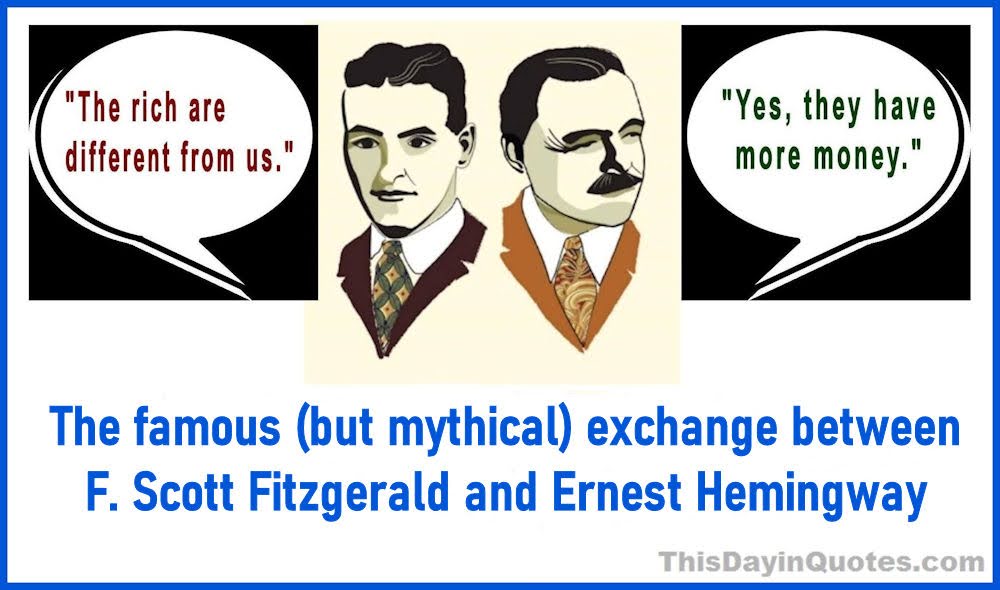
“The rich are different”… The legendary “exchange” between F. Scott Fitzgerald and Ernest Hemingway…


If you’re a quotation buff, you’ve probably heard of a legendary exchange about “rich people” that supposedly took place between the American novelists F. Scott Fitzgerald (1896-1940) and Ernest Hemingway (1899-1961).

Fitzgerald is usually quoted as saying either “The rich are different from you and me” or “The rich are different from us.”

Hemingway is quoted as responding: “Yes, they have more money."

In fact, this quote-counterquote repartee never actually occurred. But it is based on things written by Fitzgerald and Hemingway.

Here’s how it became a legend…

In 1925, Fitzgerald wrote a short story titled “The Rich Boy.” In 1926, it was published in Red Book magazine and included what became a very popular collection of Fitzgerald's early short stories, titled All the Sad Young Men.

The third paragraph of the story says:

     "Let me tell you about the very rich. They are different from you and me. They possess and enjoy early, and it does something to them, makes them soft where we are hard, and cynical where we are trustful, in a way that, unless you were born rich, it is very difficult to understand. They think, deep in their hearts, that they are better than we are because we had to discover the compensations and refuges of life for ourselves. Even when they enter deep into our world or sink below us, they still think that they are better than we are. They are different."

Clearly, that’s not a favorable view of rich people.

But years later, Ernest Hemingway, who had a sometimes-warm, sometimes-acrimonious relationship with Fitzgerald, decided to mock those lines from “The Rich Boy” in his short story “The Snows of Kilimanjaro.”

Hemingway’s original version of “The Snows of Kilimanjaro” was printed in the August 1936 issue of Esquire magazine. In a passage in that original version, Hemingway wrote:

     “The rich were dull and they drank too much, or they played too much backgammon. They were dull and they were repetitious. He remembered poor Scott Fitzgerald and his romantic awe of them and how he had started a story once that began, ‘The very rich are different from you and me.’ And how some one had said to Scott, Yes, they have more money. But that was not humorous to Scott. He thought they were a special glamorous race and when he found they weren't it wrecked him as much as any other thing that wrecked him.”

Understandably, Fitzgerald was shocked and offended.

He expressed his dismay to Hemingway in a letter. He also complained to Maxwell Perkins, the editor who oversaw publication of both writers’ novels and story collections at the Charles Scribner’s Sons book company. Hemingway responded with what Fitzgerald described as a “crazy letter,” a rambling diatribe that offered no real explanation or apology.

Perkins tried to smooth things over between his two prized writers and used his editorial power to fix the source of the problem when Scribner’s reprinted “The Snows of Kilimanjaro” in the 1938 anthology of Hemingway stories, The Fifth Column and the First Forty-Nine Stories.

In the version of the story in that book, the name “Scott Fitzgerald” was changed to “Julian.” It has appeared that way in most subsequent reprintings.

Unfortunately for Fitzgerald, he made the mistake of writing a cryptic entry in a personal notebook that cemented the legendary version of his “exchange” with Hemingway into literary history.

The entry said simply: “They have more money. (Ernest’s wisecrack.)”

After Fitzgerald died in 1940, his friend, the noted critic and book reviewer Edmund Wilson, compiled a collection of his essays and unpublished writings in a book titled The Crack-Up. It was published in 1945. Wilson included various entries from Fitzgerald’s notebooks in the anthology.

One of them was the brief note about “Ernest’s wisecrack.”

Wilson decided to add an explanatory footnote for that entry in the book. He wrote:

     “Fitzgerald had said, ‘The rich are different from us.’ Hemingway had replied, ‘Yes, they have more money.’”

Then, the famous literary critic Lionel Trilling repeated what he called this “famous exchange” that “everyone knows” in a review and essay about The Crack-Up, published in The Nation.

After that, many other articles and books cited this “exchange” as if it were an actual conversation between Fitzgerald and Hemingway.

And thus a famous quote-counterquote myth was born.

*     *     *     *     *     *     *     *     *     *

Comments? Corrections? Questions? Email me or post them on my Famous Quotations Facebook page.

Related reading and listening…


October 21, 2015

The day Hemingway’s “For Whom the Bell Tolls” made the earth move…


On October 21, 1940,
Ernest Hemingway’s novel For Whom the Bell Tolls was first published by Charles Scribner's Sons.

It’s a classic war story about an American, Robert Jordan, who goes to Spain to fight with anti-Fascist rebels during the Spanish Civil War. Along the way, he falls in love with a rebel girl named Maria.

The title of the novel is taken from a famous line written by British poet John Donne: “...never send to know for whom the bell tolls; it tolls for thee.” 

Those oft-quoted words are from Donne’s book Devotions upon Emergent Occasions, published in 1624. They come at the end of a passage that includes another famous quote by Donne: “No man is an island.”

Hemingway’s novel For Whom the Bell Tolls was a huge bestseller that generated some famous lines of its own.

The first comes in Chapter 7. As Robert and Maria are about to kiss for the first time, Maria asks the somewhat unbelievably naïve question: “Where do the noses go?”

That quote was immortalized by the immensely popular 1943 film adaptation of the book, in which Ingrid Bergman, as Maria, says it to Gary Cooper, playing Robert Jordan.

In Chapter 13 of the novel, there’s another famous quote: “But did thee feel the earth move?” (Hemingway used “thee” and other antiquated terms of speech in the novel supposedly as a way of translating what was being said in Spanish.)

Jordan poses this question to Maria after they have sex. According to a flowery previous paragraph describing their coupling, it did move for Jordan. He supposedly “felt the earth move out and away from under them.”

Maria answers Jordan’s question in the affirmative. Later, when one of the rebel leaders asks Maria if something happened between her and Jordan, she says simply: “The earth moved.”

When the novel was published in 1940, the use of the phrase “feel the earth move” was not a yet a humorous reference to enjoyable sex.

But the use of the phrase in both the book and the movie made it familiar enough to make it that – and to give songwriter-singer Carol King the title and refrain of her hit song “I Feel the Earth Move” (1971).

In Chapter 43 of For Whom the Bell Tolls, there’s another oft-quoted line: “The world is a fine place and worth fighting for.”

It’s included in many books of quotations and one of its many admirers is Senator John McCain. He used the variation Worth the Fighting For as the title of his autobiographical book published in 2003.

Ironically, McCain’s campaign nemesis, President Barack Obama has named Hemingway’s For Whom the Bell Tolls as one of the books that have inspired him.  

I live near Key West, where Ernest Hemingway lived from late 1920s to the late 1930s.

He worked on some of his most famous novels and stories there, including For Whom the Bell Tools, A Farewell To Arms, To Have and Have Not and the short story “The Snows of Kilimanjaro.”

Hemingway’s former house in Key West, now the Hemingway Home and Museum, is a big tourist attraction that is famous for the dozens of “polydactyl” (six- and seven-toed) cats that hang out there.

They’re descendants of the polydactyl cats Hemingway had there in the Thirties.

As a Keys resident, I should probably like Ernest Hemingway more than I do. But the truth is his books and stories never really made the earth move for me.

Plus, I’m just not macho enough to appreciate the fine arts of bullfighting, big game hunting and killing beautiful big fish – three of Hemingway’s favorite sports.

Nor do I find it easy to overlook the way he treated his wives, lovers and kids.

But I really like his polydactyl cats.

*     *     *     *     *     *     *     *     *     *

Comments? Corrections? Post them on the Famous Quotations Facebook page.

Related reading…

Copyrights, Disclaimers & Privacy Policy


Copyright © Subtropic Productions LLC

All original text written for the This Day in Quotes quotations blog is copyrighted by the Subtropic Productions LLC and may not be used without permission, except for short "fair use" excerpts or quotes which, if used, must be attributed to ThisDayinQuotes.com and, if online, must include a link to http://www.ThisDayinQuotes.com/.

To the best of our knowledge, the non-original content posted here is used in a way that is allowed under the fair use doctrine. If you own the copyright to something posted here and believe we may have violated fair use standards, please let us know.

Subtropic Productions LLC and ThisDayinQuotes.com is committed to protecting your privacy. For more details, read this blog's full Privacy Policy.