Showing posts with label Viet Nam. Show all posts

April 07, 2021

The origins of the “The Domino Effect”…


Contrary to what
many sites on the Internet say, President Dwight D. Eisenhower did not coin the famous Cold War term “the Domino Effect.” 

He did use the phrase “falling domino principle” in a famous press conference on April 7, 1954.

Journalists at the time dubbed this “The Domino Theory,” which later came to be referred to as “the Domino Effect.”

The political concept encapsulated by those terms — the idea that if one country fell to the control of Communists, then nearby countries could follow — was a major foundation of America’s foreign policy during the Cold War years, which lasted from 1947 until the dissolution of the Soviet Union in 1991.

This concern was initially raised by President Truman’s Undersecretary of State, Dean Acheson.

In 1947, the government of Greece faced threats from Communist insurgents and Turkey seemed to be falling under the sway of the Soviet Union. Acheson warned in various public statements that, if the “Reds” took over in Greece and Turkey, Communism would likely spread south to Iran and as far east as India.

To counter this threat, President Truman asked Congress to approve $400 million in military and economic assistance for Greece and Turkey and proposed an anti-Communist policy eventually referred to as “The Truman Doctrine.” 

“It must be the policy of the United States,” Truman explained in a high-profile speech to Congress, “to support free peoples who are resisting attempted subjugation by armed minorities or by outside pressures.”

President Eisenhower, Truman’s successor, agreed with the Truman Doctrine’s goal of containing the spread of Communism. And, early  in his first term in office, he was forced to consider the need to apply that doctrine to Southeast Asia.

By 1954, France was on the verge of losing control of its colony Indochina (later called Vietnam) to Communist insurgents led by Ho Chi Minh. Eisenhower and his administration worried that if Indochina fell to Communist control, other Southeast Asian countries would follow.

During a White House press conference on April 7, 1954, reporter Robert Richards of the Copley Press asked Eisenhower: “Mr. President, would you mind commenting on the strategic importance of Indochina for the free world? I think there has been, across the country, some lack of understanding on just what it means to us.”

Eisenhower famously responded:

“You have, of course, both the specific and the general when you talk about such things. First of all, you have the specific value of a locality in its production of materials that the world needs.

Then you have the possibility that many human beings pass under a dictatorship that is inimical to the free world.

Finally, you have broader considerations that might follow what you would call ‘the falling domino principle.’ You have a row of dominoes set up, you knock over the first one, and what will happen to the last one is the certainty that it will go over very quickly. So you could have a beginning of a disintegration that would have the most profound influences.”

Eisenhower said this disintegration would lead to the “loss of Indochina, of Burma, of Thailand, of the Peninsula, and Indonesia following.”

In many news stories, reporters referred to Eisenhower’s falling domino principle as “the Domino Theory” or as “the Domino Effect.” The latter was a term that journalists Joseph and Stewart Alsop used in their popular syndicated newspaper column and claimed to have coined.

A month after Eisenhower made his famous remarks in 1954, Vietminh forces under General Vo Nguyen Giap defeated French troops at the Battle of Dien Bien Phu.

France soon ceded control of its former colony. And, under an agreement hammered out in Geneva, Indochina was partitioned into Communist-controlled North Vietnam and non-Communist South Vietnam.

In the following years, Eisenhower provided economic assistance and weapons to the fledgling South Vietnamese government and sent in a small number of American military advisors.

During the early 1960s, President John F. Kennedy significantly expanded U.S. economic and military assistance to South Vietnam and increased the number of military advisors there to more than 16,000.

These decisions by Eisenhower and Kennedy set in motion a political and military domino effect that ultimately led to the Vietnam War.

*     *     *     *     *     *     *     *     *     *

Comments? Corrections? Questions? Email me or post them on my Famous Quotations Facebook page.

Related reading and viewing…

March 21, 2016

“Life is unfair,” as President John F. Kennedy famously observed on this date…


Many people are familiar with the famous quotation by President John F. Kennedy, “Life is unfair.”

But few people today remember or know the context of this quote.

It was something he said, in part, with respect to what would become the Vietnam War.

In 1961, the newly-elected president decided to send more than a thousand American “military advisors” to South Vietnam, where the pro-Western regime of President Ngo Dinh Diem faced mounting threats from Communist insurgents and the North Vietnamese army.

In 1962, Kennedy increased the American presence in Vietnam to nearly 10,000 troops.

When Army reservists began being called up to serve there, after recently being stationed on another Cold War front in West Berlin, some complained that they had “done their time” and expressed their resentment by holding public demonstrations. One reservist even began a hunger strike.

President Kennedy was asked about this opposition during a press conference held on March 21, 1962.

He responded by saying that calling up the reservists “strengthened the foreign policy of the United States.”

After making this political point, Kennedy waxed philosophical.

“There is always inequity in life,” he said. “Some men are killed in a war and some men are wounded, and some men never leave the country, and some men are stationed in the Antarctic and some are stationed in San Francisco. It’s very hard in military or in personal life to assure complete equality. Life is unfair.”

Since then, those last three words have often been quoted, generally without any context.

When put into the original context, this quote might not fit the liberal image of JFK that many people have.

In fact, Kennedy was a committed Cold Warrior. He essentially accepted the “Domino theory” articulated by his predecessor, President Dwight D. Eisenhower, and believed the spread of Communism needed to be stopped—by military means if necessary.

Thus, Kennedy shared Eisenhower’s concern that a potential takeover of South Vietnam by Communists could cause more “falling dominos” in Southeast Asia.

Eisenhower was the first president to send American servicemen to Vietnam. In the early 1950s, he sent a handful of U.S. “military advisors” there to aid France in its unsuccessful effort to keep Vietnam as a colony.

After the French were ousted and Vietnam was split into South and North Vietnam in 1954, Eisenhower sent more “military advisors” to help support Ngo Dinh Diem’s fledgling government in South Vietnam. But the numbers were still relatively small; from 750 to 1,500 U.S. servicemen between 1955 and 1960.

When Kennedy became president, he took more significant steps toward getting the U.S. entangled in what we now call the Vietnam War.

In 1961, he sent 3,200 American “military advisors” to South Vietnam. He increased that number in 1962. By the time of his assassination on November 22, 1963, Kennedy had sent a total of more than 16,000 U.S. servicemen to Vietnam and more than 100 had been killed.

Kennedy’s successor Lyndon Baines Johnson dramatically escalated U.S. involvement in Vietnam. By 1968, LBJ had committed more than half a million US troops to the war.

When Richard M. Nixon became president in 1969, he began to withdraw American troops, pushed the South Vietnamese government to increasingly fight the war on its own and entered fruitless peace negotiations with the North Vietnamese.

Nixon resigned in 1974 in the wake of the Watergate scandal and Gerald Ford became president. By that time there were only a small number of American troops left in Vietnam. Most were there primarily to guard the U.S. embassy in Saigon.

Saigon fell to the North Vietnamese on April 30, 1975, bringing the Vietnam War to an ignominious end.

More than 58,000 American servicemen and women were killed during the course of the war.

Somewhere between 1 and 3 million North and South Vietnamese men, women and children were killed.

Ultimately, all of those deaths did not prevent Communists from controlling South Vietnam. Today, nobody in the U.S. seems to care that Vietnam is a Communist state.

Life, as President Kennedy noted, is unfair.

*     *     *     *     *     *     *     *     *     * 

Comments? Questions? Corrections? Post them on my quotations Facebook group.

Related reading and viewing…

February 07, 2015

“It became necessary to destroy the town to save it.”


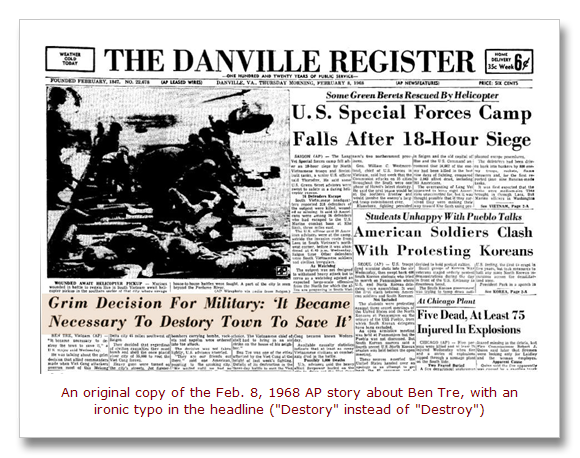
On February 7, 1968, American bombs, rockets and napalm obliterated much of the South Vietnamese town of Ben Tre — killing hundreds of civilians who lived there.

Later that day, an unidentified American officer gave Associated Press reporter Peter Arnett a memorable explanation for the destruction.

Arnett used it in the opening of the story he wrote:

   “It became necessary to destroy the town to save it,” a U.S. major said Wednesday.
   He was talking about the grim decision that allied commanders made when Viet Cong attackers overran most of this Mekong Delta city 45 miles southwest of Saigon. They decided that regardless of civilian casualties they must bomb and shell the once placid river city of 35,000 to rout the Viet Cong forces.

After Arnett’s story was published in newspapers the next morning, February 8, 1968, the unnamed major’s remark became one of the most infamous war-related quotes in modern history.

To this day, it is still used as a quotation that epitomizes the brutal absurdities of war in general and of the Vietnam War in particular.

The veracity of the quote has also been a subject of controversy. Since Arnett did not identify the officer who supposedly used the line, some people have questioned whether anyone actually said it.

In 2006, a Vietnam veteran named Michael D. Miller created a website titled “Saving Ben Tre.” On that site, Miller claims to have been present when a “Major Booris” said something very close to what Arnett reported.

Miller gives the quote as: “We had to destroy Ben Tre in order to save it.”

However, like Arnett’s report, Miller’s version has been disputed.

More significant to the people of Vietnam is the issue of whether Ben Tre actually had to be destroyed.

The U.S. military’s official explanation of why “it became necessary to destroy the town” is that it had been infiltrated by thousands of Viet Cong.

Thus, their rationale went, trying to oust the VC in ground-level fighting, from street to street, would have caused a high number of American casualties and even more civilian casualties.

Perhaps they were right. But the outcome described in Arnett’s news story doesn’t quite smell like victory:

U.S. advisers said the heavy allied firepower hurled on the city to drive out the Viet Cong probably contributed largely to the deaths of at least 500 civilians and possibly 1,000. South Vietnamese officials say the enemy dead totaled 451. About 50 Vietnamese soldiers died, along with more than 20 Americans...Lt. Col James Dare of Chicago, commander of U.S. Advisory Team 93, said “we will never know for sure” the number of civilians who died…Maj. Chester L. Brown of Erie, Pa., spent hours over the city as an Air Force forward air controller directing helicopter and fighter-bomber attacks. “It is always a pity about the civilians,” he said.

The story went on to say:

U.S. officials reported it was impossible to determine the attitude of the city’s residents to the bombing and artillery fire. “Most of those we see around appear mighty relieved that they survived,” one official said, “But I know that there are lots of refugees, maybe 10,000 to 15,000, outside of town in a camp and they may not be so happy.”

I suspect that last quote was a bit of an understatement.

Related post: Variations on “It became necessary to destroy the town…” – from Vietnam to Afghanistan

*     *      *     *     *     *     *     *     *     *

Comments? Corrections? Post them on the Famous Quotations Facebook page.

Related reading and viewing…

Copyrights, Disclaimers & Privacy Policy


Copyright © Subtropic Productions LLC

All original text written for the This Day in Quotes quotations blog is copyrighted by the Subtropic Productions LLC and may not be used without permission, except for short "fair use" excerpts or quotes which, if used, must be attributed to ThisDayinQuotes.com and, if online, must include a link to http://www.ThisDayinQuotes.com/.

To the best of our knowledge, the non-original content posted here is used in a way that is allowed under the fair use doctrine. If you own the copyright to something posted here and believe we may have violated fair use standards, please let us know.

Subtropic Productions LLC and ThisDayinQuotes.com is committed to protecting your privacy. For more details, read this blog's full Privacy Policy.