Showing posts with label John F. Kennedy. Show all posts

June 26, 2022

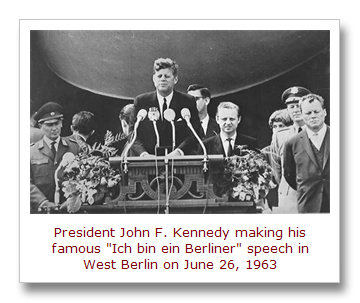
President Kennedy’s “Ich bin ein Berliner” speech


One of the famous quotations linked to the date June 26th is a line President John F. Kennedy spoke in German on June 26, 1963: “Ich bin ein Berliner.”

Kennedy used the line twice that day in a historic speech in West Berlin, which was then separated from Communist-controlled East Berlin by the Berlin Wall.

His intention was to express his solidarity with the people there, by symbolically calling himself a citizen of Berlin. And, the literal translation of “Ich bin ein Berliner” is indeed “I am a Berliner.”

However, there’s been a long-running debate over Kennedy’s grammar.

His use of “ein” is the issue.

Ein” does means “a” in English. But Germans use the word “Berliner” without “ein” to mean “a citizen of Berlin.”

They say “Ich bin Berliner” when they want to say the English equivalent of “I am a Berliner.”

The term “ein Berliner” — when used as a noun — refers to the jelly-filled, doughnut-like pastry Germans call “ein Pfannkuchen Berliner” or “ein Berliner” for short.

Similarly, a citizen of Frankfurt, Germany, would say “Ich bin Frankfurter,” rather than “Ich bin ein Frankfurter.” The latter could theoretically be interpreted to mean “I am a hot dog.”

For this reason, Kennedy’s line “Ich bin ein Berliner” has generated both amusement and heated discussion over the years.

Technically, it’s true that what he said in German could be interpreted as “I am a jelly-filled doughnut.”

That’s why some people claim the quote is laughable.

It has also been claimed that West Germans who were there listening to Kennedy laughed at him when he said the line.

On the flip side, some people have claimed “ein Berliner” is grammatically correct when used by someone who is not really a citizen of Berlin. They say the doughnut theory is an urban legend.

My own view is that Kennedy’s grammar was non-standard.

However, much more importantly, the people of West Berlin knew exactly what Kennedy meant when he said “Ich bin ein Berliner.”

They knew he wasn’t talking about a jelly-filled doughnut. And, they found his words inspiring, not laughable.

You can see why by reading or watching a video of Kennedy’s speech.

It’s one of the most famous speeches in history. And, the crowd of more than 120,000 West Germans who were there on June 26, 1963 were cheering loudly — not laughing.

*     *     *     *     *     *     *     *     *     *

John F. Kennedy’s “Ich bin ein Berliner” speech

Delivered in front of the Berlin Wall at Rudolph Wilde Platz in West Berlin
June 26, 1963

I am proud to come to this city as the guest of your distinguished Mayor, who has symbolized throughout the world the fighting spirit of West Berlin. And I am proud to visit the Federal Republic with your distinguished Chancellor who for so many years has committed Germany to democracy and freedom and progress, and to come here in the company of my fellow American, General Clay, who has been in this city during its great moments of crisis and will come again if ever needed.

John F Kennedy Ich Bin Ein Berliner speechTwo thousand years ago, the proudest boast was “Civis Romanus sum.” [“I am a Roman Citizen”] Today, in the world of freedom, the proudest boast is “Ich bin ein Berliner.”

I appreciate my interpreter translating my German.

There are many people in the world who really don’t understand, or say they don’t, what is the great issue between the free world and the Communist world. Let them come to Berlin.

There are some who say that communism is the wave of the future. Let them come to Berlin.

And there are some who say, in Europe and elsewhere, we can work with the Communists. Let them come to Berlin.

And there are even a few who say that it is true that communism is an evil system, but it permits us to make economic progress. Lass’ sie nach Berlin kommen. Let them come to Berlin.

Freedom has many difficulties and democracy is not perfect. But we have never had to put a wall up to keep our people in — to prevent them from leaving us. I want to say on behalf of my countrymen who live many miles away on the other side of the Atlantic, who are far distant from you, that they take the greatest pride, that they have been able to share with you, even from a distance, the story of the last 18 years. I know of no town, no city, that has been besieged for 18 years that still lives with the vitality and the force, and the hope, and the determination of the city of West Berlin.

While the wall is the most obvious and vivid demonstration of the failures of the Communist system — for all the world to see — we take no satisfaction in it; for it is, as your Mayor has said, an offense not only against history but an offense against humanity, separating families, dividing husbands and wives and brothers and sisters, and dividing a people who wish to be joined together.

What is true of this city is true of Germany: Real, lasting peace in Europe can never be assured as long as one German out of four is denied the elementary right of free men, and that is to make a free choice. In 18 years of peace and good faith, this generation of Germans has earned the right to be free, including the right to unite their families and their nation in lasting peace, with good will to all people.

You live in a defended island of freedom, but your life is part of the main. So let me ask you, as I close, to lift your eyes beyond the dangers of today, to the hopes of tomorrow, beyond the freedom merely of this city of Berlin, or your country of Germany, to the advance of freedom everywhere, beyond the wall to the day of peace with justice, beyond yourselves and ourselves to all mankind.

Freedom is indivisible, and when one man is enslaved, all are not free. When all are free, then we can look forward to that day when this city will be joined as one and this country and this great Continent of Europe in a peaceful and hopeful globe. When that day finally comes, as it will, the people of West Berlin can take sober satisfaction in the fact that they were in the front lines for almost two decades.

All free men, wherever they may live, are citizens of Berlin.

And, therefore, as a free man, I take pride in the words “Ich bin ein Berliner.”

*     *     *     *     *     *     *     *     *     *

Comments? Corrections? Questions? Email me or post them on my Famous Quotations Facebook page.

Related reading, listening and stuff…

April 07, 2021

The origins of the “The Domino Effect”…


Contrary to what
many sites on the Internet say, President Dwight D. Eisenhower did not coin the famous Cold War term “the Domino Effect.” 

He did use the phrase “falling domino principle” in a famous press conference on April 7, 1954.

Journalists at the time dubbed this “The Domino Theory,” which later came to be referred to as “the Domino Effect.”

The political concept encapsulated by those terms — the idea that if one country fell to the control of Communists, then nearby countries could follow — was a major foundation of America’s foreign policy during the Cold War years, which lasted from 1947 until the dissolution of the Soviet Union in 1991.

This concern was initially raised by President Truman’s Undersecretary of State, Dean Acheson.

In 1947, the government of Greece faced threats from Communist insurgents and Turkey seemed to be falling under the sway of the Soviet Union. Acheson warned in various public statements that, if the “Reds” took over in Greece and Turkey, Communism would likely spread south to Iran and as far east as India.

To counter this threat, President Truman asked Congress to approve $400 million in military and economic assistance for Greece and Turkey and proposed an anti-Communist policy eventually referred to as “The Truman Doctrine.” 

“It must be the policy of the United States,” Truman explained in a high-profile speech to Congress, “to support free peoples who are resisting attempted subjugation by armed minorities or by outside pressures.”

President Eisenhower, Truman’s successor, agreed with the Truman Doctrine’s goal of containing the spread of Communism. And, early  in his first term in office, he was forced to consider the need to apply that doctrine to Southeast Asia.

By 1954, France was on the verge of losing control of its colony Indochina (later called Vietnam) to Communist insurgents led by Ho Chi Minh. Eisenhower and his administration worried that if Indochina fell to Communist control, other Southeast Asian countries would follow.

During a White House press conference on April 7, 1954, reporter Robert Richards of the Copley Press asked Eisenhower: “Mr. President, would you mind commenting on the strategic importance of Indochina for the free world? I think there has been, across the country, some lack of understanding on just what it means to us.”

Eisenhower famously responded:

“You have, of course, both the specific and the general when you talk about such things. First of all, you have the specific value of a locality in its production of materials that the world needs.

Then you have the possibility that many human beings pass under a dictatorship that is inimical to the free world.

Finally, you have broader considerations that might follow what you would call ‘the falling domino principle.’ You have a row of dominoes set up, you knock over the first one, and what will happen to the last one is the certainty that it will go over very quickly. So you could have a beginning of a disintegration that would have the most profound influences.”

Eisenhower said this disintegration would lead to the “loss of Indochina, of Burma, of Thailand, of the Peninsula, and Indonesia following.”

In many news stories, reporters referred to Eisenhower’s falling domino principle as “the Domino Theory” or as “the Domino Effect.” The latter was a term that journalists Joseph and Stewart Alsop used in their popular syndicated newspaper column and claimed to have coined.

A month after Eisenhower made his famous remarks in 1954, Vietminh forces under General Vo Nguyen Giap defeated French troops at the Battle of Dien Bien Phu.

France soon ceded control of its former colony. And, under an agreement hammered out in Geneva, Indochina was partitioned into Communist-controlled North Vietnam and non-Communist South Vietnam.

In the following years, Eisenhower provided economic assistance and weapons to the fledgling South Vietnamese government and sent in a small number of American military advisors.

During the early 1960s, President John F. Kennedy significantly expanded U.S. economic and military assistance to South Vietnam and increased the number of military advisors there to more than 16,000.

These decisions by Eisenhower and Kennedy set in motion a political and military domino effect that ultimately led to the Vietnam War.

*     *     *     *     *     *     *     *     *     *

Comments? Corrections? Questions? Email me or post them on my Famous Quotations Facebook page.

Related reading and viewing…

August 30, 2020

The origins of the Cold War term “hot line” and the mythical “red phones”…


Many books and websites note that the famed “hot line” communication link between the Pentagon and the Kremlin was established on August 30, 1963.

Press reports about this new tool, intended to provide a possible way to avoid a nuclear war between the United States and the Union of Soviet Socialist Republics (USSR), soon cemented the term hot line into our language.

It also added a new plot device and the image of the red phones into movies and TV shows.

Two of my favorite examples were in movies released not long after the new link was established: Fail-Safe (1964) and Dr. Strangelove, Or: How I Learned to Stop Worrying and Love the Bomb (1964).

The term hot line (sometimes given as the single word hotline) had actually been used previously in other contexts, but not in the sense of the international hot line established in 1963.

That use is generally credited to Jess Gorkin (1936-1985).

Gorkin was the respected and influential editor of Parade Magazine, the widely-circulated Sunday newspaper insert. 

In the March 20, 1960 issue of Parade, Gorkin published an open letter to President Dwight D. Eisenhower and the Soviet Union’s Premier Nikita Khrushchev, titled “RE: ACCIDENTAL WAR.”

In it, he urged them to consider: “the establishment of a direct telephone line between you...to prevent the possibility of an accidental war.”

He ended his letter with the rhetorical question: “Must a world be lost for want of a telephone call?”

Gorkin didn’t use the term hot line in that open letter, but he did use it in a subsequent series editorials in Parade in 1960, promoting the idea to presidential candidates John F. Kennedy and Richard Nixon.

According to language maven William Safire’s great Political Dictionary, Gorkin’s editorial in the October 30, 1960 issue of Parade mentioned an internal “hot line” that the US Strategic Air Command (SAC) maintained for emergency communications.

Gorkin suggested that SAC’s “red telephone” system was a model for the communication link he believed the US and USSR should establish.

After Kennedy was elected President, Gorkin ran more editorials pushing the hot line idea.

And, after the US and USSR came to the brink of nuclear Armageddon in October 1962 during the Cuban missile crisis, Kennedy and Khrushchev decided it was indeed a pretty good idea.

On April 23, 1963, Kennedy sent a personal letter of thanks to Gorkin for promoting the concept, calling it “an excellent example of the most constructive aspects of our free press.” 

Gorkin proudly published the letter in Parade.

On June 20, 1963, in Geneva, President Kennedy and Premier Khrushchev signed an agreement to create the crisis communication system Gorkin had suggested. The Washington-Kremlin hot line officially went live on August 30, 1963.

However, despite what we’ve seen in movies and TV shows, there never were red phones in the offices of the President of the United States and the Premier of Russia.

The hot line was actually a secure teletype connection between the offices of the Pentagon and the Kremlin. No phones, red or otherwise, were involved.

Sorry, movie fans.

As I was researching this post, I noticed there’s a fairly recent book titled Hotline that gives the term a whole new meaning. It’s a racy novel described with this memorable blurb: “A sex worker and a trust fund brat…It’s like Romeo and Juliet, but with less stabbing and slightly fewer dick jokes.” I haven’t read it, but if you do, let me know how it is.

*     *     *     *     *     *     *     *     *     *

Comments? Corrections? Questions? Email me or post them on my Famous Quotations Facebook page.

Related reading and viewing…

May 25, 2020

7 famous space-related quotes launched on the date May 25th…


By an odd coincidence, some famous space-related quotations from several different sources are linked to the date May 25th.

On May 25, 1977, Star Wars — a movie by the then little-known director George Lucas — was released in the United States.

Yeah, yeah…I know. It’s now technically referred to as Star Wars: Episode IV - A New Hope.

But I saw it at my local movie theater when it first came out (several times) and I still think of it as the first Star Wars movie. I also still tend to think of it by its simple, original name.

As almost everyone on our planet knows, the opening crawl at the beginning starts with the famous words:

        “A long time ago in a galaxy far, far away...”

That same phrase was later used in the opening crawls in the five following movies in the Star Wars series.

Of course, Star Wars also coined the catchphrase “May the Force be with you” and various other quotes that are well known to science fiction fans.

Given the current fame of the words “May the Force be with you” it seems strange in retrospect that they are spoken only twice in the original film; first by the character General Dodonna (actor Alex McCrindle) and then, somewhat jokingly, by Han Solo (Harrison Ford).

Other popular quotes from that film include two lines by Obi-Wan Kenobi (actor Alec Guinness): “These are not the Droids you’re looking for” and “Use the Force, Luke!”

Another is the plea made by the holographic image of Princess Leia Organa (Carrie Fisher): “Help me, Obi-Wan Kenobi. You’re my only hope.”

On May 25, 1979, exactly two years after Star Wars debuted nationwide, the movie
Alien was released in the U.S.

It was by directed by another director who was little-known at the time: Ridley Scott.

The tagline on the posters and ads for Alien launched another famous space quotation:

        “In space no one can hear you scream.”

Exactly 16 years before Star Wars debuted and 18 years before Alien hit American movie screens, President John F. Kennedy announced a vision for space travel that wasn’t science fiction.

On May 25, 1961, in a speech before a joint session of Congress, he famously announced:

I believe this nation should commit itself to achieving the goal, before this decade is out, of landing a man on the moon and returning him safely to Earth.”

Kennedy didn’t live to see it, but America succeeded in achieving his goal in 1969, when NASA’s Apollo 11 astronauts landed on and returned from the moon.

The last of America’s six manned lunar landing missions was in 1972.

Ever since then, some of us have continued to hope that our government would pursue new manned trips to the moon.

It hasn’t. And, it won’t in the near future. President Barack Obama threw cold water on that hope in a speech on April 15, 2010.

Obama announced his support for “robotic exploration of the solar system” and kept open the option of future manned missions to Mars.

But he essentially told us to forget about new manned missions to the moon during his tenure in office.

“I understand that some believe that we should attempt a return to the surface of the Moon,” said Obama. “But I just have to say pretty bluntly here: We’ve been there before.”

Ironically, Obama gave this speech at the John F. Kennedy Space Center on Merritt Island, Florida.

*     *     *     *     *     *     *     *     *     *

Comments? Questions? Corrections? Post them on the Famous Quotations Facebook page.

Related reading and viewing…

March 21, 2016

“Life is unfair,” as President John F. Kennedy famously observed on this date…


Many people are familiar with the famous quotation by President John F. Kennedy, “Life is unfair.”

But few people today remember or know the context of this quote.

It was something he said, in part, with respect to what would become the Vietnam War.

In 1961, the newly-elected president decided to send more than a thousand American “military advisors” to South Vietnam, where the pro-Western regime of President Ngo Dinh Diem faced mounting threats from Communist insurgents and the North Vietnamese army.

In 1962, Kennedy increased the American presence in Vietnam to nearly 10,000 troops.

When Army reservists began being called up to serve there, after recently being stationed on another Cold War front in West Berlin, some complained that they had “done their time” and expressed their resentment by holding public demonstrations. One reservist even began a hunger strike.

President Kennedy was asked about this opposition during a press conference held on March 21, 1962.

He responded by saying that calling up the reservists “strengthened the foreign policy of the United States.”

After making this political point, Kennedy waxed philosophical.

“There is always inequity in life,” he said. “Some men are killed in a war and some men are wounded, and some men never leave the country, and some men are stationed in the Antarctic and some are stationed in San Francisco. It’s very hard in military or in personal life to assure complete equality. Life is unfair.”

Since then, those last three words have often been quoted, generally without any context.

When put into the original context, this quote might not fit the liberal image of JFK that many people have.

In fact, Kennedy was a committed Cold Warrior. He essentially accepted the “Domino theory” articulated by his predecessor, President Dwight D. Eisenhower, and believed the spread of Communism needed to be stopped—by military means if necessary.

Thus, Kennedy shared Eisenhower’s concern that a potential takeover of South Vietnam by Communists could cause more “falling dominos” in Southeast Asia.

Eisenhower was the first president to send American servicemen to Vietnam. In the early 1950s, he sent a handful of U.S. “military advisors” there to aid France in its unsuccessful effort to keep Vietnam as a colony.

After the French were ousted and Vietnam was split into South and North Vietnam in 1954, Eisenhower sent more “military advisors” to help support Ngo Dinh Diem’s fledgling government in South Vietnam. But the numbers were still relatively small; from 750 to 1,500 U.S. servicemen between 1955 and 1960.

When Kennedy became president, he took more significant steps toward getting the U.S. entangled in what we now call the Vietnam War.

In 1961, he sent 3,200 American “military advisors” to South Vietnam. He increased that number in 1962. By the time of his assassination on November 22, 1963, Kennedy had sent a total of more than 16,000 U.S. servicemen to Vietnam and more than 100 had been killed.

Kennedy’s successor Lyndon Baines Johnson dramatically escalated U.S. involvement in Vietnam. By 1968, LBJ had committed more than half a million US troops to the war.

When Richard M. Nixon became president in 1969, he began to withdraw American troops, pushed the South Vietnamese government to increasingly fight the war on its own and entered fruitless peace negotiations with the North Vietnamese.

Nixon resigned in 1974 in the wake of the Watergate scandal and Gerald Ford became president. By that time there were only a small number of American troops left in Vietnam. Most were there primarily to guard the U.S. embassy in Saigon.

Saigon fell to the North Vietnamese on April 30, 1975, bringing the Vietnam War to an ignominious end.

More than 58,000 American servicemen and women were killed during the course of the war.

Somewhere between 1 and 3 million North and South Vietnamese men, women and children were killed.

Ultimately, all of those deaths did not prevent Communists from controlling South Vietnam. Today, nobody in the U.S. seems to care that Vietnam is a Communist state.

Life, as President Kennedy noted, is unfair.

*     *     *     *     *     *     *     *     *     * 

Comments? Questions? Corrections? Post them on my quotations Facebook group.

Related reading and viewing…

October 05, 2013

Dan Quayle is no Jack Kennedy – and Lloyd Bentsen is no Michael Sheehan…


It’s not often that debates between candidates for Vice President of the United States generate a famous quotation – or even much attention.

But there are some notable exceptions.

One is the October 13, 1992 vice-presidential debate, in which Independent Ross Perot’s V.P. pick, James Stockdale, said “Who am I? Why am I here?” (It had the unfortunate effect of making him seem a bit, er, lost.)

A more famous quote from a vice-presidential debate occurred four years earlier on October 5, 1988.

In that one, Republican V.P. candidate Senator Dan Quayle debated Senator Lloyd Bentsen, candidate for the Democratic Party. (The presidential candidates were Republican George Herbert Walker Bush and Democrat Michael Dukakis.)

Tom Brokaw was among the journalists asking the candidates questions that night. At one point, Brokaw raised an issue that had previously been raised by various political pundits (and Democrats) in the weeks leading up to the debate: the question of whether Quayle, who was only 41 years old, had the experience needed to serve as President of the United States in the event it became necessary.

In his reply to Brokaw, Quayle made the mistake of saying: “I have far more experience than many others that sought the office of vice president of this country. I have as much experience in the Congress as Jack Kennedy did when he sought the presidency.”

Bentsen pounced on this quickly, responding with what is considered to be one of the best zingers ever used in a political debate:

“Senator, I served with Jack Kennedy. I knew Jack Kennedy. Jack Kennedy was a friend of mine. Senator, you're no Jack Kennedy.”

Democrats and the media loved it. And, ever since then, the linguistic formula “You’re no [fill in the name]” has been part of our cultural lexicon, usually as a line used for humorous effect.

Of course, despite all the attention the line received, Bush and Quayle handily defeated Dukakis and Bentsen in the November 1988 election.

And, although the quip made Bentsen seem like a debating genius, he didn’t exactly come up with it out of the blue.
Before the debate, Bentsen had received extensive training from the legendary professional speakers trainer and debate coach Michael Sheehan.

Sheehan has coached more US Presidents, Vice Presidents, First Ladies, Cabinet Secretaries, Governors, Mayors and Congressmen than anyone in the country. He’s a master at creating quotable quips for them to use.

Sheehan knew that Quayle had often compared himself to President Kennedy when reporters asked him about his youth and qualifications. He was also aware that Bentsen had known Kennedy personally.

During their practice for the vice-presidential debate, Sheehan had Bentsen prepare and hone responses to a number of things Quayle was likely to say during the debate. One was how to respond if Quayle compared himself to Kennedy.

In a story published in Vanity Fair magazine in 2011, Democratic political consultant Mike Curry, who was involved in the 1988 campaign, gave Bentsen all the credit for his famous debate zinger.

But some people who know Michael Sheehan think he may have crafted the final version of the quip Bentsen used in the debate.

I happen know Michael Sheehan myself. I worked with him on some political campaigns I’ve been involved in.

I once asked him whether he created Bentsen’s “You’re no Jack Kennedy” lines. He avoided giving me a direct answer.

Nonetheless, here’s my opinion: Lloyd Bentsen is no Michael Sheehan.

*     *     *     *     *     *     *     *     *     *

Comments? Corrections? Post them on the Famous Quotations Facebook page.

Related reading…

November 07, 2009

Is Nixon’s November 7, 1962 rant a “teachable moment”?


Long before dogged news coverage of the Watergate scandal helped force Richard M. Nixon to resign as President in 1974, he disliked the press.

In fact, throughout his long political career, Nixon felt the media generally had a liberal bias and an unfairly negative attitude toward him.

He disliked the way the press failed to fully embrace his anti-communist fervor in the late 1940s, when he was a Congressman and member of the House Un-American Activities Committee.

He was annoyed by some of the coverage he got as Vice President under President Dwight D. Eisenhower in the 1950s.

He thought the press was unfair to him in his unsuccessful campaign for President against John F. Kennedy in 1960.

And, in 1962, after Nixon lost the race for Governor of California to Democrat Pat Brown, he was convinced that slanted press coverage was a factor in his loss.

On November 7, 1962, the morning after that election, Nixon held a press conference in which his ire at the press infamously overflowed.

Most people know this frequently quoted part of what he said that day:

“You won't have Nixon to kick around any more because, gentlemen, this is my last press conference.”

But that quote is just the short sound bite from what Nixon said that day – a famous quotation with no context.

If you’re interested in politics and the media, you should read the entire transcript of what Nixon said, especially since it has some ironic relevance to recent political events. (The transcript is posted on the venerable Language Log. There’s also a video excerpt on YouTube.)

I particularly suggest the transcript of Nixon’s November 7, 1962 rant as recommended reading for President Obama and his team, because their recent attacks on Fox News seem eerily Nixonian to me.

I don’t say that because I believe Obama will be creating an “enemies list” or tapping reporters’ phones or doing other evil Nixonian things like that.

I say it because, to me, the attacks on Fox News seem as petty and counterproductive as Nixon’s “last press conference.”

Here are some of the other famous quotes and phrases linked to November 7:

“She would rather light a candle than curse the darkness, and her glow has warmed the world.”  - American politician Adlai Stevenson’s famous comment to the press when he learned about the death of Eleanor Roosevelt on November 7, 1962. He was adapting an old Chinese proverb that was also used as the motto of the Catholic humanitarian group, the Christopher Society, in the form: “It is better to light one candle than curse the darkness.”

“It's a Mad, Mad, Mad, Mad World.” - The title of the classic movie comedy that spawned the linguistic formula of four repeating adjectives: “It's a —, —, —, — , [something].” The film, with it’s all star cast of great comedians, had its world premiere at the Hollywood Cinerama on November 7, 1963.

Copyrights, Disclaimers & Privacy Policy


Copyright © Subtropic Productions LLC

All original text written for the This Day in Quotes quotations blog is copyrighted by the Subtropic Productions LLC and may not be used without permission, except for short "fair use" excerpts or quotes which, if used, must be attributed to ThisDayinQuotes.com and, if online, must include a link to http://www.ThisDayinQuotes.com/.

To the best of our knowledge, the non-original content posted here is used in a way that is allowed under the fair use doctrine. If you own the copyright to something posted here and believe we may have violated fair use standards, please let us know.

Subtropic Productions LLC and ThisDayinQuotes.com is committed to protecting your privacy. For more details, read this blog's full Privacy Policy.