Showing posts with label Cuban missile crisis. Show all posts

August 30, 2020

The origins of the Cold War term “hot line” and the mythical “red phones”…


Many books and websites note that the famed “hot line” communication link between the Pentagon and the Kremlin was established on August 30, 1963.

Press reports about this new tool, intended to provide a possible way to avoid a nuclear war between the United States and the Union of Soviet Socialist Republics (USSR), soon cemented the term hot line into our language.

It also added a new plot device and the image of the red phones into movies and TV shows.

Two of my favorite examples were in movies released not long after the new link was established: Fail-Safe (1964) and Dr. Strangelove, Or: How I Learned to Stop Worrying and Love the Bomb (1964).

The term hot line (sometimes given as the single word hotline) had actually been used previously in other contexts, but not in the sense of the international hot line established in 1963.

That use is generally credited to Jess Gorkin (1936-1985).

Gorkin was the respected and influential editor of Parade Magazine, the widely-circulated Sunday newspaper insert. 

In the March 20, 1960 issue of Parade, Gorkin published an open letter to President Dwight D. Eisenhower and the Soviet Union’s Premier Nikita Khrushchev, titled “RE: ACCIDENTAL WAR.”

In it, he urged them to consider: “the establishment of a direct telephone line between you...to prevent the possibility of an accidental war.”

He ended his letter with the rhetorical question: “Must a world be lost for want of a telephone call?”

Gorkin didn’t use the term hot line in that open letter, but he did use it in a subsequent series editorials in Parade in 1960, promoting the idea to presidential candidates John F. Kennedy and Richard Nixon.

According to language maven William Safire’s great Political Dictionary, Gorkin’s editorial in the October 30, 1960 issue of Parade mentioned an internal “hot line” that the US Strategic Air Command (SAC) maintained for emergency communications.

Gorkin suggested that SAC’s “red telephone” system was a model for the communication link he believed the US and USSR should establish.

After Kennedy was elected President, Gorkin ran more editorials pushing the hot line idea.

And, after the US and USSR came to the brink of nuclear Armageddon in October 1962 during the Cuban missile crisis, Kennedy and Khrushchev decided it was indeed a pretty good idea.

On April 23, 1963, Kennedy sent a personal letter of thanks to Gorkin for promoting the concept, calling it “an excellent example of the most constructive aspects of our free press.” 

Gorkin proudly published the letter in Parade.

On June 20, 1963, in Geneva, President Kennedy and Premier Khrushchev signed an agreement to create the crisis communication system Gorkin had suggested. The Washington-Kremlin hot line officially went live on August 30, 1963.

However, despite what we’ve seen in movies and TV shows, there never were red phones in the offices of the President of the United States and the Premier of Russia.

The hot line was actually a secure teletype connection between the offices of the Pentagon and the Kremlin. No phones, red or otherwise, were involved.

Sorry, movie fans.

As I was researching this post, I noticed there’s a fairly recent book titled Hotline that gives the term a whole new meaning. It’s a racy novel described with this memorable blurb: “A sex worker and a trust fund brat…It’s like Romeo and Juliet, but with less stabbing and slightly fewer dick jokes.” I haven’t read it, but if you do, let me know how it is.

*     *     *     *     *     *     *     *     *     *

Comments? Corrections? Questions? Email me or post them on my Famous Quotations Facebook page.

Related reading and viewing…

May 27, 2018

“A Hard Rain’s A-Gonna Fall…”


When Columbia Records released the first, self-titled album by Bob Dylan in 1962 it went largely unnoticed by the general public. Only about 5,000 copies were sold at the time.

But Columbia music producer John Hammond, who signed Dylan to the label, had faith in the young folk singer.

He ignored the jibes of other music executives who dubbed Dylan “Hammond’s Folly” and, in eight sessions strung out over the next twelve months, he recorded a second album with Dylan for Columbia.

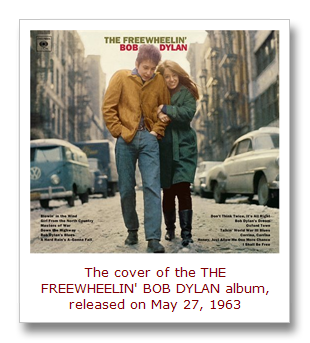
That album, The Freewheelin’ Bob Dylan, was released on May 27, 1963, three days after Dylan’s 22nd birthday.

It’s now considered one of the greatest and most influential albums in American music history.

The Freewheelin’ LP includes what remain some of Dylan’s best-known songs, such as “Blowin’ in the Wind,” “Girl from the North Country,” “Masters of War,” “Don't Think Twice, It’s All Right” and “A Hard Rain’s A-Gonna Fall.”

“Blowin’ In The Wind” became the most famous song from the album. But the one that stuck in my mind even more when I first listened to the album in 1963 was “A Hard Rain’s A-Gonna Fall.”

The song’s foreboding title, from a phrase in the chorus, was memorable in itself and has since been widely cited and repurposed.

I believe it struck a special chord with kids from the Baby Boom generation, like me.

We grew up at a time when a nuclear war between the US and the USSR seemed inevitable.

In elementary school, we practiced “duck and cover” drills and watched public service films like the one at right, in which a narrator and “Bert the Turtle” helpfully explain what to do when the A-bombs start falling.

Bert told us: “The flash of an atomic bomb can come at any time, no matter where you may be...When there is a flash, duck and cover, and do it fast!”

It seems a bit humorous now. But back then, during the height of the Cold War years, the possibility of an atomic Armageddon was a serious and constant fear.

Movies, TV shows, books, magazine stories and politically-oriented songs of the era helped stoke that fear by portraying what a nuclear holocaust and the hellish aftermath would be like.

That frightening scenario is also conjured up by “A Hard Rain’s A-Gonna Fall.”

Bob Dylan singing Had Rain in 1964Many of the lyrics are early examples of the elliptical, dreamlike language Dylan became better known for later. But the title phrase seemed to be a clear metaphor for falling atomic bombs and nuclear fallout.

This appears to be confirmed by the original liner notes for The Freewheelin’ Bob Dylan, written by journalist, historian and music critic Nat Hentoff. 

Hentoff said the song “was written during the Cuban missile crisis of October 1962 when those who allowed themselves to think of the impossible results of the Kennedy-Khrushchev confrontation were chilled by the imminence of oblivion.”

Dylan is then quoted as saying: “Every line in it is actually the start of a whole song. But when I wrote it, I thought I wouldn’t have enough time alive to write all those songs so I put all I could into this one.”

Fortunately, Bob and the world survived. On May 24, 2014, he turned 73.

I’m not many years from that age myself.

Today, I can listen to “A Hard Rain’s A-Gonna Fall” from a less paranoid perspective. But it still gives me the chills.

In case you haven’t read the lyrics, I’m reprinting them below.

By clicking this link or image at left, you can see Dylan perform the song in 1964, in an episode of the Canadian TV show Quest.

And, by clicking this link, you can listen to some of the many interesting cover versions that have been recorded by other musicians and groups over the years.

Here’s to you, Bob.  Hope you had a good birthday! Glad you’ve been wrong about that hard rain … so far.


“A Hard Rain's A-Gonna Fall” by Bob Dylan   

(Copyright © 1963 by Warner Bros. Inc.; renewed 1991 by Special Rider Music)

Oh, where have you been, my blue-eyed son?
Oh, where have you been, my darling young one?
I’ve stumbled on the side of twelve misty mountains
I’ve walked and I’ve crawled on six crooked highways
I’ve stepped in the middle of seven sad forests
I’ve been out in front of a dozen dead oceans
I’ve been ten thousand miles in the mouth of a graveyard
And it’s a hard, and it’s a hard, it’s a hard, and it’s a hard
And it’s a hard rain’s a-gonna fall

Oh, what did you see, my blue-eyed son?
Oh, what did you see, my darling young one?
I saw a newborn baby with wild wolves all around it
I saw a highway of diamonds with nobody on it
I saw a black branch with blood that kept drippin’
I saw a room full of men with their hammers a-bleedin’
I saw a white ladder all covered with water
I saw ten thousand talkers whose tongues were all broken
I saw guns and sharp swords in the hands of young children
And it’s a hard, and it’s a hard, it’s a hard, it’s a hard
And it’s a hard rain’s a-gonna fall

And what did you hear, my blue-eyed son?
And what did you hear, my darling young one?
I heard the sound of a thunder, it roared out a warnin’
Heard the roar of a wave that could drown the whole world
Heard one hundred drummers whose hands were a-blazin’
Heard ten thousand whisperin’ and nobody listenin’
Heard one person starve, I heard many people laughin’
Heard the song of a poet who died in the gutter
Heard the sound of a clown who cried in the alley
And it’s a hard, and it’s a hard, it’s a hard, it’s a hard
And it’s a hard rain’s a-gonna fall

Oh, who did you meet, my blue-eyed son?
Who did you meet, my darling young one?
I met a young child beside a dead pony
I met a white man who walked a black dog
I met a young woman whose body was burning
I met a young girl, she gave me a rainbow
I met one man who was wounded in love
I met another man who was wounded with hatred
And it’s a hard, it’s a hard, it’s a hard, it’s a hard
It’s a hard rain’s a-gonna fall

Oh, what’ll you do now, my blue-eyed son?
Oh, what’ll you do now, my darling young one?
I’m a-goin’ back out ’fore the rain starts a-fallin’
I’ll walk to the depths of the deepest black forest
Where the people are many and their hands are all empty
Where the pellets of poison are flooding their waters
Where the home in the valley meets the damp dirty prison
Where the executioner’s face is always well hidden
Where hunger is ugly, where souls are forgotten
Where black is the color, where none is the number
And I’ll tell it and think it and speak it and breathe it
And reflect it from the mountain so all souls can see it
Then I’ll stand on the ocean until I start sinkin’
But I’ll know my song well before I start singin’
And it’s a hard, it’s a hard, it’s a hard, it’s a hard
It’s a hard rain’s a-gonna fall

*     *     *     *     *     *     *     *     *     *

Comments? Corrections? Post them on my Famous Quotations Facebook page or send me an email.

Related listening and reading…

November 18, 2016

“We will bury you!” (Or something like that.)


On November 18, 1956, Communist leader Nikita Khrushchev, the head of the Soviet Union, attended a party at the Polish Embassy in Moscow.

At that event, he made some boasting comments about the competition between Communism and “capitalist states” like the US.

One of those comments included what would become Khrushchev’s most famous (and infamous) quotation.

The words he spoke in Russian were “My vas pokhoronim,” an idiomatic expression that was traditionally used as a humor-tinged taunt in Russia.

Some translations say it means “We will outlast you.” But since the word pokhoronim does refer to burial, it has also been interpreted as “We will be present at your funeral.” 

It bears a similarity to the American English idiom “It’s your funeral,” which is often used jokingly.

US news reports translated Khrushchev’s remark as “We will bury you.”

In an era when nuclear war between US and USSR was a constant concern, Americans didn’t see it as funny.

The context of the quote involved comments Khrushchev made about two recent world events.

One was the brief revolution in Soviet-dominated Hungary, which had just been brutally squashed by Russian troops.

The other was the recent bombing and invasion of Egypt by France, Britain and Israel, precipitating the Suez Crisis.

At the Embassy party on November 18th, Khrushchev blamed Western-backed “Fascist gangs” for fomenting the rebellion in Hungary. He also denounced the “imperialists and their puppets” who had attacked Egypt, a recent Soviet ally.

Then, according to an Associated Press report, Khrushchev added:

“Socialist states...base ourselves on the idea that we must peacefully co-exist. About the capitalist states, it doesn’t depend on you whether or not we exist...If you don’t like us, don’t accept our invitations and don’t invite us to come to see you. Whether you like it or not, history is on our side. We will bury you.”

The story caused a huge stir in the US.

Headlines blared “‘We Will Bury You,’ Russian Boss Rants” and “Raging Soviet Boss Shouts At The West ‘We Will Bury You.’” 
 
Many Americans believed Khrushchev was saying that the Soviet Union could — and some day would — violently destroy the US and its allies, implicitly in a nuclear war.

Nowadays, most books and Internet posts that cite the quote say “We will bury you” is a mistranslation of the Russian idiom and that Khrushchev was being more flippant than fearsomely threatening.

A post on the always-interesting site Cracked.com, titled “6 Mistranslations That Changed The World,” offered this explanation:

“As it turns out, a better literal translation of his words would have been, ‘We will be present when you are buried.’ This was actually a pretty common saying in Soviet Russia. What Khrushchev really meant was, ‘We will outlast you.’ It was just the usual ‘communism is better than capitalism’ posturing that went on all the time in the Cold War, but thanks to misinterpretations...Americans thought Khrushchev was threatening to literally bury us in the rubble of a nuclear attack.”

I grew up in the 1950s, when we practiced “duck and cover” drills at school and families were building fallout shelters in their back yards in the hopes of surviving the expected nuclear showdown with Russia.

I tend to think the modern take on Khrushchev’s most (in)famous quote overlooks something.

In 1956, the nuclear arms race and the threat of nuclear war were real and taken very seriously.

“We shall be present at your funeral” or “We shall outlive you” or any of the other “better” translations that are now suggested would probably have sounded just as hostile and threatening to most Americans.

So the fact that “We will bury you” may have been a mistranslation, misquote or misunderstanding, while interesting, may also be moot.

The concern caused by Khrushchev’s use of the words “My vas pokhoronim” would likely have been the same in the US regardless of the translation.

Of course, six years later, during the 1962 Cuban Missile Crisis, we found out Khrushchev didn’t actually have the sharries to start a nuclear war with the U.S.

He backed down after President John F. Kennedy threatened to push the button first if the Soviets refused to remove the nuclear missiles they had secretly shipped to Cuba.

I don’t know what Kennedy said to Khrushchev behind the scenes during that high stakes game of Cold War brinksmanship.

But I suspect it might have been something along the lines of “We will bury you.”

*     *     *     *     *     *     *     *     *     *

Comments? Corrections? Post them on the Famous Quotations Facebook group.

Related reading, listening and viewing…

Copyrights, Disclaimers & Privacy Policy


Copyright © Subtropic Productions LLC

All original text written for the This Day in Quotes quotations blog is copyrighted by the Subtropic Productions LLC and may not be used without permission, except for short "fair use" excerpts or quotes which, if used, must be attributed to ThisDayinQuotes.com and, if online, must include a link to http://www.ThisDayinQuotes.com/.

To the best of our knowledge, the non-original content posted here is used in a way that is allowed under the fair use doctrine. If you own the copyright to something posted here and believe we may have violated fair use standards, please let us know.

Subtropic Productions LLC and ThisDayinQuotes.com is committed to protecting your privacy. For more details, read this blog's full Privacy Policy.