Showing posts with label Abraham Lincoln. Show all posts

November 19, 2023

Lincoln’s Gettysburg Address – and Lord Buckley’s “hip translation” . . .


On November 19, 1863, President Abraham Lincoln gave a brief speech in Gettysburg, Pennsylvania at the dedication of a cemetery for the Union soldiers who had died in that bloody Civil War battle four months earlier.

Lincoln’s remarks came to be known as “The Gettysburg Address.”

It’s his best known speech and includes two of his most famous quotes.

One is the opening sentence:

“Fourscore and seven years ago our fathers brought forth on this continent a new nation, conceived in liberty and dedicated to the proposition that all men are created equal.”

The other the closing line, which contains the oft-cited phrase: “government of the people, by the people, for the people.”  

As noted by many sources, Lincoln appears to have based his memorable of/by/for the people line on words used in a sermon by the abolitionist preacher Theodore Parker.

During the early months of the Civil War, Lincoln’s law partner William Herndon gave the president a book of Parker’s sermons and speeches. It included a sermon titled “The Effect of Slavery on the American People,” which Parker delivered at the Music Hall in Boston, Massachusetts on July 4, 1858.

In that, Parker said: “Democracy is direct self-government over all the people, for all the people, by all the people.”

According to Herndon, Lincoln marked that sentence in pencil in the book before he wrote the Gettysburg Address.

Parker had used similar words in earlier sermons and speeches.

For example, in a speech he gave in Boston on May 29, 1850
, he defined democracy as “a government of all the people, by all the people, and for all the people.” However, the of/for/by the people formulation was not coined by Parker. 

Scholars have found several of/by/for the people quotations that predate Parker’s.

In the decades since 1863, there have been countless other uses and variations inspired by the Gettysburg Address. (See this post on my Quote/Counterquote site for some examples.)

My own favorite adaptation of Lincoln’s address is the hipster version done by the late, great Richard Buckley, aka Lord Buckley.

Buckley performed as a vaudeville-style comedian from the late 1920s to the late 1940s.

Starting in 1947 and throughout the 1950s, he performed as the character “Lord Buckley,” an ultra-cool hepcat who told wild stories and recited poems using the hipster slang of black jazz musicians and beatniks.

In 1956, HIP Records released a recording of Buckley doing his “hip translation” of the Gettysburg Address. It’s included on a CD issued by Rhino in 1993 titled His Royal Hipness: Lord Buckley.

As I write this, there’s a copy you can listen to on YouTube.

Lord Buckley made it clear in his introductory remarks that, although his version is humorous, he had great respect for Lincoln and he believed Lincoln would have been able to appreciate it.

I agree. So, to honor two of my favorite orators, here in a historic side-by-side “appearance” are President Abraham Lincoln, reciting the Gettysburg Address, and Lord Buckley reciting his hip translation...


Abraham Lincoln:
The Gettysburg Address***


Lord Buckley:
The hip translation…
“Four score and seven years ago our fathers brought forth, upon this continent, a new nation, conceived in Liberty, and dedicated to the proposition that all men are created equal.

“Four big hits and seven licks ago, our before-daddies swung forth, upon this sweet groovy land a swingin’, stompin’, jumpin’, blowin’, wailin’ new nation, hip to the cool groove of liberty and solid sent with the ace lick dat all the studs, chicks, cats and kitties – red, white, or blue – is created level in front. In straight talk, the same, dig what I mean?

Now we are engaged in a great civil war, testing whether that nation, or any nation so conceived, and so dedicated, can long endure.

Now we are hung with a king-size main-day civil drag, soundin’ of whether that nation or any up-there nation, so hip and so solid sent can stay with it all the way.

We are met here on a great battlefield of that war.

We’s here to dig this chop-beatin’ session on the site of the worst jazz blown in the entire issue – Gettys-mother-burg.

We have come to dedicate a portion of it as a final resting place for those who here gave their lives that that nation might live.

We have stomped out here to turn on a small soil stash of the before-mentioned hassle site, as a final sweet sod pad for those who laid it down and left it there, so that this jumpin’ happy beat might blow forevermore.
It is altogether fitting and proper that we should do this. And we all dig that this is the straightest lick ever dug.

But in a larger sense we can not dedicate — we can not consecrate — we can not hallow this ground. The brave men, living and dead, who struggled, here, have consecrated it far above our poor power to add or detract.

But diggin’ it harder from afar, we cannot take no wailin’ bows, we cannot mellow, we cannot put down the stamp of the Nazz on this sweet sod, ‘cause the strong non-stop studs, both diggin’ it and dug under it, who hassled here have mellowed it with such a wild mad beat that we can hear it, but we can't touch it.
The world will little note, nor long remember, what we say here, but can never forget what they did here. Now the world cats will short dig, you hear what I say, short dig nor long stash in their wigs what we is beatin’ our chops around here, but it never can successively shade what they vanced here.

It is for us, the living, rather to be dedicated here to the unfinished work which they have, thus far, so nobly carried on. It is rather for us to be here dedicated to the great task remaining before us.

It is for us, the swingin’, to pick up the dues of these fine studs who cut out here and fly it through to Endsville. It is hipper for us to be signifyin’ to the glorious gig that we can’t miss with all these bulgin’ eyes.
That from these honored dead we take increased devotion to that cause for which they here gave the last full measure of devotion — that we here highly resolve that these dead shall not have died in vain; that this nation shall have a new birth of freedom; and that this government of the people, by the people, for the people, shall not perish from the earth.”

***NOTE: There are
five written versions of Lincoln’s Gettysburg Address, with slight wording variations among them. The version above is from the “Hay Copy,” stored in The Library of Congress. Some scholars believe it is the version Lincoln used, but this is not known with certainty.

That from all these A-stamp studs we double our love kick, to that righteous ride for which these cats hard sounded the last 'nth bong of the bell of their bell. That we here want it stuck up straight for all to dig that these departed studs shall not have split in vain; that this nation, under the great swingin’ Nazz, shall ring up a whopper of endless Mardi Gras, and that the Big Law of you straights, by you studs, and for you kitties, shall not be scratched from the big race.”

*     *     *     *     *     *     *     *     *     *

Comments? Corrections? Questions? Email me or post them on my Famous Quotations Facebook page.

Related reading and listening…

April 14, 2022

“Now he belongs to the ages” – or maybe to the angels…


Three famous quotations are linked to the assassination and death of President Abraham Lincoln.

Many history and quotation books say that after John Wilkes Booth shot Lincoln on April 14, 1865 at Ford’s Theatre in Washington, D.C. he shouted “Sic semper tyrannis!”

That Latin phrase — which means “Thus always to tyrants!” — was and still is the official state motto of Virginia, one of the Confederate states during the Civil War.

According to some accounts, Booth also shouted “The South is avenged!”

Many history and quotation books also say that when Lincoln died the next morning, on April 15, 1865, his friend and Secretary of War Edwin M. Stanton said to the small gathering of people at Lincoln’s bedside: “Now he belongs to the ages.”

However, it’s not actually clear whether these traditionally-cited quotes by Booth and Stanton are accurate. There are different “earwitness” accounts of what they said.

In his painstakingly-researched book We Saw Lincoln Shot, author Timothy Good determined that most witnesses recalled hearing Booth shout “Sic semper tyrannis!” But others — including Booth himself — claimed that he only yelled “Sic semper!” Some didn’t recall hearing Booth shout anything in Latin.

What Booth shouted in English is also muddied by varying recollections. Some witnesses said he shouted “The South is avenged!” Others thought they heard him say “Revenge for the South!” or “The South shall be free!” Two said Booth yelled “I have done it!”

Similarly, there are differing accounts of the words Edwin Stanton spoke when Lincoln died.

The traditional version of Edwin M. Stanton’s quote —  “Now he belongs to the ages” — were the words remembered John Hay, who was Lincoln’s private secretary at the time and in the room when Lincoln died.


That quote was included in a book Hay wrote about Lincoln with John G. Nicolay in 1890. It was also cited in Ida M. Tarbell’s widely-read biography of Lincoln, published in 1900. 

Dr. Charles Sabin Taft, one of Lincoln’s attending physicians, wrote his own account of the President’s death for Century Magazine in 1883. According to Taft, Stanton said “He now belongs to the Ages.”

The Hay and Taft versions vary only in the order of Stanton’s words.

However, as explained in a fascinating article by Adam Gopnik in the May 28, 2007 issue of The New Yorker, there’s another account that uses the word “angels” instead of “ages,” giving the quote a significantly different meaning.

On the night Lincoln was shot, he was taken to a room in Peterson’s boarding house (sometimes spelled Petersen’s). That evening, Edwin Stanton had witnesses to the shooting brought there to report what they had seen.

A Civil War veteran named James Tanner, who lived nearby and could write shorthand, was brought in to record what the witnesses said.

Tanner was also present on the morning of April 15, 1865, when Lincoln died. He didn’t write down Stanton’s words that morning. But he did later. And, according to Tanner, what Stanton said was: “Now he belongs to the angels.”

This has created a debate among historians. Most believe the traditional “ages” version is probably correct. But some, such as James L. Swanson, author of the book Manhunt: The 12-Day Chase for Lincoln's Killer, side with “the angels.” 

In his New Yorker article, Adam Gopnik concluded:
“The past is so often unknowable not because it is befogged now but because it was befogged then, too, back when it was still the present. If we had been there listening, we still might not have been able to determine exactly what Stanton said. All we know for sure is that everyone was weeping, and the room was full.”

*     *     *     *     *     *     *     *     *     *

Comments? Corrections? Questions? Email me or post them on my Famous Quotations Facebook page.

Related reading and listening…

March 04, 2018

March 4th: a good day for famous presidential quotes – until 1933…

The date for the United States presidential inauguration was not specified in the original U.S. Constitution.

In 1788, the Continental Congress set Inauguration Day as March 4. Then, in 1933, the Twentieth Amendment to the Constitution changed it to January 20, reducing the outdated four-month lag between the time a president was elected and took office.

That’s why famous quotes from inaugural addresses of presidents elected before 1933 are on a March 4th date and those of presidents elected after 1933 are on a January 20th.

The Inauguration Day speeches of all of the presidents (online here) are historically interesting and many include memorable lines. But only a handful of those lines have become famous quotes.

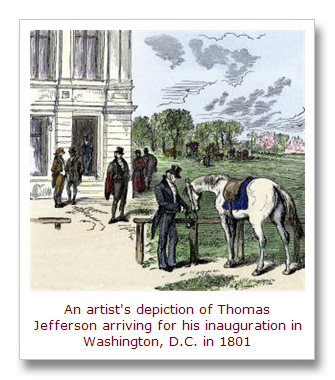
The earliest comes from the first inaugural address of Thomas Jefferson, which took place on March 4, 1801.

That speech includes Jefferson’s oft-cited warning against “entangling alliances.”

It’s part of a longer sentence that Jefferson said embodied his view on “the essential principles of our Government”:

“Equal and exact justice to all men, of whatever state or persuasion, religious or political; peace, commerce, and honest friendship with all nations, entangling alliances with none.”

You have to flash forward 60 years to find another truly famous quote from a president’s inaugural address.

In Abraham Lincoln’s first inaugural address on March 4, 1861, he coined the well-known, almost poetic phrase “the mystic chords of memory.”

It came near the end of his speech, in what was a clear plea to citizens in Southern states.

At that point, some states had already seceded from the Union, but no blatant act of war between the North and South had occurred.

Lincoln said:

     “In your hands, my dissatisfied fellow-countrymen, and not in mine, is the momentous issue of civil war...We must not be enemies. Though passion may have strained it must not break our bonds of affection. The mystic chords of memory, stretching from every battlefield and patriot grave to every living heart and hearthstone all over this broad land, will yet swell the chorus of the Union, when again touched, as surely they will be, by the better angels of our nature.”

Six weeks later, Confederate troops fired on Fort Sumter in Charleston, South Carolina. The Civil War had begun.

Four years later, when Lincoln gave his second inaugural address on March 4, 1865, the end of that bloody war was in sight.

Knowing this, Lincoln expressed his hope for reconciliation in a speech that included his famous quote about “malice towards none” and “charity for all.”

Here’s the sentence in his address those words come from:

“With malice towards none; with charity for all; with firmness in the right, as God gives us to see the right, let us strive on to finish the work we are in; to bind up the nation’s wounds, to care for him who shall have borne the battle, and for his widow and for his orphan — to do all which may achieve and cherish a just and lasting peace among ourselves, and with all nations.”

Four weeks later, on April 9, 1865 , Confederate General Robert E. Lee surrendered to General Ulysses S. Grant at Appomattox Courthouse in Virginia. The Civil War was over.

Four years after that, when Grant himself became president, Northern and Southern states were fighting in the legal arena over various federal laws, such as those related to the rights of the freed African-American slaves.

In Grant’s first inaugural address on March 4, 1869, he said he would not hesitate to use his power as President to veto laws that he opposed.

But he noted that he would faithfully execute all laws “whether they meet my approval or not.”

To those comments, Grant added one of the most slyly witty quotes ever uttered by a U.S. president:

“I know of no method to secure the repeal of bad or obnoxious laws so effective as their stringent execution.”

The next famous presidential quotations from a March 4th inauguration speech came half a century later, in Franklin D. Roosevelt’s first inaugural address on March 4, 1933.

One line in that speech helped popularize the term “good neighbor policy.” Speaking about his views on foreign affairs, Roosevelt said:

“In the field of world policy I would dedicate this Nation to the policy of the good neighbor — the neighbor who resolutely respects himself and, because he does so, respects the rights of others — the neighbor who respects his obligations and respects the sanctity of his agreements in and with a world of neighbors.”

But the most famous line from Roosevelt’s first inaugural address was related to domestic policy.

In 1933, America was in the midst of the Great Depression. Roosevelt wanted to generate a renewed sense of hope in the American people and inspire support for his plans to restore the economy with ambitious new government programs. But he knew that many people were afraid for their future and some were afraid that a more activist federal government would just make things worse.

So, in the first paragraph of Roosevelt’s speech, he famously addressed those fears:

“This is preeminently the time to speak the truth, the whole truth, frankly and boldly. Nor need we shrink from honestly facing conditions in our country today. This great Nation will endure as it has endured, will revive and will prosper. So, first of all, let me assert my firm belief that the only thing we have to fear is fear itself — nameless, unreasoning, unjustified terror which paralyzes needed efforts to convert retreat into advance. In every dark hour of our national life a leadership of frankness and vigor has met with that understanding and support of the people themselves which is essential to victory. I am convinced that you will again give that support to leadership in these critical days.”
 
Of course, Roosevelt did gain the support of the majority of Americans and was reelected to two more terms.

But his first inaugural address was the last presidential speech that included famous quotes spoken on the date March 4th.

*     *     *     *     *     *     *     *     *     *

Comments? Corrections? Post them on my Famous Quotations Facebook page or send me an email.

Related reading…

March 06, 2016

“No rights which the white man was bound to respect.”


On March 6, 1857, the U.S. Supreme Court issued it’s controversial decision on Scott v. Sandford — generally referred to as “the Dred Scott case.”

The plaintiff, Dred Scott, was a slave purchased from the Blow family of St. Louis in 1831 by U.S. Army surgeon John Emerson.

Over the next 12 years, Emerson took Scott with him to various places where he was assigned. When Emerson died in 1843, Scott tried to purchase his freedom from the doctor’s widow, Irene. She denied his request.

So, in 1846, Scott sued for his freedom on the grounds that Dr. Emerson had previously taken him to Illinois, where slavery was prohibited by state law, and to the Wisconsin Territory, where federal law prohibited slavery as part of the “Missouri Compromise” in 1820.

Scott lost in his first trial, then won in a second — only to have that decision overturned by the Missouri State Supreme Court. In 1854, with the help of local abolitionists, Scott filed suit in Federal Court against John Sanford, Mrs. Emerson's brother and executor of the Emerson estate.

When that case was decided in favor of Sanford, Scott and his allies appealed it to the U.S. Supreme Court.

The infamous, oft-quoted conclusion of the Supreme Court’s decision, written by Chief Justice Roger B. Taney, was that current or former slaves and their descendants had “no rights which the white man was bound to respect.”

Taney wrote in the majority decision:

“In the opinion of the court, the legislation and histories of the times, and the language used in the Declaration of Independence, show, that neither the class of persons who had been imported as slaves, nor their descendants, whether they had become free or not, were then acknowledged as a part of the people, nor intended to be included in the general words used in that memorable instrument...They had for more than a century before been regarded as beings of an inferior order, and altogether unfit to associate with the white race, either in social or political relations; and so far inferior, that they had no rights which the white man was bound to respect; and that the negro might justly and lawfully be reduced to slavery for his benefit."

The Supreme Court’s decision in the Dred Scott case was among the most consequential in American history and key aspects of it are ironic in hindsight.

One irony is that the decision was not just a blow against the rights of blacks. It was also a blow to states rights, a principle often espoused by Southern states to justify slavery and oppose federal civil rights laws.

In the Dred Scott decision, the Supreme Court concluded that, under the U.S. Constitution, states had no right prohibit slavery. Many people on both sides of the slavery debate had hoped the Court’s decision would resolve the issue. Instead, it had the opposite effect. It made that issue hotter than ever and helped propel the country into a civil war that turned the temporary legal win of slaveholders into a final defeat.

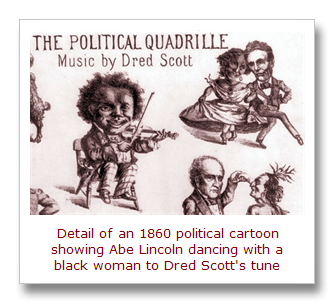
The grave implications of the Dred Scott decision were clear to Abraham Lincoln. They were the main focus of his famous “House Divided” speech on June 16, 1858, at the Illinois Republican convention in Springfield, Illinois.

In that speech, Lincoln warned that the Court’s decision took away the rights of states to make their own decisions and would eventually force the legalization of slavery throughout the country.

“What Dred Scott's master might lawfully do with Dred Scott, in the free State of Illinois,” Lincoln said, “every other master may lawfully do with any other one, or one thousand slaves, in Illinois, or in any other free State.”

Using a quote from the Bible, Lincoln also made a famous, correct prediction:

‘A house divided against itself cannot stand.’ I believe this government cannot endure, permanently, half slave and half free. I do not expect the Union to be dissolved; I do not expect the house to fall; but I do expect it will cease to be divided. It will become all one thing, or all the other. Either the opponents of slavery will arrest the further spread of it and place it where the public mind shall rest in the belief that it is in the course of ultimate extinction, or its advocates will push it forward till it shall become alike lawful in all the states, old as well as new, North as well as South.”

After the South lost the Civil War, the Dred Scott decision was nullified by the Thirteenth Amendment and Fourteenth Amendment to the U.S. Constitution, which officially prohibited slavery nationwide and granted citizenship to former slaves. Dred Scott didn’t live to see those great legal victories. However, he did enjoy a brief period of freedom.

Shortly after the Supreme Court’s decision in 1857, Irene Emerson’s second husband convinced her to return ownership of Scott to the Blow family in St. Louis.

The head of the family at that time was Missouri Congressman Henry Taylor Blow, a strong opponent of slavery.

On May 26, 1857, Blow gave Scott his freedom — which was allowed under Missouri law despite the Supreme Court’s ruling that states could not prohibit slavery.

Once freed, Scott got a job working as a hotel porter in St. Louis.

A little over a year later, on September 17, 1858, he died from tuberculosis.

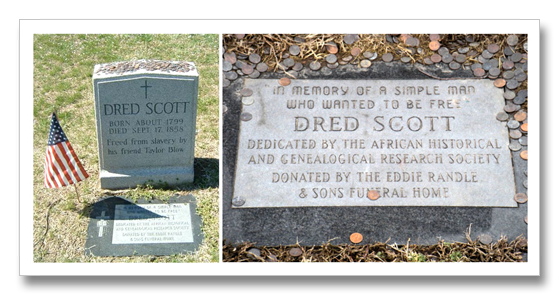
Today, his body lies in a grave in the Calvary Cemetery in St. Louis. For many years, it has been a local tradition to place Lincoln pennies on his headstone. Often, the pennies overflow and fall next to the commemorative marker on the ground, which says:

IN MEMORY OF A SIMPLE MAN
WHO WANTED TO BE FREE
DRED SCOTT

*     *     *     *     *     *     *     *     *     *    

Comments? Corrections? Post them on the Famous Quotations Facebook page.

Related reading…


September 18, 2009

SEPTEMBER 18 - Was Lincoln a Great Emancipator or a Great Obfuscator?

An Abraham Lincoln quotation that is often noted in modern, clear-eyed accounts of his life comes from one of his debates with Stephen Douglas, during their 1858 contest for an Illinois Senate seat in Congress.

At the time, white male voters were the only voters and most were racist. So, Douglas had been doing his best to scare them into thinking Lincoln was an unqualified abolitionist and an advocate of “mixed race” marriage.

In the fourth Lincoln-Douglas debate, held on September 18, 1858, Lincoln responded. He said:

“I am not, nor ever have been, in favor of bringing about in any way the social and political equality of the white and black races.”

Lincoln went on to say: “I am not, nor ever have been, in favor of making voters or jurors of negroes, nor of qualifying them to hold office, nor to intermarry with white people; and I will say in addition to this that there is a physical difference between the white and black races which I believe will forever forbid the two races living together on terms of social and political equality.”

How does this now oft-cited quote square with the old traditional image of Lincoln “The Great Emancipator” who “freed the slaves” with his Emancipation Proclamation?

Well, in a nutshell, the Civil War wasn’t really a war to free the slaves. And, the Emancipation Proclamation was a wartime strategy employed by Lincoln. It only “freed” slaves in Confederate states, to encourage them to leave their Southern masters and hopefully disrupt the Southern economy and war effort.

In the Northern states, slavery wasn’t legally abolished until the 13th Amendment to the U.S. Constitution was ratified in 1865.

Lincoln’s pandering speech to voters on September 18, 1858 doesn’t mean he wasn’t a great man. It just means that he was complex – like real people and real politics really are. 

It’s a fitting time to read more about this great and complex man, since 2009 is the 200th anniversary of his birth.

Here are some of the other famous quotes and phrases linked to SEPTEMBER 18:

“Bring ‘em Back Alive.” - Wildlife collector Frank Buck’s signature catchphrase, which he used as the title of a best selling book copyrighted on September 18, 1930.

“Hit the road, Jack, and don't you come back no more...” - The hit song by Ray Charles (written by Percy Mayfield) which entered Billboard’s Top 40 music chart on September 18, 1961.

“Men Behaving Badly.” - The title of a British TV sitcom that ran from 1992 to 1998. It was creeping into American vernacular, but was fully embedded in our language here when an Americanized version of the show started airing on September 18, 1996.

Copyrights, Disclaimers & Privacy Policy


Copyright © Subtropic Productions LLC

All original text written for the This Day in Quotes quotations blog is copyrighted by the Subtropic Productions LLC and may not be used without permission, except for short "fair use" excerpts or quotes which, if used, must be attributed to ThisDayinQuotes.com and, if online, must include a link to http://www.ThisDayinQuotes.com/.

To the best of our knowledge, the non-original content posted here is used in a way that is allowed under the fair use doctrine. If you own the copyright to something posted here and believe we may have violated fair use standards, please let us know.

Subtropic Productions LLC and ThisDayinQuotes.com is committed to protecting your privacy. For more details, read this blog's full Privacy Policy.