Showing posts with label Thomas Jefferson. Show all posts

January 28, 2023

“Eternal vigilance is the price of liberty.”


The quote “Eternal vigilance is the price of liberty” is
often mistakenly attributed to the Irish lawyer and politician John Philpot Curran and frequently to Thomas Jefferson.

In fact, Curran’s line was somewhat different. What he actually said, in a speech in Dublin on July 10, 1790, was:

       “The condition upon which God hath given liberty to man is eternal vigilance.”

And, according to Jefferson scholars there is “no evidence to confirm that Thomas Jefferson ever said or wrote, ‘Eternal vigilance is the price of liberty’ or any of its variants.”

Traditionally, the most famous use of “Eternal vigilance is the price of liberty” that’s included in books of quotations is from a speech made by the American Abolitionist and liberal activist Wendell Phillips on January 28, 1852.

Speaking to members of the Massachusetts Anti-Slavery Society that day, Phillips said:

Eternal vigilance is the price of liberty; power is ever stealing from the many to the few. The manna of popular liberty must be gathered each day or it is rotten. The living sap of today outgrows the dead rind of yesterday. The hand entrusted with power becomes, either from human depravity or esprit de corps, the necessary enemy of the people. Only by continued oversight can the democrat in office be prevented from hardening into a despot; only by unintermitted agitation can a people be sufficiently awake to principle not to let liberty be smothered in material prosperity.”

However, Anna Berkes, a research librarian at The Jefferson Library, has discovered uses that predate Phillips’ speech.

In a post on the Jefferson Library blog, Berkes wrote:

“Not to be mean to Mr. Wendell Phillips, but he’s about to get slightly less famous. After two days of ridiculously feverish searching, I’ve traced the purported Phillips version of this quote all the way back to 1809.  (For the record, Mr. Phillips was -2 years old at that time.)”

Berkes noted that, in a biography of Major General James Jackson published in 1809, author Thomas Charlton used the same words, just in a different order.

Charlton wrote that that one of the obligations of biographers of famous people is “fastening upon the minds of the American people the belief, that ‘the price of liberty is eternal vigilance.’

Berkes also found several news articles that include the more familiar version of the line as later used by Phillips.

For example, an article in the May 2, 1833 edition of The Virginia Free Press and Farmers' Repository says:

“Some one has justly remarked, that ‘eternal vigilance is the price of liberty.’ Let the sentinels on the watch-tower sleep not, and slumber not.”

One of the news articles she found, in the January 4, 1838 edition of the Pennsylvania Inquirer and Daily Courier, uses the same quote and attributes it to Thomas Jefferson — one of the earliest sources to do so.

Berkes reiterated that the consensus of Jefferson scholars is that he never spoke or wrote the words “Eternal vigilance is the price of liberty.”

She also concluded that, although Wendell Phillips still gets credit for the most famous use of that phrase, it was already a well-known saying prior to his speech in 1852.

Many witty variations on this old saying have been created since then.

My personal favorite is by the novelist Aldous Huxley.

In his spoken introduction to the 1956 CBS Radio Workshop adaptation of his novel Brave New World, Huxley said: “The price of liberty, and even of common humanity, is eternal vigilance.”

Editor’s Note: Special thanks to reader Chris Cox for emailing me a correction on my original citation of the Huxley quote and for giving me the link to listen to the CBS Radio adaptation on the Internet Archive.

*     *     *     *     *     *     *     *     *     *

Comments? Corrections? Post them on my Famous Quotations Facebook page or send me an email.

 Related reading…

March 04, 2018

March 4th: a good day for famous presidential quotes – until 1933…

The date for the United States presidential inauguration was not specified in the original U.S. Constitution.

In 1788, the Continental Congress set Inauguration Day as March 4. Then, in 1933, the Twentieth Amendment to the Constitution changed it to January 20, reducing the outdated four-month lag between the time a president was elected and took office.

That’s why famous quotes from inaugural addresses of presidents elected before 1933 are on a March 4th date and those of presidents elected after 1933 are on a January 20th.

The Inauguration Day speeches of all of the presidents (online here) are historically interesting and many include memorable lines. But only a handful of those lines have become famous quotes.

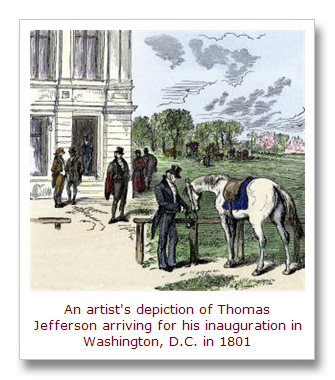
The earliest comes from the first inaugural address of Thomas Jefferson, which took place on March 4, 1801.

That speech includes Jefferson’s oft-cited warning against “entangling alliances.”

It’s part of a longer sentence that Jefferson said embodied his view on “the essential principles of our Government”:

“Equal and exact justice to all men, of whatever state or persuasion, religious or political; peace, commerce, and honest friendship with all nations, entangling alliances with none.”

You have to flash forward 60 years to find another truly famous quote from a president’s inaugural address.

In Abraham Lincoln’s first inaugural address on March 4, 1861, he coined the well-known, almost poetic phrase “the mystic chords of memory.”

It came near the end of his speech, in what was a clear plea to citizens in Southern states.

At that point, some states had already seceded from the Union, but no blatant act of war between the North and South had occurred.

Lincoln said:

     “In your hands, my dissatisfied fellow-countrymen, and not in mine, is the momentous issue of civil war...We must not be enemies. Though passion may have strained it must not break our bonds of affection. The mystic chords of memory, stretching from every battlefield and patriot grave to every living heart and hearthstone all over this broad land, will yet swell the chorus of the Union, when again touched, as surely they will be, by the better angels of our nature.”

Six weeks later, Confederate troops fired on Fort Sumter in Charleston, South Carolina. The Civil War had begun.

Four years later, when Lincoln gave his second inaugural address on March 4, 1865, the end of that bloody war was in sight.

Knowing this, Lincoln expressed his hope for reconciliation in a speech that included his famous quote about “malice towards none” and “charity for all.”

Here’s the sentence in his address those words come from:

“With malice towards none; with charity for all; with firmness in the right, as God gives us to see the right, let us strive on to finish the work we are in; to bind up the nation’s wounds, to care for him who shall have borne the battle, and for his widow and for his orphan — to do all which may achieve and cherish a just and lasting peace among ourselves, and with all nations.”

Four weeks later, on April 9, 1865 , Confederate General Robert E. Lee surrendered to General Ulysses S. Grant at Appomattox Courthouse in Virginia. The Civil War was over.

Four years after that, when Grant himself became president, Northern and Southern states were fighting in the legal arena over various federal laws, such as those related to the rights of the freed African-American slaves.

In Grant’s first inaugural address on March 4, 1869, he said he would not hesitate to use his power as President to veto laws that he opposed.

But he noted that he would faithfully execute all laws “whether they meet my approval or not.”

To those comments, Grant added one of the most slyly witty quotes ever uttered by a U.S. president:

“I know of no method to secure the repeal of bad or obnoxious laws so effective as their stringent execution.”

The next famous presidential quotations from a March 4th inauguration speech came half a century later, in Franklin D. Roosevelt’s first inaugural address on March 4, 1933.

One line in that speech helped popularize the term “good neighbor policy.” Speaking about his views on foreign affairs, Roosevelt said:

“In the field of world policy I would dedicate this Nation to the policy of the good neighbor — the neighbor who resolutely respects himself and, because he does so, respects the rights of others — the neighbor who respects his obligations and respects the sanctity of his agreements in and with a world of neighbors.”

But the most famous line from Roosevelt’s first inaugural address was related to domestic policy.

In 1933, America was in the midst of the Great Depression. Roosevelt wanted to generate a renewed sense of hope in the American people and inspire support for his plans to restore the economy with ambitious new government programs. But he knew that many people were afraid for their future and some were afraid that a more activist federal government would just make things worse.

So, in the first paragraph of Roosevelt’s speech, he famously addressed those fears:

“This is preeminently the time to speak the truth, the whole truth, frankly and boldly. Nor need we shrink from honestly facing conditions in our country today. This great Nation will endure as it has endured, will revive and will prosper. So, first of all, let me assert my firm belief that the only thing we have to fear is fear itself — nameless, unreasoning, unjustified terror which paralyzes needed efforts to convert retreat into advance. In every dark hour of our national life a leadership of frankness and vigor has met with that understanding and support of the people themselves which is essential to victory. I am convinced that you will again give that support to leadership in these critical days.”
 
Of course, Roosevelt did gain the support of the majority of Americans and was reelected to two more terms.

But his first inaugural address was the last presidential speech that included famous quotes spoken on the date March 4th.

*     *     *     *     *     *     *     *     *     *

Comments? Corrections? Post them on my Famous Quotations Facebook page or send me an email.

Related reading…

January 30, 2016

“A little rebellion, now and then, is a good thing” for “the tree of liberty”…

Thomas Jefferson a little rebellion quote

In 1786, the new democratic government of the United States of America wasn’t quite working out like some Revolutionary War veterans had expected.

Many had not been paid for their military service in local state militias or the Continental Army as promised.

And, when they went back to their family farms, they found they were subject to heavy new state taxes imposed to help pay off government war debts owed to rich merchants.

Many farmers who couldn’t afford to pay their taxes and other debts had their farms seized and were sentenced to serve time a debtors’ prison.

In response, angry veterans in Massachusetts began joining together to take over and shut down local courts. One group of vets tried to take over the Springfield armory.

This mini-revolt — called “Shays’ Rebellion” after one of its leaders, Daniel Shays — was quickly and forcefully crushed by the Massachusetts state militia, under orders from Governor James Bowdoin.

In the confrontation at the Springfield armory, four Shaysites were killed and twenty wounded. The rest fled.

Eventually hundreds were rounded up and indicted.

Some were sent to prison. Eighteen were sentenced to be hanged, as recommended by Founding Father Samuel Adams.

Drawing a somewhat arbitrary distinction between governments with and without kings at the top, Adams said:

“Rebellion against a king may be pardoned, or lightly punished, but the man who dares to rebel against the laws of a republic ought to suffer death.”

Adams’ fellow Founding Father Thomas Jefferson, who was in Paris at the time, agreed that there was a distinction between a monarchy and America’s new system of government.

However, his view of the anti-tax uprising in Massachusetts was less harsh.

In fact, two of Jefferson’s most famous (and arguably most misused) quotations are from letters he wrote about Shays’ Rebellion.

One of those oft-cited quotes — “I hold it that a little rebellion, now and then, is a good thing” — was in a letter he wrote to James Madison on January 30, 1787.

Jefferson said in the letter that a democratic government like America’s “has a great deal of good in it. The mass of mankind under that enjoys a precious degree of liberty and happiness. It has its evils, too, the principal of which is the turbulence to which it is subject. But weigh this against the oppressions of monarchy, and it becomes nothing.”

He added:

“I hold it that a little rebellion, now and then, is a good thing, and as necessary in the political world as storms in the physical. Unsuccessful rebellions, indeed, generally establish the encroachments on the rights of the people, which have produced them. An observation of this truth should render honest republican governors so mild in their punishment of rebellions, as not to discourage them too much. It is a medicine necessary for the sound health of government.”

Later that same year, Jefferson penned another famous quote that referred to Shays’ Rebellion:

In a letter to Col. William Smith, dated November 13, 1787, he said:

       “The tree of liberty must be refreshed from time to time with the blood of patriots and tyrants.”

Both of Jefferson’s famous quotes about Shays’ Rebellion are still frequently cited by people who are “mad as hell” about something the government has done.

Today, relatively few people actually believe that the sentiments Jefferson expressed should be interpreted and acted out literally, through a violent revolution. 

Some anti-gun control protesters who carry signs referring to Jefferson’s “tree of liberty” quote apparently do.

So, apparently, did the anti-government “rump militia” members who occupied the Malheur National Wildlife Refuge.

I wonder how many of them know what happened to the Shaysite rebels Jefferson was referring to when he wrote that line.

*     *     *     *     *     *     *     *     *     *

Comments? Corrections? Post them on the Famous Quotations Facebook page.

Related reading…

November 13, 2009

Jefferson’s bloody “Tree of Liberty” quote still fertilizes freedom and fanaticism


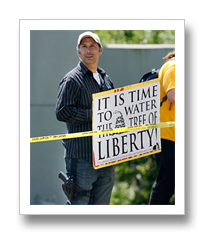
One of the signs held by a gun-toting protester against the Democratic health care proposal earlier this year said “IT IS TIME TO WATER THE TREE OF LIBERTY!”

This is a shorthand reference to an oft-used and abused quotation by Thomas Jefferson:

“The tree of liberty must be refreshed from time to time with the blood of patriots and tyrants.”

Jefferson made this remark in a letter to Col. William Smith, dated November 13, 1787.

It was part of a what he said in the letter about Shays’s Rebellion, a brief uprising of poor farmers and revolutionary war veterans in western Massachusetts that reached a head that year.

They were mad as hell about the crushing taxes they were forced to pay and the laws that let the government confiscate their property if they couldn’t pay those taxes.

As a symbol of their protest, they designated certain trees as liberty trees,” like those used during the Revolution to hang tax collectors working for the British Crown. They demanded changes in the tax laws, they had guns – and they were prepared to use them.

The Massachusetts state government reacted forcefully to put down this threat to their power, with encouragement from Founding Fathers like Samuel Adams. In the rebellion’s most significant “battle,” dozens of protesting farmers were killed or wounded by the state militia. Hundreds were eventually put in prison. Some were executed.

Thomas Jefferson was in Paris at the time. From that distance, he adopted a philosophical view of Shay’s Rebellion.

In his letter to Col. Smith, Jefferson did not justify the rebellion. In fact, he said it was “founded in ignorance.”

But then, Jefferson went on to say the part that people who are mad as hell about something love to quote:

“What country can preserve it's liberties if their rulers are not warned from time to time that their people preserve the spirit of resistance? Let them take arms...The tree of liberty must be refreshed from time to time with the blood of patriots & tyrants. It is it’s natural manure.”

Protesters against “Obamacare” are fans of Jefferson’s “tree of liberty” quote.

So was Oklahoma City bomber Timothy McVeigh, who killed 168 people by blowing up the Alfred P. Murrah Building in Oklahoma City in 1995, as an anti-government “protest.” When arrested, McVeigh was wearing a t-shirt that had a picture of a tree of liberty dripping blood, and the words: “The tree of liberty must be refreshed from time to time with the blood of patriots and tyrants.”

Indeed, for over two centuries now, Jefferson’s “tree of liberty” quote has been used by various people who think it somehow justifies what they believe and do.

And, I expect it will be for years to come.

*     *     *     *     *     *     *     *     *     *     *     *     *     *     *     *     *     *     *

For further reading and viewing, check out Shays's Rebellion: The American Revolution's Final Battle by Leonard L. Richards and the recent DVD A Little Rebellion. There’s also an interesting discussion of Jefferson’s “tree of liberty” quote on the American Creation blog.

*     *     *     *     *     *     *     *     *     *     *     *     *     *     *     *     *     *     *

Copyrights, Disclaimers & Privacy Policy


Copyright © Subtropic Productions LLC

All original text written for the This Day in Quotes quotations blog is copyrighted by the Subtropic Productions LLC and may not be used without permission, except for short "fair use" excerpts or quotes which, if used, must be attributed to ThisDayinQuotes.com and, if online, must include a link to http://www.ThisDayinQuotes.com/.

To the best of our knowledge, the non-original content posted here is used in a way that is allowed under the fair use doctrine. If you own the copyright to something posted here and believe we may have violated fair use standards, please let us know.

Subtropic Productions LLC and ThisDayinQuotes.com is committed to protecting your privacy. For more details, read this blog's full Privacy Policy.