Showing posts with label Humorous quotes. Show all posts

January 02, 2024

“There is less in this than meets the eye.”

Tallulah Bankhead meets the eye quote WM
On January 4, 1922, the New York Times published a review of the dramatic play Aglavaine and Selysette by the paper’s witty critic
Alexander Woollcott.

Woollcott had attended the premiere of the play at the Maxine Elliott Theatre in New York City the day before, on the afternoon of January 3rd.

His review wasn’t glowing.

Aglavaine and Selysette was written in French by the Belgian playwright and poet Maurice Maeterlinck in 1896.

The plot involves a high society love triangle. The language of the play is rather twee.

It was the kind of thing some high society types or eggheads might like. But not Woollcott.

He was one of the iconoclastic, opinionated writers and celebrities who were members of the “Algonquin Round Table.”

In fact he was one of the founding members, along with other legendary wits like columnist Franklin Pierce Adams, humorist and actor Robert Benchley and writer Dorothy Parker.

So, it’s not surprising that Woollcott’s aimed some zingers at the performance of the Maeterlinck’s play.

One of the lines in his review quickly became a famous quip that’s included in many books of quotations. He wrote:

“...the matinee was best summed up by the beautiful lady in the back row, who said: ‘There is less in this than meets the eye.’”

Woollcott was dissembling a bit by making it seem like he didn’t know the identity of “the beautiful lady.” He’d brought her to the play himself and she was sitting right next to him. She was the then little-known, 19-year-old actress Tallulah Bankhead.

It seems likely that Woollcott didn’t name Tallulah in the review to protect her against possible backlash from high society theatre patrons and producers. But he apparently did tell his Algonquin Club friends, who loved snarky gibes. One way or the other, word got around that Tallulah was the beautiful quipster.

Alexander Woollcott picWoollcott confirmed that publicly in a book he published later the same year, Shouts and Murmurs: Echoes of a Thousand and One First Nights.

In that book, he called the line one of the most memorable bon mots to appear in his reviews and said:

“[It] was whispered in my ear by a comely young actress named Tallulah Bankhead, who was sitting incredulous before a deliberate and intentional revival of Maeterlinck’s ‘Aglavaine and Selysette,’ a monstrous piece of perfumed posturing, meaning exactly nothing. Two gifted young actresses and a considerable bit of scenery were involved, and much pretentious rumbling of voice and wafting of gesture had gone into the enterprise. Miss Bankhead, fearful, apparently, lest she be struck dead for impiety, became desperate enough to whisper, ‘There is less in this than meets the eye.’”

In her own autobiography, Tallulah, published in 1952, Bankhead recalled it this way:

“It was through Alex Woollcott that I won my first citation as a wit...At the end of the first act I turned to my escort to say, ‘There’s less in this than meets the eye.’ I wasn’t aware that I’d said anything devastating, but the next morning the comment was repeated in Woollcott’s review in the Times...This gave me considerable prestige among those jesters who took such delight in ridicule of their peers, even their betters.”

By “those jesters” she meant the Algonquin Round Table, of which she became an occasional member.

However, as the term she chose for them suggests, she was not entirely a fan of the sometimes vicious humor those jesters were known for.

Nor, ultimately, was she a fan of Woollcott, who died nine years before Bankhead’s autobiography was published.

In that book she wrote:

“Since this is supposed to be a frank and open review of my life it is only fair to say that most of the wisecracks I have mothered have been accidental quips. So long as I have dragged Alexander Woollcott into this saga I may as well voice my opinion of him. It isn’t high. He was vindictive, shockingly petty in a feminine fashion, given to excesses when expressing his preferences or his prejudices.”

Of course, Tallulah, who died in 1968, became notorious for her own excesses, involving wild parties, multiple affairs, marijuana and cocaine.

*     *     *     *     *     *     *     *     *     *

Comments? Corrections? Questions? Email me or post them on my Famous Quotations Facebook page.

Related reading…

December 14, 2023

I’m dreaming of a white, gay, green, brown or red Christmas...


THE FAMOUS CHRISTMAS SONG:

“I’m dreaming of a white Christmas
Just like the ones I used to know.
Where the treetops glisten and children listen
To hear sleigh bells in the snow.
I’m dreaming of a white Christmas
With every Christmas card I write.
May your days be merry and bright
And may all your Christmases be white.”
      
Irving Berlin (1888-1989)
       American songwriter 
       Lyrics of Berlin’s song
“White Christmas”
       “White Christmas” was publicly introduced and made famous by the 1942 film Holiday Inn, in which it is
sung by Bing Crosby. The fact that it became one of the most popular Christmas songs of all time may seem a bit ironic, since Berlin was Jewish. However, as noted by journalist Nate Bloom in a post on the InterfaithFamily.com website, 12 of the 25 most popular Christmas holiday songs were written by Jews.


THE GAY FRIENDLY VERSION:

“I’m dreaming of a gay Christmas
Just like the ones I used to know.
Where the treetops shimmer with rainbow glitter
And ev-ry fella had a beau.
Oh, I’m dreaming of a gay Christmas
With Every Streisand song I play.
And no matter which way you sway
I hope all your Christmases are gay.”
       The “Gay Christmas” song, from
the “Last Christmas” musical show, first performed in 2007 by Theatre Out, a California-based gay and lesbian theatre group.


THE ECO-FRIENDLY VERSION:

“I’m dreaming of a green Christmas
Not like the ones I used to know.
With presents handmade or re-gifted
To prevent the climate being shifted
And leaving Christmas trees to grow.” 
      
Nancy Hiler, the “Go Green Gal” 
       In a blog post titled
“I’m Dreaming of a Green Christmas (with apologies to Irving Berlin)” 


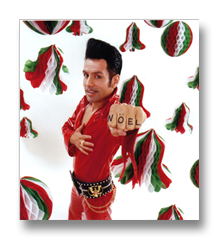
THE LATINO VERSION:

“I’m dreaming of a brown Christmas,
Just like the one in Mexico.
Where bunuelos glisten,
Posadas at the mission,
And yes, we don’t need no snow.”
      
El Vez (stage name of Robert Lopez)
       Mexican-American rock and roll artist
       From his song
“Brown Christmas”


THE CHRISTMAS CHEERS! VERSION:

“I’m dreaming of a white Christmas
But if the white runs out
I’ll drink the red.” 
       A
popular variation I first saw as the caption of this cartoon from the now defunct website YourFunnyStuff.com. It inspired the title of a notebook you can buy for Christmas.


*     *     *     *     *     *     *     *     *     *

Comments? Corrections? Questions? Email me or post them on my Famous Quotations Facebook page.

Christmas parody reading and listening

November 19, 2023

Lincoln’s Gettysburg Address – and Lord Buckley’s “hip translation” . . .


On November 19, 1863, President Abraham Lincoln gave a brief speech in Gettysburg, Pennsylvania at the dedication of a cemetery for the Union soldiers who had died in that bloody Civil War battle four months earlier.

Lincoln’s remarks came to be known as “The Gettysburg Address.”

It’s his best known speech and includes two of his most famous quotes.

One is the opening sentence:

“Fourscore and seven years ago our fathers brought forth on this continent a new nation, conceived in liberty and dedicated to the proposition that all men are created equal.”

The other the closing line, which contains the oft-cited phrase: “government of the people, by the people, for the people.”  

As noted by many sources, Lincoln appears to have based his memorable of/by/for the people line on words used in a sermon by the abolitionist preacher Theodore Parker.

During the early months of the Civil War, Lincoln’s law partner William Herndon gave the president a book of Parker’s sermons and speeches. It included a sermon titled “The Effect of Slavery on the American People,” which Parker delivered at the Music Hall in Boston, Massachusetts on July 4, 1858.

In that, Parker said: “Democracy is direct self-government over all the people, for all the people, by all the people.”

According to Herndon, Lincoln marked that sentence in pencil in the book before he wrote the Gettysburg Address.

Parker had used similar words in earlier sermons and speeches.

For example, in a speech he gave in Boston on May 29, 1850
, he defined democracy as “a government of all the people, by all the people, and for all the people.” However, the of/for/by the people formulation was not coined by Parker. 

Scholars have found several of/by/for the people quotations that predate Parker’s.

In the decades since 1863, there have been countless other uses and variations inspired by the Gettysburg Address. (See this post on my Quote/Counterquote site for some examples.)

My own favorite adaptation of Lincoln’s address is the hipster version done by the late, great Richard Buckley, aka Lord Buckley.

Buckley performed as a vaudeville-style comedian from the late 1920s to the late 1940s.

Starting in 1947 and throughout the 1950s, he performed as the character “Lord Buckley,” an ultra-cool hepcat who told wild stories and recited poems using the hipster slang of black jazz musicians and beatniks.

In 1956, HIP Records released a recording of Buckley doing his “hip translation” of the Gettysburg Address. It’s included on a CD issued by Rhino in 1993 titled His Royal Hipness: Lord Buckley.

As I write this, there’s a copy you can listen to on YouTube.

Lord Buckley made it clear in his introductory remarks that, although his version is humorous, he had great respect for Lincoln and he believed Lincoln would have been able to appreciate it.

I agree. So, to honor two of my favorite orators, here in a historic side-by-side “appearance” are President Abraham Lincoln, reciting the Gettysburg Address, and Lord Buckley reciting his hip translation...


Abraham Lincoln:
The Gettysburg Address***


Lord Buckley:
The hip translation…
“Four score and seven years ago our fathers brought forth, upon this continent, a new nation, conceived in Liberty, and dedicated to the proposition that all men are created equal.

“Four big hits and seven licks ago, our before-daddies swung forth, upon this sweet groovy land a swingin’, stompin’, jumpin’, blowin’, wailin’ new nation, hip to the cool groove of liberty and solid sent with the ace lick dat all the studs, chicks, cats and kitties – red, white, or blue – is created level in front. In straight talk, the same, dig what I mean?

Now we are engaged in a great civil war, testing whether that nation, or any nation so conceived, and so dedicated, can long endure.

Now we are hung with a king-size main-day civil drag, soundin’ of whether that nation or any up-there nation, so hip and so solid sent can stay with it all the way.

We are met here on a great battlefield of that war.

We’s here to dig this chop-beatin’ session on the site of the worst jazz blown in the entire issue – Gettys-mother-burg.

We have come to dedicate a portion of it as a final resting place for those who here gave their lives that that nation might live.

We have stomped out here to turn on a small soil stash of the before-mentioned hassle site, as a final sweet sod pad for those who laid it down and left it there, so that this jumpin’ happy beat might blow forevermore.
It is altogether fitting and proper that we should do this. And we all dig that this is the straightest lick ever dug.

But in a larger sense we can not dedicate — we can not consecrate — we can not hallow this ground. The brave men, living and dead, who struggled, here, have consecrated it far above our poor power to add or detract.

But diggin’ it harder from afar, we cannot take no wailin’ bows, we cannot mellow, we cannot put down the stamp of the Nazz on this sweet sod, ‘cause the strong non-stop studs, both diggin’ it and dug under it, who hassled here have mellowed it with such a wild mad beat that we can hear it, but we can't touch it.
The world will little note, nor long remember, what we say here, but can never forget what they did here. Now the world cats will short dig, you hear what I say, short dig nor long stash in their wigs what we is beatin’ our chops around here, but it never can successively shade what they vanced here.

It is for us, the living, rather to be dedicated here to the unfinished work which they have, thus far, so nobly carried on. It is rather for us to be here dedicated to the great task remaining before us.

It is for us, the swingin’, to pick up the dues of these fine studs who cut out here and fly it through to Endsville. It is hipper for us to be signifyin’ to the glorious gig that we can’t miss with all these bulgin’ eyes.
That from these honored dead we take increased devotion to that cause for which they here gave the last full measure of devotion — that we here highly resolve that these dead shall not have died in vain; that this nation shall have a new birth of freedom; and that this government of the people, by the people, for the people, shall not perish from the earth.”

***NOTE: There are
five written versions of Lincoln’s Gettysburg Address, with slight wording variations among them. The version above is from the “Hay Copy,” stored in The Library of Congress. Some scholars believe it is the version Lincoln used, but this is not known with certainty.

That from all these A-stamp studs we double our love kick, to that righteous ride for which these cats hard sounded the last 'nth bong of the bell of their bell. That we here want it stuck up straight for all to dig that these departed studs shall not have split in vain; that this nation, under the great swingin’ Nazz, shall ring up a whopper of endless Mardi Gras, and that the Big Law of you straights, by you studs, and for you kitties, shall not be scratched from the big race.”

*     *     *     *     *     *     *     *     *     *

Comments? Corrections? Questions? Email me or post them on my Famous Quotations Facebook page.

Related reading and listening…

November 04, 2023

As Maine goes, so goes: (a) the nation (b) Vermont . . .


In the November 1936 presidential election, President Franklin Delano Roosevelt was reelected for a second term in a landslide victory over his Republican opponent, Kansas Governor Alf Landon.

Roosevelt received more than 60% of the vote and won in all but two states – Maine and Vermont.

On November 4, 1936, the day after the election, Roosevelt’s campaign manager James A. Farley gave reporters what would now be called a good sound bite.

“As Maine goes, so goes Vermont,” he quipped.

Farley’s witty remark soon became a famous humorous political quotation.

It was especially funny to political observers because it’s a take-off on the older saying: “As Maine goes, so goes the nation.”

What’s the origin of that venerable political proverb?

It is sometimes claimed to be based on the fact that Maine was the first state to enact a law prohibiting alcohol in 1851.

For example, an article published in the Boston Globe in 2000 said it “was coined at the peak of the state’s 19th-century temperance movement, in an era when New England shaped national opinion on fundamental issues from slavery to child labor to women's suffrage.”

But that temperance theory is wrong.

Nor is the saying based on Mainers’ record on votes for president.

In fact, historically, Mainers have voted for a higher percentage of losing presidential candidates than many other states.

The saying “As Maine goes, so goes the nation” primarily stems from the fact that Maine once held its state elections for Governor, U.S. Senators and Congressmen and other non-presidential offices in September – two months before other states.

The outcome of this unique early election was seen as an indication of how the political winds were blowing in general for the Democrat and Republican parties.

Maine’s September election, on the second Monday of the month, was created in its constitution in 1820, when it split from Massachusetts to became a separate state.

In presidential election years, Mainers also went back to the polls in November to vote on the presidential race.

In 1957, Maine changed its election law and, in 1960, started holding all general elections on the same November election dates as other states.

But even though Maine’s old September election tradition is gone, the saying “As Maine goes, so goes the nation” has lived on – as has James Farley’s update, “As Maine goes, so goes Vermont.”

In 1972, some observers thought Maine gave a different sign of things to come in politics when it passed a law making it the first state to allow its electoral vote to be split. Under that law, the winner of each congressional district gets one electoral vote, and the winner of the statewide vote gets the state's remaining two electoral votes.

Supporters of that law touted it as a more democratic alternative to the traditional system of having all of a state’s electoral votes go to the presidential candidate who gets the most votes statewide.

As it turned out, the nation didn’t go that way. In 1996, Nebraska became the only other state to pass a similar law, though I don’t think it led anyone to start saying: “As Maine goes so goes Nebraska.”

NOTE: If you’d like to read more about the 1936 election, FDR and James Farley, I recommend the book Mr. Democrat: Jim Farley, the New Deal and the Making of Modern American Politics.

*     *     *     *     *     *     *     *     *     *

Comments? Corrections? Questions? Email me or post them on my Famous Quotations Facebook page.

Related reading ad listening…

October 11, 2023

“Live from New York, it’s Saturday Night!” (and finger-eating wolverines)


On October 11, 1975, at 11:30pm Eastern Time, a new TV comedy show debuted on the NBC network.

It opened with a wacky skit featuring three comic actors who were virtually unknown at the time.

In the skit, a frumpy-looking East European immigrant with a heavy accent is being tutored on how to speak proper English by a well-dressed teacher.

They are sitting in comfortable chairs next to each other in a small room.

The teacher starts a repeat-after-me type lesson with an unusual language exercise about wolverines…

       TEACHER: “Let us begin. Repeat after me. I would like...”

       IMMIGRANT: (With a noticeable accent.) “I wude like...”

       TEACHER: “...to feed your fingertips...”

       IMMIGRANT: “...to feed yur fingerteeps...”

       TEACHER: “...to the wolverines.”

       IMMIGRANT: “...to de woolvur-eenes.”

After a couple more odd exercises about wolverines and badgers (or, “woolvur-eenes” and “bed-jurs” as the immigrant pronounces them), the teacher suddenly gasps, clutches his chest and falls to the floor, apparently dead from a heart attack.

The European immigrant looks confused for a moment.

Then he gasps, clutches his chest and falls to the floor, copying the professor.

Next, a Stage Manager walks into the scene, smiles into the camera and says, for the very first time, what would soon be a well-known line:

       “Live from New York, it’s Saturday Night!”

The three not-yet-famous comedians in the skit were: John Belushi a former Second City improv performer who went on to become one of the most beloved comic actors in the world prior to his tragic death in 1982 from an apparent drug overdose; Michael O'Donoghue, a former National Lampoon magazine writer picked as head writer for the new show (who died of a cerebral hemorrhage in 1994 at age 54); and, the fortunately still living comic legend, Chevy Chase, who was best known at the time as a cast member of the National Lampoon Radio Hour.

All three were among the amazingly talented group of original cast members of the show, which was officially titled NBC’s Saturday Night when it started airing in 1975, but soon came to be called Saturday Night Live, or SNL for short.

The revolving, evolving group of comic actors who performed comedy sketches on NBC’s new Saturday Night series were collectively dubbed the “Not Ready for Prime Time Players.”

The voice heard after Chevy Chase on the historic first episode was that of longtime television show announcer Don Pardo, reading the names of the performers who would be appearing (a function he continued on SNL until his death in August 2014). The first host was my favorite curmudgeon, the great George Carlin (1937-2008).

I was watching the premiere of SNL that night and watched the show almost every weekend for nearly 20 years. Nowadays, I record the show on DVR and watch the opening long enough to hear the famed line “Live from New York, it’s Saturday Night!”

I check out who the guest host and musical guest will be. Then I usually fast forward a lot, though skits that rarely strike me as funny as anything done by the early “Not Ready for Prime Time Players.” I often have no idea who the guest hosts or musical performers are and don’t understand most of the jokes that include current pop culture references.

Yep, I’m nearly as old as John Belushi would have been if he’d survived his oversized lust for life and I’m nearly as much of a curmudgeon as George Carlin. I miss them both.

Of course, there are some things I do like about the modern world. For example, I can now rewatch old episodes of Saturday Night Live any time I want as streaming video on my iPad.

And whenever I get nostalgic and rewatch the opening skit that turned the lines “I would like to feed your fingertips to the wolverines” and “Live from New York, it’s Saturday Night” into catchphrases, it still cracks me up.

*     *     *     *     *     *     *     *     *     *

Comments? Corrections? Questions? Email me or post them on my Famous Quotations Facebook page.

Related viewing, reading and listening…

April 24, 2023

“Yada Yada Yada…”

Yada Yada quote Seinfeld

During its long, successful original run on NBC, from 1989 to 1998, the Seinfeld TV show created or popularized many catchphrases.

Some of the best known are:
       ● the famed snub of the “Soup Nazi,” “No soup for you!”
       ● the sexual euphemism “master of your domain”
       ● the food-related faux pas term “double dip”
       ● and, the handy denial of prejudice, “Not that there's anything wrong with that.”

My own favorite Seinfeld catchphrase is “Yada yada yada.”

It was first used in the episode that originally aired on April 24, 1997, appropriately titled “The Yada Yada” (Season 8, Episode 19).

In that episode, the phrase is initially used by the character Marcy (played by Suzanne Cryer), a girlfriend of George Costanza (Jason Alexander), while she’s talking to George and Jerry Seinfeld.

The conversation goes like this:

MARCY:  You know, a friend of mine thought she got Legionnaire’s Disease in the hot tub.
GEORGE:  Really? What happened?
MARCY:  Oh, yada yada yada, just some bad egg salad. I'll be right back. (She gets up)
JERRY:  I noticed she’s big on the phrase “yada yada.”
GEORGE:  Is “yada yada” bad?
JERRY:  No, “yada yada” is good. She’s very succinct.
GEORGE:  She is succinct.
JERRY:  Yeah, it’s like you’re dating
USA Today.

As the episode proceeds, almost all the characters start using “yada yada yada” (or sometimes just “yada” or “yada yada”) as a way to gloss over and shorten descriptions of things, much like people use “et cetera, et cetera” or “blah blah blah” or “and so on, and so forth.”

I think one of the funniest uses is by George.

It’s in a scene now immortalized on YouTube under the title “George Costanza Life Story.”

MARCY:  So I'm on Third Avenue, minding my own business and, yada yada yada, I get a free massage and a facial.
GEORGE:  Wow. What a succinct story.
MARCY:  I’m surprised you drive a Cadillac.
GEORGE:  Oh, it’s not mine. It’s my mother’s.
MARCY:  Oh. Are you close with your parents?
GEORGE:  Well, they gave birth to me, and, yada yada.
MARCY:  Yada what?
GEORGE:  Yada yada yada…

“The Yada Yada” script was written by veteran TV writer and producer Steve Koren, a former member of the Saturday Night Live writing team who wrote or co-wrote dozens of other Seinfeld episodes. He also scripted a number of popular movies, including Bruce Almighty, Click, Superstar and A Night at the Roxbury.

Koren didn’t coin the phrase “yada yada yada.”

But the origin is still being debated by linguists and etymology buffs.

Some believe it is Jewish-American “Yiddish” slang that may have descended from the Hebrew word “yada” or “yadaa,” which means tell, know or show.

Other language mavens think the Yiddish/Hebrew theory is totally fakakta.

The renowned Oxford English Dictionary contributor Barry Popik cites a list of possible precursors from the English language on his excellent Big Apple site.

The OED itself suggests that “yada” may have been derived from the British word “yatter,” meaning mindless chatter.

A Norwegian source has also been postulated.

In the Norwegian language, the letter J is pronounced as Y. So, the Norwegian word “jada,” meaning “yeah,” is pronounced as “yada.” And, “jada jada jada” is used by Norwegians in the same disbelieving or dismissive way English-speaking people use “yeah yeah yeah.” (As in, “Yeah, sure.”)

The bottom line when you read all the yada yada yada in the various theories is that the linguistic origin is uncertain.

What is certain is that the Seinfeld show gets and deserves the credit for making “yada yada yada” familiar to millions of people.

And, although the one and only appearance of the character Marcy in the Seinfeld show was in “The Yada Yada” episode of Season 8, she gets the credit for being the first Seinfeld character to use that now immortal catchphrase.

*     *     *     *     *     *     *     *     *     *

Comments? Corrections? Questions? Email me or post them on my Famous Quotations Facebook page.

Related reading, listening and swag…

Copyrights, Disclaimers & Privacy Policy


Copyright © Subtropic Productions LLC

All original text written for the This Day in Quotes quotations blog is copyrighted by the Subtropic Productions LLC and may not be used without permission, except for short "fair use" excerpts or quotes which, if used, must be attributed to ThisDayinQuotes.com and, if online, must include a link to http://www.ThisDayinQuotes.com/.

To the best of our knowledge, the non-original content posted here is used in a way that is allowed under the fair use doctrine. If you own the copyright to something posted here and believe we may have violated fair use standards, please let us know.

Subtropic Productions LLC and ThisDayinQuotes.com is committed to protecting your privacy. For more details, read this blog's full Privacy Policy.