Showing posts with label Christmas. Show all posts

December 24, 2023

“Silent Night” – the origin and evolving words of the famous Christmas carol...


In 1818, during the annual Christmas Midnight Mass at the St. Nicholas Church at Oberndorf, Austria, the song we know as “Silent Night! Holy Night!” (or just “Silent Night”) was performed in public for the first time.

Most sources say this happened on Christmas Eve, the night of December 24, 1818, though some say it was after midnight on December 25.

The lyrics of the song were written in German by Joseph Mohr (1792-1848), an Austrian Catholic priest who sang tenor during the song’s debut.

The church organist, Franz Gruber (1787-1863), wrote the music.

During that first performance of the song, Gruber accompanied Mohr and the choir on guitar. According to legend, he played a guitar because a mouse had chewed on and damaged the bellows of the church organ.

The original German title of the song — “Stille Nacht! Heilige Nacht!” — is taken from the opening line of the first verse:

      “Stille Nacht! Heilige Nacht!
       Alles schläft; einsam wacht
       Nur das traute heilige Paar.
       Holder Knab im lockigten Haar,
       Schlafe in himmlischer Ruh!
       Schlafe in himmlischer Ruh!”

Today, the familiar English version of this first verse that most of us know is:

      “Silent night! Holy night!
       All is calm, all is bright.
       Round yon virgin mother and child,
       Holy infant so tender and mild.
       Sleep in heavenly peace,
       Sleep in heavenly peace.”

However, it wasn’t until the 20th Century that this version became standard. And, although it’s the only one most people are aware of today, there have actually been many different English translations.

A literal English translation of the German words of the first verse is something like this:

      “Silent night! Holy night!
       All are sleeping, alone and awake
       Only the intimate holy pair,
       Lovely boy with curly hair,
       Sleep in heavenly peace!
       Sleep in heavenly peace!”

The most famous English version of the song was written by American Episcopal Bishop John Freeman Young (1820-1885) and first published in 1859.

Young made up his own words for the middle part of the first verse and for most of the other two verses (of the original six) that he “translated.”

His English adaptation became the one that’s best known. But it wasn’t the first.

According to the authoritative, amazingly detailed history of the song on The Hymns and Carols of Christmas site, an American named J. F. Warner created what is believed to be the oldest English version of Mohr’s German lyrics in 1849.

Warner titled the song “Silent Night! Hallowed Night!”

That makes sense since “hallowed” is one of the possible translations of the German word Heilige. (It can also be translated as awed, blessed, devout, righteous, sacred, saintly, solemn — or holy.)

Warner’s lyrics for the rest of the first verse (and other verses) are, if anything, even more creative “translations” than Young’s.

He started his version of the song this way:

      “Silent night! halllow’d night!
       Land and deep silent sleep,
       Softly glitters bright Bethlehem’s star,
       Beck’ning Israel’s eye from afar,
       Where the Saviour is born,
       Where the Saviour is born.”

Another early English translation that preceded Young’s was written in 1858 by Emily E.S. Elliott. She titled her version of the song “Stilly Night, Holy Night.” Elliott’s lyrics also bear little relation to the original German.

Since then, twenty or so other English versions of “Stille Nacht! Heilige Nacht!” have been created, each with its own unique lyrics.

But at some unknown turning point in the 20th Century, for some unknown reason, Rev. Young’s became the standard.

There’s a good chance you’ve been hearing — and possibly singing — his words this Holiday season.

Merry Christmas, Happy Hanukkah, Happy Kwanzaa and Happy Everything Else from ThisDayinQuotes.com!

*     *     *     *     *     *     *     *     *     *

Comments? Corrections? Questions? Email me or post them on my Famous Quotations Facebook page.

Related listening and reading…


December 14, 2023

I’m dreaming of a white, gay, green, brown or red Christmas...


THE FAMOUS CHRISTMAS SONG:

“I’m dreaming of a white Christmas
Just like the ones I used to know.
Where the treetops glisten and children listen
To hear sleigh bells in the snow.
I’m dreaming of a white Christmas
With every Christmas card I write.
May your days be merry and bright
And may all your Christmases be white.”
      
Irving Berlin (1888-1989)
       American songwriter 
       Lyrics of Berlin’s song
“White Christmas”
       “White Christmas” was publicly introduced and made famous by the 1942 film Holiday Inn, in which it is
sung by Bing Crosby. The fact that it became one of the most popular Christmas songs of all time may seem a bit ironic, since Berlin was Jewish. However, as noted by journalist Nate Bloom in a post on the InterfaithFamily.com website, 12 of the 25 most popular Christmas holiday songs were written by Jews.


THE GAY FRIENDLY VERSION:

“I’m dreaming of a gay Christmas
Just like the ones I used to know.
Where the treetops shimmer with rainbow glitter
And ev-ry fella had a beau.
Oh, I’m dreaming of a gay Christmas
With Every Streisand song I play.
And no matter which way you sway
I hope all your Christmases are gay.”
       The “Gay Christmas” song, from
the “Last Christmas” musical show, first performed in 2007 by Theatre Out, a California-based gay and lesbian theatre group.


THE ECO-FRIENDLY VERSION:

“I’m dreaming of a green Christmas
Not like the ones I used to know.
With presents handmade or re-gifted
To prevent the climate being shifted
And leaving Christmas trees to grow.” 
      
Nancy Hiler, the “Go Green Gal” 
       In a blog post titled
“I’m Dreaming of a Green Christmas (with apologies to Irving Berlin)” 


THE LATINO VERSION:

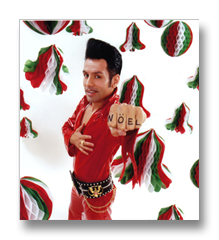
“I’m dreaming of a brown Christmas,
Just like the one in Mexico.
Where bunuelos glisten,
Posadas at the mission,
And yes, we don’t need no snow.”
      
El Vez (stage name of Robert Lopez)
       Mexican-American rock and roll artist
       From his song
“Brown Christmas”


THE CHRISTMAS CHEERS! VERSION:

“I’m dreaming of a white Christmas
But if the white runs out
I’ll drink the red.” 
       A
popular variation I first saw as the caption of this cartoon from the now defunct website YourFunnyStuff.com. It inspired the title of a notebook you can buy for Christmas.


*     *     *     *     *     *     *     *     *     *

Comments? Corrections? Questions? Email me or post them on my Famous Quotations Facebook page.

Christmas parody reading and listening

December 22, 2016

“Let It Snow!” – the Christmas song that isn’t…


Every year at Christmas time, when I hear someone sing or say “Let It Snow!” I am reminded of what I learned when I looked into the song that popularized that phrase.

It was launched into our holiday lexicon in December 1945, when singer and big band leader Vaughn Monroe released the first recording of “Let It Snow! Let It Snow! Let It Snow!”

On December 22, 1945 his 78 RPM recording of that song entered the Billboard “Best Sellers in Stores” chart (a precursor of Billboard’s Top 40 and Hot 100 charts).
 
The words were written by lyricist Sammy Cahn. The music was by Cahn’s songwriting partner at the time, Jule Styne.

Monroe’s version of the song quickly became a huge hit, making it to Billboard’s number one spot on January 26, 1946.

In the decades since then, “Let It Snow! Let It Snow! Let It Snow!” has been recorded by countless other singers and bands.

Nowadays, many people think it’s a traditional Christmas song. “Let It Snow” is common on Christmas cards and in Christmas-related internet posts.

But, in fact, there’s no reference to Christmas or the holiday season in the lyrics and it wasn’t intended to be Christmas song.

It’s actually a romantic, somewhat corny love song about a guy who is visiting his girlfriend during the winter in some unnamed location.

Since it was the era of PG lyrics, the guy is not expecting to stay for the night. However, when it’s time for him to leave, “the weather is frightful.”

Gosh darnit! It’s snowing too hard for him to travel safely.

The lyrics are written from the guy’s point of view. He seems to see the weather as a stroke of luck and is happy to “let it snow.” 

He suggests to the girl that he’d hate to go out into the storm right at that moment, but if she’d just hold him tight for a while he’d be warm all the way home.

He also mentions he’d brought some popcorn they didn’t get around to eating yet, and the fire is so delightful, and the lights are turned down low, and…

And, the girl buys his snow job. Perhaps not reluctantly.

Then, like in the movies, there’s sort of a fade to a later time in the lyrics. The fire is dying and the couple is still, er, “good-bye-ing.”

Yeah, baby! “Let it snow! Let it snow! Let it snow!”

Although you may not be old enough to have heard Vaughn Monroe’s original version when it first entered the Billboard chart on December 22, 1945, you’ve heard it if you’re a fan of Bruce Willis action movies.

Monroe’s recording of “Let It Snow! Let It Snow! Let It Snow!” is the first song that plays during the end credits of Willis’ popular action movie Die Hard. It was also used in the soundtrack of Die Hard II.
 
So, yippee-kay-yay, fellow Bruce fans! Click on the video link at right and sing along! Here are the lyrics...

       “Oh, the weather outside is frightful
       But the fire is so delightful
       And since we’ve no place to go
       Let it snow! Let it snow! Let it snow!

       It doesn’t show signs of stopping
       And I brought some corn for popping
       The lights are turned way down low
       Let it snow! Let it snow! Let it snow!

       When we finally kiss good night
       How I hate going out in the storm
       But if you really you hold me tight
       All the way home I’ll be warm.

       The fire is slowly dying
       And, my dear, we’re still good-bye-ing
       But as long as you love me so
       Let it snow! Let it snow! Let it snow!”

Ironically, as noted in the excellent book Stories Behind the Greatest Hits of Christmas, Cahn and Styne wrote the song while sitting in a stifling hot office in Hollywood during the summer of 1945.

Author Ace Collins says Styne worked out a melody he thought sounded “cool” on the piano. Then Cahn turned his thoughts to winter and: “Looking out the window at the California sun baking the landscape, he whispered, ‘Let it snow.’”

It was perfect! In a short time, Cahn and Styne finished what is now considered one of the top 25 Christmas songs of all time — even though it’s not really about Christmas.

*     *     *     *     *     *     *     *     *     * 

Comments? Corrections? Post them on the Famous Quotations Facebook page. 

Related reading, listening and viewing…

December 25, 2013

The American Christmas classic by a Russian-born Jewish songwriter that ended the Vietnam War…


I like odd facts and there are a number of them about the song “White Christmas.”

First off, this American Christmas classic was written by the Russian-born Jewish songwriter Irving Berlin (who also wrote the classic American anthem “God Bless America”).

Berlin’s original name was Israel Baline. His family emigrated to America in 1893 to escape violent pogroms against Jews and settled in New York City.

By the age of 20, the young immigrant was on his way to becoming one of the greatest songwriters in modern history, under his Americanized name. 

Berlin wrote “White Christmas” sometime in the late 1930s.

Bing Crosby introduced it publicly on his NBC radio show, The Kraft Music Hall, on Christmas Day, December 25, 1941.

But the song first gained true national fame the following year, when it was sung by Crosby in the film Holiday Inn, a musical full of Irving Berlin songs that was released in the US on August 4, 1942.

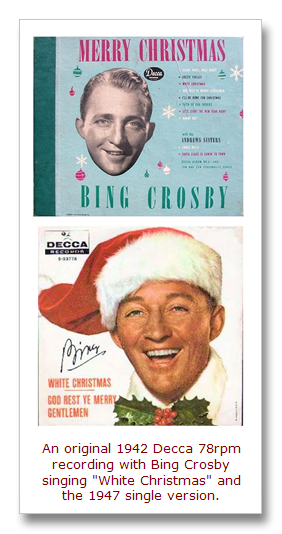
In the fall of 1942, Decca issued the first recording of Crosby singing “White Christmas.”

It became a huge hit and a sentimental favorite of American troops and their families during World War II.

The recording of the song we’re most familiar with today, however, is not the 1942 version.

By 1947, the Decca master of Crosby’s 1942 recording had been used to make so many records that it was literally worn out.

So, on March 19, 1947 Crosby recorded the song for Decca again, with John Scott Trotter and his orchestra.

That version of “White Christmas” went on to become the best-selling single of all time, with estimated sales of more than 50 million copies.

In total, over 100 million copies of 78rpm records, 45rpm singles and albums with Bing’s various renditions of the song have been sold, according to the Guinness Book of World Records.

In 1975, “White Christmas” also had a bizarre role at the end of the Vietnam War.

By April of that year, the United States had pulled most of its troops out of Vietnam and the North Vietnamese were closing in on Saigon.

As part of secret preparations for the evacuation of all remaining American personnel, the American embassy distributed a 15-page booklet to US civilians who were still in the city. It included a map showing where evacuation helicopters would be landing.

A page inserted into the booklet said:

“Note evacuational signal. Do not disclose to other personnel. When the evacuation is ordered, the code will be read out on American Forces Radio. The code is: THE TEMPERATURE IN SAIGON IS 112 DEGREES AND RISING. THIS WILL BE FOLLOWED BY THE PLAYING OF ‘I’M DREAMING OF A WHITE CHRISTMAS.’”

The final panicky evacuation of Saigon is now inglorious history — and the fact that “White Christmas” played a role in it is one more odd thing about the song.

OK, now please sing along with Bing, without panicking:

“I’m dreaming of a white Christmas,
Just like the ones I used to know.
Where the tree-tops glisten
And children listen
To hear sleigh bells in the snow...”

.*     *     *     *     *     *     *     *     *     * 

Comments? Corrections? Post them on the Famous Quotations Facebook page.

Related reading, viewing and listening…

Copyrights, Disclaimers & Privacy Policy


Copyright © Subtropic Productions LLC

All original text written for the This Day in Quotes quotations blog is copyrighted by the Subtropic Productions LLC and may not be used without permission, except for short "fair use" excerpts or quotes which, if used, must be attributed to ThisDayinQuotes.com and, if online, must include a link to http://www.ThisDayinQuotes.com/.

To the best of our knowledge, the non-original content posted here is used in a way that is allowed under the fair use doctrine. If you own the copyright to something posted here and believe we may have violated fair use standards, please let us know.

Subtropic Productions LLC and ThisDayinQuotes.com is committed to protecting your privacy. For more details, read this blog's full Privacy Policy.