Showing posts with label Irving Berlin. Show all posts

December 14, 2023

I’m dreaming of a white, gay, green, brown or red Christmas...


THE FAMOUS CHRISTMAS SONG:

“I’m dreaming of a white Christmas
Just like the ones I used to know.
Where the treetops glisten and children listen
To hear sleigh bells in the snow.
I’m dreaming of a white Christmas
With every Christmas card I write.
May your days be merry and bright
And may all your Christmases be white.”
      
Irving Berlin (1888-1989)
       American songwriter 
       Lyrics of Berlin’s song
“White Christmas”
       “White Christmas” was publicly introduced and made famous by the 1942 film Holiday Inn, in which it is
sung by Bing Crosby. The fact that it became one of the most popular Christmas songs of all time may seem a bit ironic, since Berlin was Jewish. However, as noted by journalist Nate Bloom in a post on the InterfaithFamily.com website, 12 of the 25 most popular Christmas holiday songs were written by Jews.


THE GAY FRIENDLY VERSION:

“I’m dreaming of a gay Christmas
Just like the ones I used to know.
Where the treetops shimmer with rainbow glitter
And ev-ry fella had a beau.
Oh, I’m dreaming of a gay Christmas
With Every Streisand song I play.
And no matter which way you sway
I hope all your Christmases are gay.”
       The “Gay Christmas” song, from
the “Last Christmas” musical show, first performed in 2007 by Theatre Out, a California-based gay and lesbian theatre group.


THE ECO-FRIENDLY VERSION:

“I’m dreaming of a green Christmas
Not like the ones I used to know.
With presents handmade or re-gifted
To prevent the climate being shifted
And leaving Christmas trees to grow.” 
      
Nancy Hiler, the “Go Green Gal” 
       In a blog post titled
“I’m Dreaming of a Green Christmas (with apologies to Irving Berlin)” 


THE LATINO VERSION:

“I’m dreaming of a brown Christmas,
Just like the one in Mexico.
Where bunuelos glisten,
Posadas at the mission,
And yes, we don’t need no snow.”
      
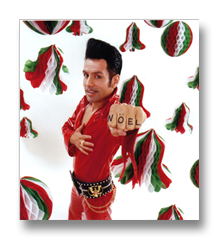
El Vez (stage name of Robert Lopez)
       Mexican-American rock and roll artist
       From his song
“Brown Christmas”


THE CHRISTMAS CHEERS! VERSION:

“I’m dreaming of a white Christmas
But if the white runs out
I’ll drink the red.” 
       A
popular variation I first saw as the caption of this cartoon from the now defunct website YourFunnyStuff.com. It inspired the title of a notebook you can buy for Christmas.


*     *     *     *     *     *     *     *     *     *

Comments? Corrections? Questions? Email me or post them on my Famous Quotations Facebook page.

Christmas parody reading and listening

November 11, 2015

How “God Bless America” created a musical duel between Woody Guthrie and Irving Berlin


In 1917, during World War I, American songwriter Irving Berlin was drafted into the U.S. Army.

He was already a successful songwriter at that point, known for huge hits like “Alexander's Ragtime Band” (1911) and “A Pretty Girl Is Like a Melody” (1915).

Berlin was stationed at Camp Upton in Yaphank, New York. Not long after he arrived, an officer asked if he’d be willing to write a musical show for the soldiers at the base to perform.

Berlin agreed and composed a set of songs for a musical he called Yip-Yip-Yaphank.

He wrote at least eight songs for the show. They included “Oh, How I Hate To Get Up in the Morning,” which later became a hugely popular hit, and several now-forgotten songs, like “Mandy” (a minstrel-style song performed by soldiers in drag and blackface).

One notable song Berlin wrote for Yip-Yip-Yaphank that didn’t make it into the show was titled “God Bless America.” 

Before the musical was performed in July 1918, Berlin decided “God Bless America” was “too solemn.” So, he cut it from the song list, stored his written copy away and forgot about it for twenty years.

Then, in 1938, British Prime Minister Neville Chamberlain’s attempt to appease Adolf Hitler and prevent a second world war ended up bringing the song to light.

Irving Berlin happened to be in London when Chamberlain announced that he and Hitler had signed the “Anglo-German Pact of Friendship,” or “Munich Agreement.” That pact permitted Nazi Germany to annex the part of Czechoslovakia called Sudetenland in return for Hitler’s supposed promise to refrain from any further land grabs and remain at peace with other European countries.

Chamberlain optimistically proclaimed that the agreement had secured “peace for our time.”

Chamberlain’s remark inspired Berlin. He told a friend he wanted to write “a great peace song,” a patriotic song that celebrated America at peace.

After a couple of false starts, Berlin recalled his abandoned song from Yip-Yip-Yaphank. He made some edits to the lyrics and ended up with the song as we know it today. It starts with these familiar lines:

       “God bless America,
       Land that I love,
       Stand beside her and guide her
       Through the night with a light from above.
       From the mountains to the prairies,
       To the oceans white with foam,
       God bless America,
       My home sweet home.”

Berlin gave his patriotic “peace song” to renowned American singer Kate Smith for its initial unveiling.

She debuted it on her popular radio show on November 11, 1938 — the 20th anniversary of Armistice Day, the commemoration of the peace agreement that ended World War I.

Ultimately (and infamously) Chamberlain’s attempt to appease Hitler failed to prevent World War II.

However, “God Bless America” quickly became a major hit, a signature song for Smith and the unofficial American national anthem.

It also rubbed activist-folksinger Woody Guthrie the wrong way.

Irving Berlin and Kate Smith were rich and famous celebrities.

Woody Guthrie was a vocal advocate for low-income Americans and was a poor man himself. He knew from first-hand experience that life in America wasn’t so sweet for most people in late 1930s — the height of the Great Depression.

He felt America needed an anthem for those common folk, instead of a mawkish one that seemed to just wave the flag and ignore the economic problems millions of Americans faced.

So, in 1940, Guthrie wrote a song responding to “God Bless America.” He originally titled it “God Blessed America.”

In the original lyrics, he ended each verse with the words “God blessed America for me.”

And the original last verse had a sardonic twist:

       “One bright sunny morning in the shadow of the steeple
       By the Relief Office I saw my people,
       As they stood hungry, I stood there wondering
       If God blessed America for me.”

Over the next few years, Guthrie reworked the lyrics of the song. It still reflected the viewpoint of working class Americans. But he gave it a more positive spin, changed the line used at the end of the verses and retitled it.

Guthrie recorded that version of the song in 1944. You’ll probably recognize it immediately from the first verse:

“This land is your land, this land is my land
From California to the New York Island
From the Redwood Forest to the Gulf Stream waters
This land was made for you and me.”

That’s right. Woody Guthrie’s well-known song “This Land is Your Land” started out as “God Blessed America,” his musical answer to Irving Berlin. And, ironically, it is now almost as famous and iconic as Berlin’s song “God Bless America.”

*     *     *     *     *     *     *     *     *     *

Comments? Corrections? Post them on the Famous Quotations Facebook Page.

Related listening and reading…

December 25, 2013

The American Christmas classic by a Russian-born Jewish songwriter that ended the Vietnam War…


I like odd facts and there are a number of them about the song “White Christmas.”

First off, this American Christmas classic was written by the Russian-born Jewish songwriter Irving Berlin (who also wrote the classic American anthem “God Bless America”).

Berlin’s original name was Israel Baline. His family emigrated to America in 1893 to escape violent pogroms against Jews and settled in New York City.

By the age of 20, the young immigrant was on his way to becoming one of the greatest songwriters in modern history, under his Americanized name. 

Berlin wrote “White Christmas” sometime in the late 1930s.

Bing Crosby introduced it publicly on his NBC radio show, The Kraft Music Hall, on Christmas Day, December 25, 1941.

But the song first gained true national fame the following year, when it was sung by Crosby in the film Holiday Inn, a musical full of Irving Berlin songs that was released in the US on August 4, 1942.

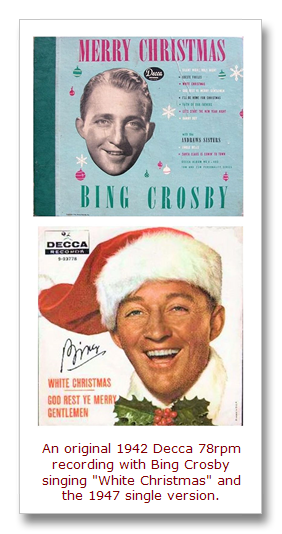
In the fall of 1942, Decca issued the first recording of Crosby singing “White Christmas.”

It became a huge hit and a sentimental favorite of American troops and their families during World War II.

The recording of the song we’re most familiar with today, however, is not the 1942 version.

By 1947, the Decca master of Crosby’s 1942 recording had been used to make so many records that it was literally worn out.

So, on March 19, 1947 Crosby recorded the song for Decca again, with John Scott Trotter and his orchestra.

That version of “White Christmas” went on to become the best-selling single of all time, with estimated sales of more than 50 million copies.

In total, over 100 million copies of 78rpm records, 45rpm singles and albums with Bing’s various renditions of the song have been sold, according to the Guinness Book of World Records.

In 1975, “White Christmas” also had a bizarre role at the end of the Vietnam War.

By April of that year, the United States had pulled most of its troops out of Vietnam and the North Vietnamese were closing in on Saigon.

As part of secret preparations for the evacuation of all remaining American personnel, the American embassy distributed a 15-page booklet to US civilians who were still in the city. It included a map showing where evacuation helicopters would be landing.

A page inserted into the booklet said:

“Note evacuational signal. Do not disclose to other personnel. When the evacuation is ordered, the code will be read out on American Forces Radio. The code is: THE TEMPERATURE IN SAIGON IS 112 DEGREES AND RISING. THIS WILL BE FOLLOWED BY THE PLAYING OF ‘I’M DREAMING OF A WHITE CHRISTMAS.’”

The final panicky evacuation of Saigon is now inglorious history — and the fact that “White Christmas” played a role in it is one more odd thing about the song.

OK, now please sing along with Bing, without panicking:

“I’m dreaming of a white Christmas,
Just like the ones I used to know.
Where the tree-tops glisten
And children listen
To hear sleigh bells in the snow...”

.*     *     *     *     *     *     *     *     *     * 

Comments? Corrections? Post them on the Famous Quotations Facebook page.

Related reading, viewing and listening…

Copyrights, Disclaimers & Privacy Policy


Copyright © Subtropic Productions LLC

All original text written for the This Day in Quotes quotations blog is copyrighted by the Subtropic Productions LLC and may not be used without permission, except for short "fair use" excerpts or quotes which, if used, must be attributed to ThisDayinQuotes.com and, if online, must include a link to http://www.ThisDayinQuotes.com/.

To the best of our knowledge, the non-original content posted here is used in a way that is allowed under the fair use doctrine. If you own the copyright to something posted here and believe we may have violated fair use standards, please let us know.

Subtropic Productions LLC and ThisDayinQuotes.com is committed to protecting your privacy. For more details, read this blog's full Privacy Policy.