Showing posts with label Religion. Show all posts

December 24, 2023

“Silent Night” – the origin and evolving words of the famous Christmas carol...


In 1818, during the annual Christmas Midnight Mass at the St. Nicholas Church at Oberndorf, Austria, the song we know as “Silent Night! Holy Night!” (or just “Silent Night”) was performed in public for the first time.

Most sources say this happened on Christmas Eve, the night of December 24, 1818, though some say it was after midnight on December 25.

The lyrics of the song were written in German by Joseph Mohr (1792-1848), an Austrian Catholic priest who sang tenor during the song’s debut.

The church organist, Franz Gruber (1787-1863), wrote the music.

During that first performance of the song, Gruber accompanied Mohr and the choir on guitar. According to legend, he played a guitar because a mouse had chewed on and damaged the bellows of the church organ.

The original German title of the song — “Stille Nacht! Heilige Nacht!” — is taken from the opening line of the first verse:

      “Stille Nacht! Heilige Nacht!
       Alles schläft; einsam wacht
       Nur das traute heilige Paar.
       Holder Knab im lockigten Haar,
       Schlafe in himmlischer Ruh!
       Schlafe in himmlischer Ruh!”

Today, the familiar English version of this first verse that most of us know is:

      “Silent night! Holy night!
       All is calm, all is bright.
       Round yon virgin mother and child,
       Holy infant so tender and mild.
       Sleep in heavenly peace,
       Sleep in heavenly peace.”

However, it wasn’t until the 20th Century that this version became standard. And, although it’s the only one most people are aware of today, there have actually been many different English translations.

A literal English translation of the German words of the first verse is something like this:

      “Silent night! Holy night!
       All are sleeping, alone and awake
       Only the intimate holy pair,
       Lovely boy with curly hair,
       Sleep in heavenly peace!
       Sleep in heavenly peace!”

The most famous English version of the song was written by American Episcopal Bishop John Freeman Young (1820-1885) and first published in 1859.

Young made up his own words for the middle part of the first verse and for most of the other two verses (of the original six) that he “translated.”

His English adaptation became the one that’s best known. But it wasn’t the first.

According to the authoritative, amazingly detailed history of the song on The Hymns and Carols of Christmas site, an American named J. F. Warner created what is believed to be the oldest English version of Mohr’s German lyrics in 1849.

Warner titled the song “Silent Night! Hallowed Night!”

That makes sense since “hallowed” is one of the possible translations of the German word Heilige. (It can also be translated as awed, blessed, devout, righteous, sacred, saintly, solemn — or holy.)

Warner’s lyrics for the rest of the first verse (and other verses) are, if anything, even more creative “translations” than Young’s.

He started his version of the song this way:

      “Silent night! halllow’d night!
       Land and deep silent sleep,
       Softly glitters bright Bethlehem’s star,
       Beck’ning Israel’s eye from afar,
       Where the Saviour is born,
       Where the Saviour is born.”

Another early English translation that preceded Young’s was written in 1858 by Emily E.S. Elliott. She titled her version of the song “Stilly Night, Holy Night.” Elliott’s lyrics also bear little relation to the original German.

Since then, twenty or so other English versions of “Stille Nacht! Heilige Nacht!” have been created, each with its own unique lyrics.

But at some unknown turning point in the 20th Century, for some unknown reason, Rev. Young’s became the standard.

There’s a good chance you’ve been hearing — and possibly singing — his words this Holiday season.

Merry Christmas, Happy Hanukkah, Happy Kwanzaa and Happy Everything Else from ThisDayinQuotes.com!

*     *     *     *     *     *     *     *     *     *

Comments? Corrections? Questions? Email me or post them on my Famous Quotations Facebook page.

Related listening and reading…


November 12, 2023

The genesis of “the Almighty Dollar” – from Genesis to Washington Irving...


The word almighty, used in connection with God, appears 57 times in the King James Version of the Bible.

Starting in the Book of Genesis, God is variously referred to as “the Almighty God,” “God Almighty” and, most often, simply as “the Almighty.”

The English idiom “the almighty dollar,” which is commonly used to mock the worship of wealth and money, does not come from the Bible.

It was coined in 1836 by the American author Washington Irving, whose best known works include the short stories “The Legend of Sleepy Hollow” and “Rip Van Winkle.”

There is an earlier, similar term. In 1616, the English playwright and poet Ben Jonson used the term “almighty gold” in his poem “Epistle to Elizabeth, Countess of Rutland.”

But the more familiar “almighty dollar” first appeared in a travel story Irving wrote about a steamboat trip he took through the Louisiana bayous.

The story, titled “The Creole Village,” was originally published in the November 12, 1836 issue of Knickerbocker Magazine.

Irving was impressed by the laid back lifestyle of the Creole people who lived in Louisiana’s bayou country and by how unconcerned they seemed (at least to him) about making or having money.

He wrote in his travel piece:

“The inhabitants, moreover, have none of that eagerness for gain and rage for improvement which keep our people continually on the move...In a word, the almighty dollar, that great object of universal devotion throughout our land, seems to have no genuine devotees in these peculiar villages; and unless some of its missionaries penetrate there, and erect banking houses and other pious shrines, there is no knowing how long the inhabitants may remain in their present state of contented poverty.”

Near the end of the piece, Irving opined:

“As we swept away from the shore, I cast back a wistful eye upon the moss-grown roofs and ancient elms of the village, and prayed that the inhabitants might long retain their happy ignorance, their absence of all enterprise and improvement, their respect for the fiddle, and their contempt for the almighty dollar.”

I suspect this romantic vision overestimated how content the locals were to be poor.

Of course, in 1855, when “The Creole Village” was included in a collection of his stories called Wolfert’s Roost, Irving made it clear that he had meant no offense — to the almighty dollar, that is.

In a satirical footnote in that book (later included in larger Irving anthologies like The Crayon Miscellany), Irving wrote:

“This phrase [the almighty dollar], used for the first time in this sketch, has since passed into current circulation, and by some has been questioned as savoring of irreverence. The author, therefore, owes it to his orthodoxy to declare that no irreverence was intended even to the dollar itself; which he is aware is daily becoming more and more an object of worship.”

*     *     *     *     *     *     *     *     *     *

Comments? Corrections? Email me or Post them on the Famous Quotations Facebook page.

RELATED READING AND LISTENING (Click on an image to see that item on Amazon)

81qAbC-cBdL._SY466_  Clipboard Image   71IdWyOUWwL._SY466_   Clipboard Image (1)   Clipboard Image (2)   Clipboard Image (3)

August 20, 2023

“Love me, love my dog.”


In the Catholic religion, August 20 is the Feast Day of
Saint Bernard of Clairvaux, a medieval French monk who died on that date in 1153 A.D.

I’m not a Catholic. But as a dog lover and a quote lover, I’m a big fan of St. Bernard, because he’s the guy who immortalized a saying that’s now best known in the modernized form “Love me, love my dog.”

The older versions of this saying, cited by many books and websites, are “Who loves me, loves my dog” and “He who loves me, also loves my dog.”

Those are the more traditional and more grammatically correct translations of something Bernard said in a sermon he once gave on another Catholic feast day — the Feast of St. Michael the Archangel, celebrated annually on September 29.

St. Bernard’s famous dog quote from that sermon was originally recorded in Latin as “Qui me amat, amat et canem meum.” (Back then, it was common for monks to use Latin for their written records and to deliver sermons in Latin to other monks.) 

The full sentence this quote comes from is “Dicitur certe vulgari proverbio: Qui me amat, amat et canem meum” which translates as “It is said truly in a common proverb: who loves me, also loves my dog.”

This makes it clear that Bernard was quoting an existing proverb. He didn’t actually coin it himself. But his use became famous and helped popularize the saying.

Contrary to what some people assume, St. Bernard of Clairvaux is not the Catholic saint associated with Saint Bernard dogs.

They were named after Saint Bernard of Menthon (a.k.a. Bernard of Montjoux), a different Catholic monk who died in 1008 A.D.

That St. Bernard established a monastery and hospice high up in the Alps. Over the centuries, the monks who lived there became famous for their efforts to rescue lost and injured travelers and for the large herding dogs they bred and trained to assist in their search and rescue missions. Since the 1700s, those dogs have been called Saint Bernards.

It’s not clear whether St. Bernard of Menthon or St. Bernard of Clairvaux were especially fond of dogs themselves.

St. Bernard of Menthon is the patron saint of skiing, not dogs or dog lovers. And, the breed of dogs named in his honor was developed by his followers after his death.

St. Bernard of Clairvaux is the patron saint of bees, beekeepers and candle-makers, apparently because Pope Pius VIII nicknamed him the “Honey-Sweet Doctor” for his honey-sweet style of preaching and writing.

And, for the record, the topic of the sermon by St. Bernard of Clairvaux that includes the words now paraphrased as “Love me, love my dog” wasn’t actually about canines. It was about angels and their love for humanity.

Bernard’s brief reference to dogs in the sermon was part of a metaphorical point he was making.

If you read (or use an online translator to decipher) the Latin transcription of his sermon, you find that he was comparing the relationship between dogs and people to the relationship between humans and Jesus.

“The holy angels...love us, in fact, because Jesus Christ loved us,” Bernard said in Paragraph 3 of the sermon. “It is said truly in a common proverb: who loves me, also loves my dog...We are the little dogs of the Lord...yes, like small dogs that want to feed on the crumbs that fall from the table of our masters.”

In case you’re wondering, there is a Catholic patron saint of dogs. His name is Saint Roch and his feast day is August 16.

According to legend, in the 13th century, Roch became gravely ill after ministering to plague victims and went off into the woods to die.

His life was saved by a dog from a nearby home. The dog accidentally found Roch, then brought him food to eat every day and licked his sores until he recovered.

I particularly like that legend because it fits my view that the creatures appropriately called “man’s best friend” are among the true saints of this world.

*     *     *     *     *     *     *     *     *     *

Comments? Corrections? Questions? Email me or post them on my Famous Quotations Facebook page.

Related reading and stuff…

April 30, 2023

The stirring words of Haile Selassie that Bob Marley used for the song “War”…

Important Utterances of H.I.M Emperor Haile Selassie
On October 4, 1963, Haile Selassie I, Emperor of Ethiopia, gave a speech to the United Nations General Assembly that includes a famous quotation you almost surely know if you’re a fan of the late, great Reggae musician Bob Marley.

Selassie’s speech provided the basis for one of Marley’s most popular songs, titled “War.”

It’s included on the classic Bob Marley & the Wailers album, Rastaman Vibration, released by Island Records on April 30, 1976.

Here’s are key words from the speech that Bob Marley incorporated into the lyrics of his song and made familiar to millions of people:

     “Until the philosophy which holds one race superior and another inferior is finally and permanently discredited and abandoned...Until there are no longer first class and second class citizens of any nation...Until the color of a man’s skin is of no more significance than the color of his eyes...Until the basic human rights are equally guaranteed to all without regard to race…Until that day, the dream of lasting peace...will remain but a fleeting illusion, to be pursued but never attained.”

Until the day when racism no longer exists, Marley sings at the end of the verses, there will be “War…Me say war.”

In 1963 and 1976, the word war literally meant armed rebellions by oppressed black people in countries like South Africa, Angola and Mozambique. But in my own mind, and I think in the minds of other Marley fans, it has also taken on a more symbolic meaning; a word that can also be used describe nonviolent protests and actions against injustice and inequality.

As a fan of Bob Marley since the late ‘70s, I’ve listened to “War” many times. It still awes and inspires me to hear Bob and the Wailers sing it or see them perform it in videos on YouTube.

However, while I am no expert on “H.I.M.” (His Imperial Majesty) Haile Selassie, I have read enough to know that his record as Emperor of Ethiopia includes some things that can seem at odds with the concept of equal rights and justice.

Selassie was born in 1892 into Ethiopia’s royal family, which practiced the Ethiopian Orthodox version of Christianity and traced the family’s origins back to King Solomon of Israel and Makeda, Queen of Sheba.

His birth name was Tafari Mkonnen. As a young nobleman he was called “Ras Tafari” – the title “Ras” roughly translating as “Duke” in English.

This became the inspiration for the name of the Rastafari movement created in 1933 by Jamaican preacher Leonard Percival Howell, whose teachings combined Pan Africanism and Ethiopian Orthodox Christianity with the use of the “sacred herb” — ganja.

Howell believed that Tafari was the “Black Messiah,” an incarnation of God on Earth, the “Dread Lion” of Judah, King of Kings, predicted by Biblical prophecy. To Howell and his followers, Tafari’s coronation as Emperor was the realization of that prophecy.

Tafari ascended to the throne in 1930, though not peaceably. He had to use his family’s army to defeat that of a rival royal family at the Battle of Anchem.

Once in control of the throne, he took the name Haile Selassie, meaning “Power of the Trinity.”

Although it’s hard to think of any absolute monarchy as a bastion of freedom, he did take steps in what most people would think of as a positive direction. For example, he introduced Ethiopia’s first written constitution in 1931. It ensured some basic rights for most Ethiopian citizens and created a bicameral legislature.

Selassie portrayed it as a transitional stage to democracy. However, it kept most real political power in the hands of the Emperor and Ethiopia’s major landowning families and did not lead to the abolition of slavery in the country. This was not a minor human rights issue, given that Ethiopia had an estimated two million slaves — in this case, black people kept as “vassals” by wealthy black people — out of a population of about eleven million.

Nonetheless, the reforms Selassie pursued and his efforts to modernize Ethiopia’s infrastructure and encourage education, made him seem like a relatively enlightened and progressive African leader to observers in Western countries and the Caribbean. And, his fame increased in the years leading up to Word War II.

During Selassie’s youth, Italy controlled the area north of Ethiopia called Eritrea. In 1896, Italy attempted to expand its control southward. This led to the Battle of Adwa, in which Ethiopia’s army defeated Italy’s colonial forces.

In 1935, Italy’s Fascist dictator Benito Mussolini, ally of Nazi Germany, had his modern army invade Ethiopia. This time the Italians prevailed.

Haile Selassie fled to England. Several months later, on June 20, 1936, he addressed the League of Nations, forerunner of the United Nations. In his speech, Selassie asked Westerns nations and other League members to help Ethiopia overthrow its Italian invaders. He warned, prophetically, “It is us today, it will be you tomorrow.”

Bob Marley & the Wailers singing 'War' liveThe speech made Selassie an even bigger celebrity. TIME magazine named him “Man of the Year” and featured him on the cover of the January 6, 1936 issue.

But neither the League of Nations nor its members helped Ethiopia fight Italy — until Selassie’s prediction came true and Western democracies were battling Nazi Germany and Italy themselves during World War II.

In 1941, British forces liberated Ethiopia. Selassie returned to the throne. To his credit, one of his first actions upon regaining power was to outlaw slavery.

After World War II, he was a leader in efforts to help African countries transition to independence from European colonial rule.

Toward that end, Selassie brought representatives of 32 African governments together in 1963 to form the Organisation of African Unity (OAU).

At the initial OAU Conference held in Ethiopia’s capital Addis Ababa in May 1963, the group’s members pledged to increase cooperation among African states to improve the lives of people throughout Africa and eliminate the last bastions of colonialism in South Africa, Angola and Mozambique.

Selassie was also a leading promoter of Pan Africanism, which fostered a sense of unity and pride among black people throughout the world whose ancestors were taken from Africa as slaves.    

For these and other reasons, from the ‘30s to the ‘70s Selassie was increasingly viewed as a towering hero in Africa and the Caribbean islands.

He was particularly popular in Jamaica among members of the Rastafarian movement, which had grown considerably in the 1960s.

Selassie was aware of the Rastafarians. But he didn’t visit Jamaica until April 21, 1966.

When he landed at the Kingston airport that day, he was surprised to find an estimated one hundred thousand Rastafarians from throughout the country had gathered in Kingston to see him.

One of them was Alpharita “Rita” Marley, who had married Bob two months previously.

Rita was into Rastafarianism before Bob. But he, too, became a knowledgeable and devoted Rastafarian, eventually the most famous Rasta on the planet. Among the things he read about Haile Selassie that inspired him was the eloquent speech the Emperor gave to the United Nations on October 4, 1963, five months after the OAU’s Addis Ababa Conference.

In that remarkable speech, Selassie urged the United Nations and its members to work together to stop the nuclear arms race and take a stand against the apartheid government in South Africa and racism in general.

Selassie chose to give the speech in his native language, Amharic.

It was later translated into English by the Imperial Ethiopian Ministry of Information, and published in the 1972 book Important Utterances Of H.I.M. Emperor Haile Selassie I, a seminal source for Rastafarians.

Bob Marley lyrics to the song WAR In English, the key part of Selassie’s speech that inspired Bob Marley’s song “War” is as follows.

“On the question of racial discrimination, the Addis Ababa Conference taught, to those who will learn, this further lesson:    
     that until the philosophy which holds one race superior and another inferior is finally and permanently discredited and abandoned;    
     that until there are no longer first class and second class citizens of any nation;    
     that until the color of a man's skin is of no more significance than the color of his eyes;    
     that until the basic human rights are equally guaranteed to all without regard to race;    
     that until that day, the dream of lasting peace and world citizenship and the rule of international morality will remain but a fleeting illusion, to be pursued but never attained.    
     And until the ignoble and unhappy regimes that hold our brothers in Angola, in Mozambique and in South Africa in subhuman bondage have been toppled and destroyed;    
     until bigotry and prejudice and malicious and inhuman self-interest have been replaced by understanding and tolerance and good will;    
     until all Africans stand and speak as free beings, equal in the eyes of all men, as they are in the eyes of Heaven;    
     until that day, the African continent will not know peace. We Africans will fight, if necessary, and we know that we shall win, as we are confident in the victory of good over evil.”

Those words, turned into lyrics and set to music by Marley, are incredibly eloquent and stirring.

Given the events that occurred in Ethiopia between 1963 and Selassie’s death in 1975, they are also somewhat ironic.

During his final decade as Emperor, human rights groups criticized Selassie’s regime for suppressing civil liberties and torturing political prisoners.

His army was charged with committing shocking atrocities against rebels who wanted independence for Eritrea, which Selassie had absorbed into Ethiopia after World War II with the approval of the Western Allies and United Nations — but against the will of most people living there.

Those atrocities reportedly included mass slaughters of civilians during late ‘60s and early ‘70s, later described as an attempt at the “ethnic cleansing” of the Muslim Harari people of Eritrea.

In 1974, a famine in Ethiopia killed tens of thousands of people. Skyrocketing inflation led to riots.

That September, Selassie was overthrown and imprisoned by a Soviet-backed group of Marxists called the Derg.

The following year, on August 28, 1975, the Ethiopian state media reported that Haile Selassie had died of “respiratory failure” at age 83 following complications from a prostate operation. His followers believed he had been murdered.

The Derg imposed a brutal Communist dictatorship on Ethiopia that was far worse than Selassie’s regime. When they were ousted by an armed revolt in 1991, Selassie’s bones were found on the palace grounds. For the next nine years they were kept in a coffin in a local church.

One November 5, 2000, the Ethiopian Orthodox church held an imperial-style funeral for Selassie. One of the people who attended was Rita Marley.

Her husband Bob, the Rasta who made Selassie’s UN speech a musical anthem, had died of cancer in 1981.

In the intervening years Rita and Bob’s sons and daughters mastered the music business in ways Bob probably never dreamed of and turned his musical legacy into a worldwide multi-faceted business empire.

One part of that legacy is the song “War,” which has helped make millions of people who know little or nothing about Haile Selassie familiar with his most famous quotation.

*     *     *     *     *     *     *     *     *     *    

Comments? Corrections? Post them on my Famous Quotations Facebook page or send me an email.

Related reading and listening…


February 24, 2023

“Man is descended from a hairy, tailed quadruped.”


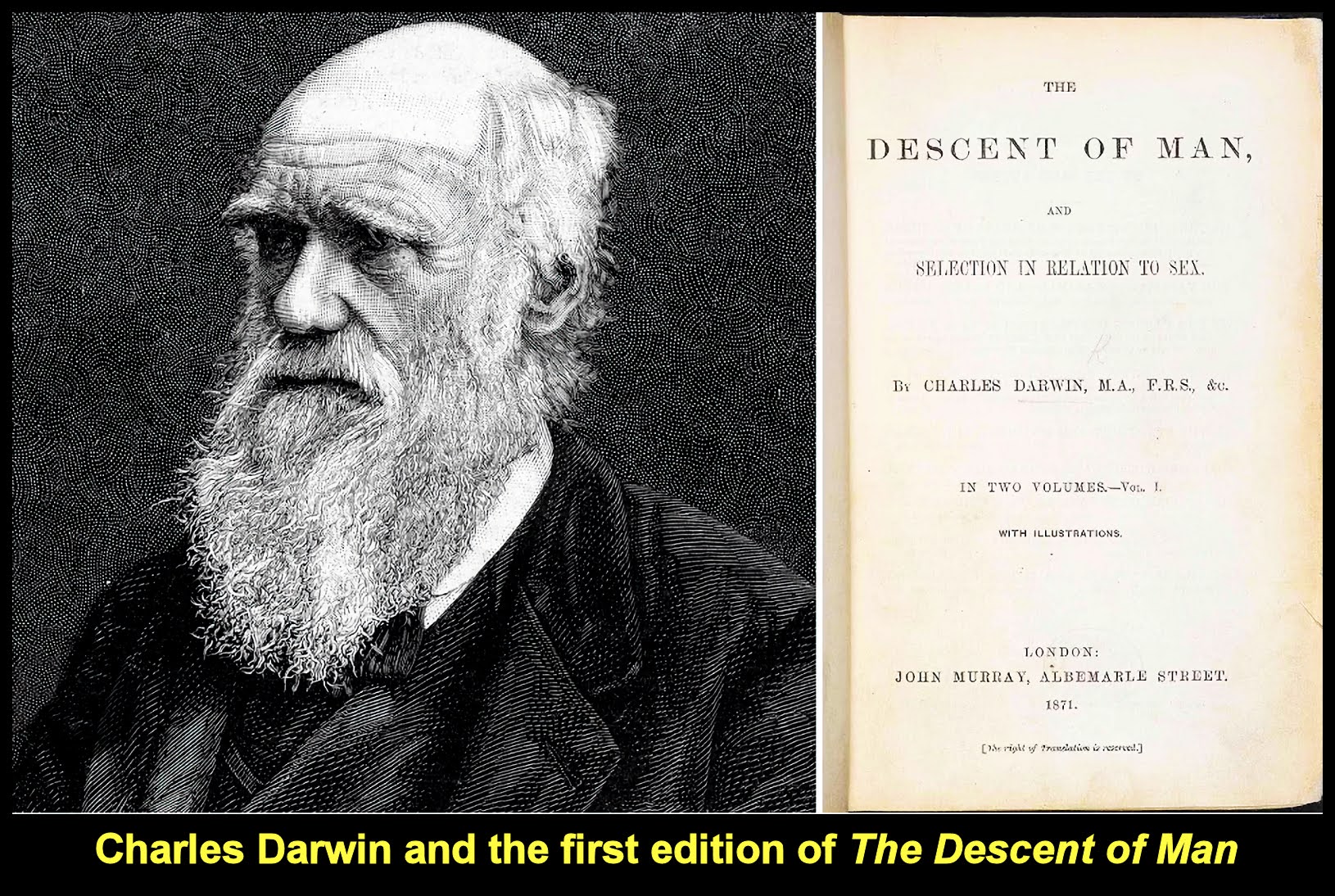
The publication of Charles Darwin’s book On the Origin of Species in 1859 helped launch the modern science of evolution.

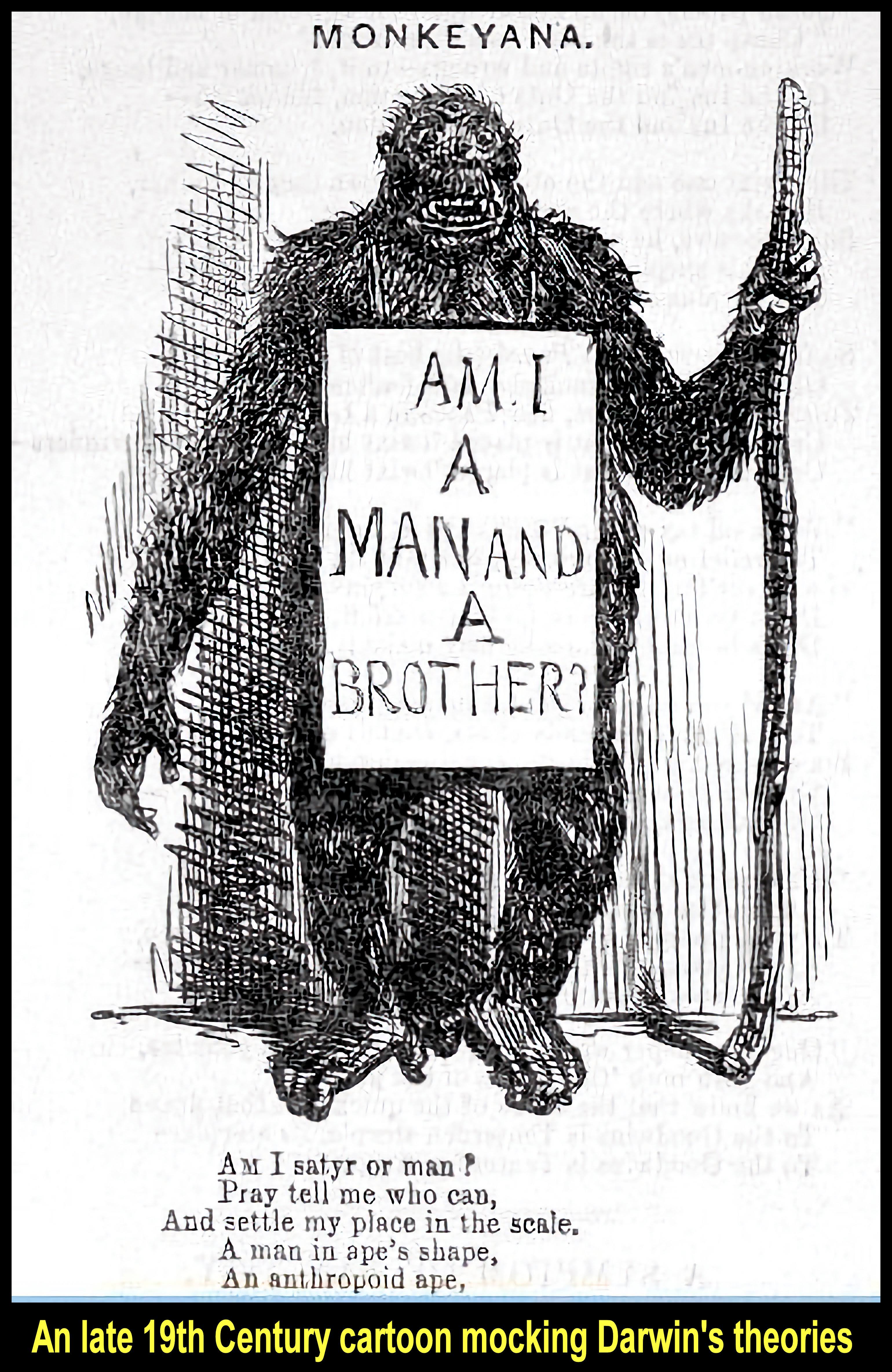
It also created a firestorm of controversy, by suggesting that all species — including homo sapiens — evolved from “lower” life forms.

However, Darwin did not explicitly state that humans evolved from ape and monkey-like precursors in On the Origin of Species.

He saved that bombshell for his next major work, The Descent of Man, which was first published in London on February 24, 1871.

The final chapter of that book, Chapter XXI—MAURITIUS TO ENGLAND, contains Darwin’s famous (and infamous) statement:

       “We thus learn that man is descended from a hairy, tailed quadruped, probably arboreal in its habits, and an inhabitant of the Old World.” 

There were— and still are— some people who are unwilling to accept the theory of evolution because it conflicts with their religious beliefs.

But from a scientific perspective, Darwin’s basic conclusions have withstood the test of time.

That’s not to say he got everything right.

Over the past 140 years, other scientists have determined that some things Darwin postulated were wrong.

Thus, like every science, the science of evolution has evolved.

Darwin himself predicted this would happen.

In the preface to the Second Edition of The Descent of Man, published in 1874, he noted:

       “It is probable, or almost certain, that several of my conclusions will hereafter be found erroneous; this can hardly fail to be the case in the first treatment of a subject.”

One of Darwin’s conclusions that’s still accepted as a basic fact by scientists is that “man is descended from a hairy, tailed quadruped.”

That’s also one of the things that is most vehemently rejected by Darwin’s religious critics.

They believe God created humans and everything else and that “Darwinism is atheism.”

As explained on the excellent AboutDarwin.com website, Darwin called himself an agnostic, not an atheist.

He felt that God’s existence was outside the realm of scientific research.

Near the end of his life, Darwin put it this way:

       “I cannot pretend to throw the least light on such abstruse problems. The mystery of the beginning of all things is insoluble to us.”

One thing is clear…

Darwin’s Descent of Man both shed lasting light on and generated lasting heat over the topic of human evolution.

*     *     *     *     *     *     *     *     *     *

Comments? Corrections? Questions? Email me or post them on my Famous Quotations Facebook page.

Related reading and listening…

July 02, 2022

“There, but for the grace of God, goes John Bradford.”


It is often claimed that the familiar expression of compassion “There, but for the grace of God, go I” is based on a quote by the 16th Century English Protestant clergyman John Bradford.

According to tradition, Bradford was a prisoner in the Tower of London when he said it.

He had previously been a prominent supporter of the religious reforms imposed by King Edward VI, which essentially banned Catholicism in England and established the Protestant Church of England as the country’s official religion.

Part of this “reformation” involved jailing or executing Catholic clergymen who weren’t willing to go along with the change.

After Edward died in 1553, Mary I (a.k.a. “Bloody Mary” Tudor) took the throne in England and forcefully reimposed Catholicism.

That involved jailing or executing Protestant clergymen who weren’t willing to go along with the change.

One of them was John Bradford, who refused to acknowledge the authority of the Pope and was convicted of “trying to stir up a mob.”

Queen Mary had Bradford locked up in the Tower of London with other notable Protestant leaders, such as Archbishop Thomas Cranmer.

One day while there, legend has it, Bradford looked down and saw a criminal being led to execution. (In some versions of the story, it’s a group of criminals.)

Simultaneously feeling compassion for the criminal and relief that he was better off, Bradford allegedly uttered the famous quotation “There, but for the grace of God, goes John Bradford.”

This quote has long been cited as the origin of the proverbial saying “There but for the grace of God go I.”

This was memorably modernized as “There but for fortune go you or I” by Sixties folksinger Phil Ochs, in his much-covered song “There But for Fortune.”           

It should be noted that modern quote and phrase sleuths have been unable to find any documentation that Bradford actually said anything like the quote he’s alleged to have said.

The traditional story of Bradford’s famous quotation appears to come from biographies written about him in the 1800s, centuries after he was dead.

There’s no record of such a quote in historical records from Bradford’s own time and no such words in his writings.

Nonetheless, “There but for the grace of God goes John Bradford” is included as an attributed quote in many books of quotations. (It’s sometimes given as “But for the grace of God there goes John Bradford.”)

The association this questionable quote has with the date July 1 is ironic.

The usual explanation of the quote’s meaning is that Bradford was expressing sympathy for the soon-to-be-executed criminal (or criminals) and suggesting that, except for God’s mercy, he might be sharing the same fate.

As it turned out, Bradford’s final fate actually was the same. Maybe worse, depending on how the criminal(s) got snuffed.

On July 1, 1555, Queen Mary had Bradford burned at the stake.

*     *     *     *     *     *     *     *     *     *

Comments? Corrections? Questions? Email me or post them on my Famous Quotations Facebook page.

Related reading, listening and viewing…

Copyrights, Disclaimers & Privacy Policy


Copyright © Subtropic Productions LLC

All original text written for the This Day in Quotes quotations blog is copyrighted by the Subtropic Productions LLC and may not be used without permission, except for short "fair use" excerpts or quotes which, if used, must be attributed to ThisDayinQuotes.com and, if online, must include a link to http://www.ThisDayinQuotes.com/.

To the best of our knowledge, the non-original content posted here is used in a way that is allowed under the fair use doctrine. If you own the copyright to something posted here and believe we may have violated fair use standards, please let us know.

Subtropic Productions LLC and ThisDayinQuotes.com is committed to protecting your privacy. For more details, read this blog's full Privacy Policy.