Showing posts with label TV quotes. Show all posts

October 11, 2023

“Live from New York, it’s Saturday Night!” (and finger-eating wolverines)


On October 11, 1975, at 11:30pm Eastern Time, a new TV comedy show debuted on the NBC network.

It opened with a wacky skit featuring three comic actors who were virtually unknown at the time.

In the skit, a frumpy-looking East European immigrant with a heavy accent is being tutored on how to speak proper English by a well-dressed teacher.

They are sitting in comfortable chairs next to each other in a small room.

The teacher starts a repeat-after-me type lesson with an unusual language exercise about wolverines…

       TEACHER: “Let us begin. Repeat after me. I would like...”

       IMMIGRANT: (With a noticeable accent.) “I wude like...”

       TEACHER: “...to feed your fingertips...”

       IMMIGRANT: “...to feed yur fingerteeps...”

       TEACHER: “...to the wolverines.”

       IMMIGRANT: “...to de woolvur-eenes.”

After a couple more odd exercises about wolverines and badgers (or, “woolvur-eenes” and “bed-jurs” as the immigrant pronounces them), the teacher suddenly gasps, clutches his chest and falls to the floor, apparently dead from a heart attack.

The European immigrant looks confused for a moment.

Then he gasps, clutches his chest and falls to the floor, copying the professor.

Next, a Stage Manager walks into the scene, smiles into the camera and says, for the very first time, what would soon be a well-known line:

       “Live from New York, it’s Saturday Night!”

The three not-yet-famous comedians in the skit were: John Belushi a former Second City improv performer who went on to become one of the most beloved comic actors in the world prior to his tragic death in 1982 from an apparent drug overdose; Michael O'Donoghue, a former National Lampoon magazine writer picked as head writer for the new show (who died of a cerebral hemorrhage in 1994 at age 54); and, the fortunately still living comic legend, Chevy Chase, who was best known at the time as a cast member of the National Lampoon Radio Hour.

All three were among the amazingly talented group of original cast members of the show, which was officially titled NBC’s Saturday Night when it started airing in 1975, but soon came to be called Saturday Night Live, or SNL for short.

The revolving, evolving group of comic actors who performed comedy sketches on NBC’s new Saturday Night series were collectively dubbed the “Not Ready for Prime Time Players.”

The voice heard after Chevy Chase on the historic first episode was that of longtime television show announcer Don Pardo, reading the names of the performers who would be appearing (a function he continued on SNL until his death in August 2014). The first host was my favorite curmudgeon, the great George Carlin (1937-2008).

I was watching the premiere of SNL that night and watched the show almost every weekend for nearly 20 years. Nowadays, I record the show on DVR and watch the opening long enough to hear the famed line “Live from New York, it’s Saturday Night!”

I check out who the guest host and musical guest will be. Then I usually fast forward a lot, though skits that rarely strike me as funny as anything done by the early “Not Ready for Prime Time Players.” I often have no idea who the guest hosts or musical performers are and don’t understand most of the jokes that include current pop culture references.

Yep, I’m nearly as old as John Belushi would have been if he’d survived his oversized lust for life and I’m nearly as much of a curmudgeon as George Carlin. I miss them both.

Of course, there are some things I do like about the modern world. For example, I can now rewatch old episodes of Saturday Night Live any time I want as streaming video on my iPad.

And whenever I get nostalgic and rewatch the opening skit that turned the lines “I would like to feed your fingertips to the wolverines” and “Live from New York, it’s Saturday Night” into catchphrases, it still cracks me up.

*     *     *     *     *     *     *     *     *     *

Comments? Corrections? Questions? Email me or post them on my Famous Quotations Facebook page.

Related viewing, reading and listening…

April 24, 2023

“Yada Yada Yada…”

Yada Yada quote Seinfeld

During its long, successful original run on NBC, from 1989 to 1998, the Seinfeld TV show created or popularized many catchphrases.

Some of the best known are:
       ● the famed snub of the “Soup Nazi,” “No soup for you!”
       ● the sexual euphemism “master of your domain”
       ● the food-related faux pas term “double dip”
       ● and, the handy denial of prejudice, “Not that there's anything wrong with that.”

My own favorite Seinfeld catchphrase is “Yada yada yada.”

It was first used in the episode that originally aired on April 24, 1997, appropriately titled “The Yada Yada” (Season 8, Episode 19).

In that episode, the phrase is initially used by the character Marcy (played by Suzanne Cryer), a girlfriend of George Costanza (Jason Alexander), while she’s talking to George and Jerry Seinfeld.

The conversation goes like this:

MARCY:  You know, a friend of mine thought she got Legionnaire’s Disease in the hot tub.
GEORGE:  Really? What happened?
MARCY:  Oh, yada yada yada, just some bad egg salad. I'll be right back. (She gets up)
JERRY:  I noticed she’s big on the phrase “yada yada.”
GEORGE:  Is “yada yada” bad?
JERRY:  No, “yada yada” is good. She’s very succinct.
GEORGE:  She is succinct.
JERRY:  Yeah, it’s like you’re dating
USA Today.

As the episode proceeds, almost all the characters start using “yada yada yada” (or sometimes just “yada” or “yada yada”) as a way to gloss over and shorten descriptions of things, much like people use “et cetera, et cetera” or “blah blah blah” or “and so on, and so forth.”

I think one of the funniest uses is by George.

It’s in a scene now immortalized on YouTube under the title “George Costanza Life Story.”

MARCY:  So I'm on Third Avenue, minding my own business and, yada yada yada, I get a free massage and a facial.
GEORGE:  Wow. What a succinct story.
MARCY:  I’m surprised you drive a Cadillac.
GEORGE:  Oh, it’s not mine. It’s my mother’s.
MARCY:  Oh. Are you close with your parents?
GEORGE:  Well, they gave birth to me, and, yada yada.
MARCY:  Yada what?
GEORGE:  Yada yada yada…

“The Yada Yada” script was written by veteran TV writer and producer Steve Koren, a former member of the Saturday Night Live writing team who wrote or co-wrote dozens of other Seinfeld episodes. He also scripted a number of popular movies, including Bruce Almighty, Click, Superstar and A Night at the Roxbury.

Koren didn’t coin the phrase “yada yada yada.”

But the origin is still being debated by linguists and etymology buffs.

Some believe it is Jewish-American “Yiddish” slang that may have descended from the Hebrew word “yada” or “yadaa,” which means tell, know or show.

Other language mavens think the Yiddish/Hebrew theory is totally fakakta.

The renowned Oxford English Dictionary contributor Barry Popik cites a list of possible precursors from the English language on his excellent Big Apple site.

The OED itself suggests that “yada” may have been derived from the British word “yatter,” meaning mindless chatter.

A Norwegian source has also been postulated.

In the Norwegian language, the letter J is pronounced as Y. So, the Norwegian word “jada,” meaning “yeah,” is pronounced as “yada.” And, “jada jada jada” is used by Norwegians in the same disbelieving or dismissive way English-speaking people use “yeah yeah yeah.” (As in, “Yeah, sure.”)

The bottom line when you read all the yada yada yada in the various theories is that the linguistic origin is uncertain.

What is certain is that the Seinfeld show gets and deserves the credit for making “yada yada yada” familiar to millions of people.

And, although the one and only appearance of the character Marcy in the Seinfeld show was in “The Yada Yada” episode of Season 8, she gets the credit for being the first Seinfeld character to use that now immortal catchphrase.

*     *     *     *     *     *     *     *     *     *

Comments? Corrections? Questions? Email me or post them on my Famous Quotations Facebook page.

Related reading, listening and swag…

October 17, 2021

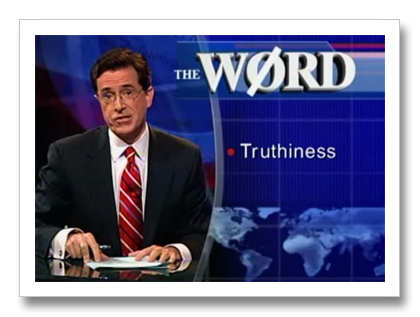
True or false: Stephen Colbert coined the word truthiness? (Hint: you’re right!)


During the very first Colbert Report show on October 17, 2005, the witty faux Conservative media pundit Stephen Colbert unleashed the word truthiness on the world. (Click here to see the video on the Colbert Nation website.)

He introduced it like this:

“On this show your voice will be heard...in the form of my voice. ‘Cause you’re looking at a straight-shooter, America. I tell it like it is. I calls ‘em like I sees ‘em. I will speak to you in plain simple English.

And that brings us to tonight's word: Truthiness.

Now I’m sure some of the Word Police, the wordanistas over at Webster’s, are gonna say, ‘Hey, that’s not a word.’ Well, anybody who knows me knows that I’m no fan of dictionaries or reference books. They’re elitist. Constantly telling us what is or isn’t true, or what did or didn’t happen. Who’s Britannica to tell me the Panama Canal was finished in 1914? If I wanna say it happened in 1941, that’s my right. I don't trust books. They’re all fact, no heart.”

In that brilliant bit, Colbert captured the nature of modern political rhetoric and punditry. Indeed, it has only become more “truthy” since 2005.

Nowadays, it doesn’t seem to matter much what “the truth” is.

Whatever is consistent with what someone believes is what they consider to be a “fact.” Whatever confirms their views is their “truth.”

For example, as a huge fan of Stephen Colbert, I believe he coined the word truthiness.

Oh sure, there are some elitist egghead language experts who have noted that the word truthiness already existed before Colbert uttered it and that uses of the word date back to the early 1800s.

Indeed, there’s a series of posts about this on the Language Log, a popular hangout for snooty linguists.

The so-called “facts” in those posts supposedly “prove” Stephen Colbert may have popularized the word truthiness but didn’t actually coin it.

The wordanista who started pushing this absurd claim appears to be Ben Zimmer, producer of the Visual Thesaurus and Vocabulary.com, language columnist for The Boston Globe and former “On Language” columnist for The New York Times.

As Colbert might say [loudly, while shaking his fist], “Damn you, Zimmer!”

No verifiable proof will shake my belief in the truthiness of my belief that Stephen Colbert coined the word truthiness!

*     *     *     *     *     *     *     *     *     *

Comments? Corrections? Questions? Email me or post them on my Famous Quotations Facebook page.

 Related reading and viewing…

October 02, 2021

OCTOBER 2 - The day we crossed over into The Twilight Zone


On the evening of October 2, 1959, CBS aired the first episode of a new television series created by Rod Serling called The Twilight Zone.

It became one of the most popular TV shows ever made and is still shown in reruns.

The name of the series itself became an idiomatic term to describe a situation that seems weird and strange. And, lines and phrases from the introductions spoken by Serling at the opening of the show became famous.

During the show’s original five year run, Serling’s opening lines changed several times.

His voiceover during the animated title sequence used for the first episode and other early Season One episodes goes like this:

“There is a fifth dimension beyond that which is known to man. It is a dimension as vast as space and as timeless as infinity. It is the middle ground between light and shadow, between science and superstition, and it lies between the pit of man’s fears and the summit of his knowledge. This is the dimension of imagination. It is an area which we call the Twilight Zone.”

During the last four episodes of Season One, Serling recites a different intro that ends with a line about the “next stop”:

“You are about to enter another dimension, a dimension not only of sight and sound but of mind. A journey into a wondrous land of imagination. Next stop, the Twilight Zone!”

Serling came up with yet another beginning for his intros in Season Two, though its ending kept the “next stop.” During the first three episodes of Season Two he said:

“You're traveling through another dimension, a dimension not only of sight and sound but of mind. A journey into a wondrous land of imagination. Next stop, the Twilight Zone!”

Starting with the fourth episode of Season Two, Serling modified that intro a bit by adding the famed “signpost” ending:

“You’re traveling through another dimension, a dimension not only of sight and sound but of mind. A journey into a wondrous land whose boundaries are that of imagination. That’s the signpost up ahead. Your next stop, the Twilight Zone!”

Serling’s intro for the episodes in Season Three was similar but had a different ending. He says:

“You are traveling through another dimension, a dimension not only of sight and sound but of mind. A journey into a wondrous land whose boundaries are that of imagination. Your next stop, the Twilight Zone!”

During Seasons Four and Five, Serling used an intro that mixed new opening and ending language with a few words and phrases from previous versions. During the final two seasons of the original series, he introduces the episodes by saying:

“You unlock this door with the key of imagination. Beyond it is another dimension — a dimension of sound, a dimension of sight, a dimension of mind. You're moving into a land of both shadow and substance, of things and ideas. You've just crossed over into the Twilight Zone.”

The haunting theme music most fans think of as the music for The Twilight Zone wasn’t used until Season Two.

That opening music begins with the nervous-sounding staccato notes some fans (like me) jokingly mimic with their voices when something is spooky: “dee-dee-dee-dee / dee-dee-dee-dee.” It was written by avant-garde French composer Marius Constant.

Constant’s version was used for Seasons Two through Five of the original series and, with re-recorded elements, for later iterations of The Twilight Zone, including the 1983 movie, the 1985 series, the 2002 series, and the 2019 series. That’s why it seems so familiar.

The original opening music used during the first season was also eerie, but different. It was written by legendary soundtrack composer Bernard Herrmann, creator of many memorable film scores, like the music for Psycho (1960).

The star of the premiere episode of The Twilight Zone was Earl Holliman.

Holliman appeared in scores of movies and TV shows, but he’s best remembered for his portrayal of the male cop partnered with Angie Dickinson in the TV police drama Police Woman during its run from 1974 to 1978.

The first Twilight Zone episode is titled “Where Is Everybody?” In it, Holliman plays a man in an Air Force jumpsuit who inexplicably finds himself in a town where all the people have disappeared.

Just in case you haven’t seen “Where Is Everybody?” I won’t say any more about the plot or the final twist at the end (an element that became a hallmark of the show).

And, if you haven’t seen it but want to after you read this post, here’s a link to watch it on Vimeo.

*     *     *     *     *     *     *     *     *     *

Comments? Corrections? Questions? Email me or post them on my Famous Quotations Facebook page.

Related reading, listening, and viewing…

September 15, 2021

On today’s date, the Vulcan blessing “Live long and prosper” became part of our Earthly language…


You don’t have to be a full-fledged Trekkie to be familiar with the “Vulcan blessing” from Star Trek “Live long and prosper” — or with the splay-fingered “Vulcan salute” that is generally used when that saying is spoken.

Actor Leonard Nimoy (1931-2015) made both famous by using them in his portrayal of the famed half-human, half-Vulcan Trek character Spock.

If you’re a knowledgeable fan of the original Star Trek television series, you may know the episode that introduced the Vulcan blessing and salute.

It’s titled “Amok Time” and it was first aired on September 15, 1967 (as Episode 1 of Season 2).

I remember watching “Amok Time” that night in ‘67 as a teenager and working to make my fingers split apart in proper Vulcan fashion.

Many Trek fans, including me, consider it one of the best episodes of the original series.

The script for “Amok Time” was written by the legendary science fiction author Theodore Sturgeon.

It’s one of three scripts Sturgeon wrote for Star Trek.

He also penned the script for the humorous “Shore Leave” episode from Season 1 and a script titled “Joy Machine” that was never produced.

In addition to being the first Trek episode to feature the Vulcan blessing and salute, “Amok Time” is the only episode of the original Trek series that includes scenes set on Vulcan, Spock’s home planet.

The Vulcan blessing and salute, and several other key elements of Vulcan culture featured in this episode, were used throughout the rest of the original series — and in the following Trek spin-off TV series and movies.

The most memorable initial use of the blessing and salute in “Amok Time” comes near the end of the episode.

As Spock prepares to leave the planet, he says to the female Vulcan leader, T’Pau (played by actress Celia Lovsky): “Live long, T’Pau, and prosper.”

T’Pau responds: “Live long and prosper, Spock.”

As they speak, they give each other the Vulcan salute.

In his 1975 autobiography, I Am Not Spock, and in several later interviews, Nimoy said he invented the Vulcan salute hand gesture for the “Amok Time” episode.

He said he based it on a traditional hand gesture used by Orthodox Jewish priests called the “the Priestly Blessing.” In Hebrew, the term is Birkat Kohanim.

Nimoy, who was Jewish, recalled seeing the gesture performed by priests during Synagogue services when he was a child and it stuck in his memory.

Traditionally, the priests, called Kohanim in Hebrew, perform the gesture with both hands raised.

They splay their fingers like the Vulcan salute, but use both hands. They raise their hands and bring their two thumbs together.

The resulting two-handed formation represents the Hebrew letter Shin (ש), which has three upward strokes similar to the way the thumbs and fingers look in the gesture.

That letter appears in both the name El Shaddai, meaning “Almighty God” and in the well-known Hebrew word Shalom (peace).

The spoken blessing the priests say when using the blessing hand gesture is translated in English as “Yahweh bless you, and guard you.”

A version of the blessing is noted in several places in the Old Testament chapters of the Bible. The most cited source is in Numbers 6:23-24.

In those verses, God says to Moses (in the King James translation): “Speak unto Aaron and unto his sons, saying, On this wise ye shall bless the children of Israel, saying unto them, / The LORD bless thee, and keep thee.”

It’s somewhat ironic that the female Vulcan T’Pau uses the Vulcanized version of the Jewish Priestly Blessing in “Amok Time.” According to Jewish tradition, only male priests may perform the Birkat Kohanim benediction. But, of course, that’s an Earth custom, not Vulcan.

EDITOR’S NOTE: Thanks to the readers who emailed me noting that, although the exact saying “Live long and prosper” was popularized by its use in Star Trek, there are several similar earlier lines in literature. For example, in William Shakespeare's 1594 play Romeo and Juliet, Romeo says to to his friend and servant Balthasar: “Live and be prosperous, and farewell, good fellow.” And, in the 1894 novel Trilby, author George Du Maurier has a character say of his friend “May he live long and prosper!”

*     *     *     *     *     *     *     *     *     *

Comments? Corrections? Questions? Email me or post them on my Famous Quotations Facebook page.

Related reading, viewing, listening (and stuff)…

January 23, 2020

“I love it when a plan comes together.”


You may or may not be a fan of the ‘80s TV series The A-Team, but you probably know the famous catchphrase from the show:

       “I love it when a plan comes together.”

It was used frequently throughout the show’s five-season run from 1983 to 1986 by the team’s cigar-chomping leader, Colonel John “Hannibal” Smith, played by actor George Peppard.

Peppard first uttered the line in the 2-hour pilot episode “Mexican Slayride,” which originally aired on January 23, 1983 as an NBC “Sunday Night Movie.”

The first regular one-hour episode of The A-Team aired the following week, on January 30, 1983, following the Superbowl.

After that, the show moved to a Tuesday 8pm time slot.

Other members of Hannibal’s team of good-guy mercenaries included: Templeton “Face” Peck, played by Dirk Benedict throughout the regular series but by Tim Dunigan in the pilot; “Howling Mad” Murdock, played by Dwight Schultz; and, Boscoe “B.A.” (for “Bad Attitude”) Baracus, memorably played by Mr. T.

Naturally, Peppard’s catchphrase in the A-Team TV series was resurrected and used several times in the A-Team movie released in 2010, which starred Liam Neeson as Hannibal Smith.

Some people assume that the A-Team series is also the origin of another well-known catchphrase — Mr. T’s famous line “I pity the fool.” 

In fact, that line was first used by Mr. T in the 1982 movie Rocky III, in which he played Rocky’s boxing opponent “Clubber” Lang.

According to the A-Team experts (i.e., hardcore fans who have watched and rewatched the entire series) Mr. T never said “I pity the fool” in any of the 98 episodes of the show.

I’m willing to take their word for it.

I did enjoy watching The A-Team back in the 1980s and I still watch reruns of the show occasionally on one of the retro TV channels.

But I’m not quite up for watching all 98 episodes and paying close attention to every line. So, for now, I’m accepting the conclusion of the A-Team experts on the the question of whether Mr. T ever said “I pity the fool” in the series.

*     *     *     *     *     *     *     *     *     *

Comments? Corrections? Post them on the Famous Quotations Facebook page.

Related viewing and reading…

December 09, 2018

“Baseball been berry, berry good to me!” – the famous SNL catchphrase of Garrett Morris as Chico Escuela…


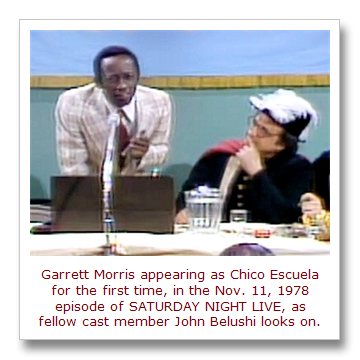
If you’re old enough to have been watching Saturday Night Live in the late Seventies you might have been watching Episode 5 of Season 4 when it first aired on November 11, 1978. (I am and I was.)

Buck Henry was the host. The Grateful Dead were the musical guests. And, there were several classic skits — including one at the end that introduced what would become a famous TV catchphrase.

The sketch takes place at a meeting of the St. Mickey’s Knights of Columbus.

After dealing with a few business items, the organization’s leader, played by SNL cast member John Belushi, announces that the club would have a special guest speaker that night.

Dan Aykroyd, playing the Knights’ treasurer, notes that the group had to go into debt to pay the speaker’s steep $900 fee.

Belushi then introduces this special guest: “the immortal” Chico Escuela, a former all-star baseball player for the Chicago Cubs who came to the US from the Dominican Republic.

After being introduced, Chico — portrayed by SNL cast member Garrett Morris — gets up, stands at the podium and says in a thick Hispanic accent:

“Thank you berry much. Baseball been berry, berry good to me. Thank you. God bless you. Gracias!”

Then he sits down.

Astonished by the brevity of this $900 “speech,” Belushi’s character asks: “Is that it Chico?”

Chico thinks about it a second, gets up again and adds: “Keep you eye...keep you eyes...on de ball.”

After which, he sits down again.

Belushi says sardonically: “Thank you, Chico. You’ve been an inspiration to all of us.”

Three weeks later, during the December 9, 1978 episode of SNL, Morris’s Chico made a second appearance and repeated his line “Baseball been berry, berry good to me!” several times — making this the night on which it gained official catchphrase status. 

In that episode (Season 4, Episode 8), the host was Monty Python star Eric idle. Kate Bush was the musical guest. Dan Aykroyd performed the insanely funny skit in which he plays a frantic Julia Child, who bleeds to death after cutting her finger. And, Don Novello showed up as Father Guido Sarducci.

Chico was in the Weekend Update segment with Jane Curtin, who announced that he had been hired as the Weekend Update sports commentator. After being introduced by Jane (this time as a former New York Mets ballplayer), Chico says:

“Thank you. Thank you, berry, berry much. Baseball been berry, berry good to me. Thank you, Hane.

[A photo of major league player Pete Rose, who had recently signed a four year, 3.2 million dollar deal with the Philadelphia Phillies, appears behind Chico.]

Pete-ee Rose...Baseball been berry, berry good to Pete Rose. Three-point-two-million-dollar para Pete Rose. Charlie Hustle, you bet. Thank you berry, berry much.

In foot-ball... I don’t know football. In Dominican Republic, football is — how you say, Hane? Um, Oh! Soccer! Your football... I don’t know.

In National Hockey League... I don’t know hockey.

In baseball… Baseball been berry, berry good to me! Thank you berry much. Thank you. Thank you berry much. Hane? Thank you, Hane.”

Hearing Chico’s fact-challenged report, Jane responds sarcastically: “Great job, Chico. I’m glad that we haven’t hired just another stupid ex-jock sportscaster.”

Morris went on to appear as Chico Escuela eight more times before leaving the Saturday Night Live cast in the summer of 1980.

Each time, he repeated “Baseball been berry, berry good to me!” (sometimes written as “Beisbol been bery, bery good to me!” and in various other ways). It remains one of the most famous of the many memorable catchphrases created by SNL.

*     *     *     *     *     *     *     *     *     *

Comments? Corrections? Post them on my Famous Quotations Facebook page or send me an email.

Related viewing and reading (and other stuff)…

January 07, 2018

“We don’t need no stinking badges!” – the misquote that became a famous quote


“We don’t need no stinking badges!” is one of the few famous lines that is both a famous quote and a misquote.

It’s also the source of many variations about stinkin’ things we don’t need.

The evolution of this line began in 1927 with the publication of the novel The Treasure of the Sierra Madre, a tale of greed, betrayal and madness written by the mysterious author and leftist/anarchist B. Traven (c. 1890-1969). 

The main characters are three American prospectors searching for gold in Mexico’s Sierra Madre mountains: Fred C. Dobbs, Bob Curtin and an old-timer named Howard.

In a scene later made famous by the movie version, the prospectors run into a group of shady-looking, heavily-armed Mexicans, who they suspect are bandits. 

Indeed, the Mexicans are bandits and the meeting ends up in a gunfight. But just before the shooting starts, the leader of the bandits tells the prospectors that they are federales — the local “mounted police.”

Dobbs says skeptically of that claim: “If you are the police, where are your badges?”

In Traven’s book, the bandit leader replies angrily (and colorfully):

“Badges, to god-damned hell with badges! We have no badges. In fact, we don’t need badges. I don’t have to show you any stinking badges, you god-damned cabron and ching’ tu madre!”

The answer given by the head bandido in the 1948 movie adaptation of The Treasure of the Sierra Madre is a bit different than that.

Most notably, it leaves out the English and Spanish profanities. (You can look up the meaning of cabron and ching’ tu madre on this web page.)

The famed film was released in the U.S. on January 7, 1948. Some sources say January 6th, but I believe that is either a local premiere date or simply wrong.

In the movie, Fred Dobbs is played by Humphrey Bogart and he asks the same question as in the book: “If you are the police, where are your badges?”

The bandit leader, called “Gold Hat” in the script and played by actor Alfonso Bedoya, responds sneeringly:

      “Badges? We ain’t got no badges! We don’t need no badges!
       I don’t have to show you any stinking badges!”

The Treasure of the Sierra Madre became one of the most highly-praised and popular movies ever made. So, it’s no surprise that Bedoya’s famous “no badges” lines spawned some humorous parodies.

What is unusual is that one of the parody versions became far better known than the lines in the original film.

In fact, many people mistakenly think it comes from the 1948 movie.

That renowned version is, of course:

       “Badges? We don't need no stinking badges!”

If you’re a Mel Brooks fan, you know those lines are in his hilarious movie, Blazing Saddles, which was released on February 7, 1974.

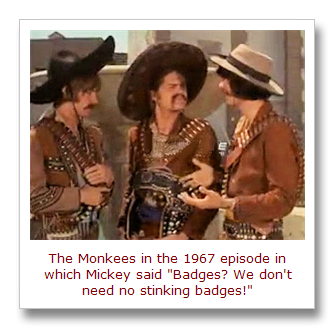
What you may not know is that the same lines were first spoken by Micky Dolenz in 1967, in the TV comedy show The Monkees.

Mickey says it in the episode titled “It’s A Nice Place To Visit” (the first episode of Season 2), which originally aired on September 11, 1967.

In that episode, Mickey and two of his Monkees bandmates, Peter Tork and Michael Nesmith, dress up as Mexican bandits to rescue their singer Davy Jones from a “real” Mexican bandit who has taken him prisoner.

Before they leave to save Davy, Nesmith says: “Wait a minute, don’t you think maybe we oughtta take something out with us, like a club card or some badges?”

Dolenz replies with a heavy Mexican accent (about 9 minutes in): “Badges? We don’t need no stinking badges!”

I don’t know if Mel Brooks was a Monkees fan, but seven years later he made those words immortal by putting them in the script for Blazing Saddles.

In a now famous scene in that movie, the corrupt State Attorney General Hedley Lamarr, played by Harvey Korman, has a sheriff’s badge given to one of his Mexican bandit henchmen, played by Rick Garcia

Korman says to Garcia: “Be ready to attack Rock Ridge at noon tomorrow. Here’s your badge.”

Garcia contemptuously throws the badge on the ground and replies with a thick Spanish accent: “Badges? We don’t need no stinking badges!”

Few people know those same words had been previously used in a Monkees episode.

But because of the huge popularity of Blazing Saddles, they became a famous movie quotation and sparked countless satirical variations based on the linguistic formula “We don’t need no stinking [fill in the blank].”

I’ve posted some of my favorite variations in a post on my Quote/Counterquote blog.

You can also click this link to see some recent examples from news stories and blogs — unless, of course, you don’t need no stinking examples.

*     *     *     *     *     *     *     *     *     *

Comments? Corrections? Questions? Email me or post them on my Famous Quotations Facebook page.

Related reading and viewing…

Copyrights, Disclaimers & Privacy Policy


Copyright © Subtropic Productions LLC

All original text written for the This Day in Quotes quotations blog is copyrighted by the Subtropic Productions LLC and may not be used without permission, except for short "fair use" excerpts or quotes which, if used, must be attributed to ThisDayinQuotes.com and, if online, must include a link to http://www.ThisDayinQuotes.com/.

To the best of our knowledge, the non-original content posted here is used in a way that is allowed under the fair use doctrine. If you own the copyright to something posted here and believe we may have violated fair use standards, please let us know.

Subtropic Productions LLC and ThisDayinQuotes.com is committed to protecting your privacy. For more details, read this blog's full Privacy Policy.