Showing posts with label September 18. Show all posts

September 19, 2022

“No one ever went broke underestimating the intelligence of the American public.”


In many books of quotations and on thousands of websites H.L. Mencken is credited with the famous quote “No one ever went broke underestimating the intelligence of the American public.”

Most sources fail to mention that this “quote” by “The Sage of Baltimore” is actually the traditional paraphrase of what Mencken actually wrote — not a true quote.

It’s based on something the acerbic journalist, editor and social critic said in his column in the September 18, 1926 edition of Baltimore’s major daily newspaper, The Sun.

Mencken’s column was syndicated and published in many other newspapers after appearing in The Sun. The next day, September 19, 1926, it appeared in the Chicago Daily Tribune and other newspapers around the country.

Mencken titled that entry in his column “Notes on Journalism.”

His topic was a recent trend in the American newspaper business: “tabloid newspapers” that were geared toward uneducated readers, including those Mencken described as “near-illiterates.”
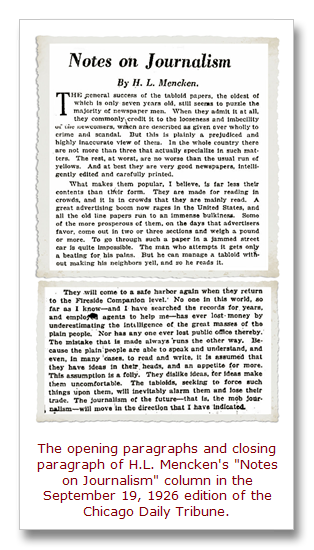
Mencken noted that tabloids had several advantages over traditional daily newspapers like The Baltimore Sun.

They were lighter and less bulky than daily newspapers, which had “two or three sections and weigh a pound or more.”

Thus, in addition to being less formal and easier to read than most dailies, tabloids could be “distributed much more quickly than the larger papers.”

“A boy on a motorcycle,” Mencken wrote, “can carry a hundred copies of even the bulkiest of them to a remote junction in ten or twenty minutes, but the old style papers have to go by truck, which is slower.”

In his usual dry way, Mencken also poked fun at the idea that most people wanted the content of newspapers to be more substantive and intellectual than what tabloids typically offered.

He opined that when a tabloid became successful the owner often tried to make it more respectable and “reach out for customers of a higher sophistication.”

Mencken said that was a mistake and, near the end of column, summed up why by writing the words that were later turned into the shorter famous “quote” about underestimating the intelligence of the American public.

His actual words were:

“No one in this world, so far as I know — and I have searched the records for years, and employed agents to help me — has ever lost money by underestimating the intelligence of the great masses of the plain people. Nor has anyone ever lost public office thereby.”

Over time, this longer quote came to be paraphrased and misquoted, most commonly in the form “No one ever went broke underestimating the intelligence of the American public.”

In the column, Mencken continued his thoughts about the public’s choices in reading matter and politicians by adding:

“The mistake that is made always runs the other way. Because the plain people are able to speak and understand, and even, in many cases, to read and write, it is assumed that they have ideas in their heads, and an appetite for more. This assumption is a folly.”

Looking around at the media and political landscape today, Mencken’s opinion might be deemed more prescient than ever.

Editor’s note: Thanks to reader James C. Morrison Jr. for the note clarifying publication dates of Mencken’s “Notes on Journalism” column!

*     *     *     *     *     *     *     *     *     *

Comments? Corrections? Questions? Email me or post them on my Famous Quotations Facebook page.

Related reading, listening and a Mencken quote coffee mug…


September 18, 2010

The first Letterman “Top Ten” list debuted 25 years ago today…


If you were watching David Letterman’s show on September 18, 1985, back when it was still on NBC and called Late Night with David Letterman, you saw a bit of TV history being made.

On that night, Letterman introduced his first “Top Ten” list.

Early in the show, he commented on that fact that “top ten” lists seemed to be popping up everywhere in the media.

He showed an example in the latest issue of Good Housekeeping magazine, then said, in his trademark deadpan style:

“Because these things are so popular and such solid network television programming material, we’ve decided tonight...we’re gonna start our own top ten list. And, tonight, I think we got a pretty good one. Tonight, will be Late Night’s ‘Top Ten Words That Almost Rhyme with ‘Peas.’”

After that, Letterman’s “Top Ten” segment became a regular and hugely popular feature of the show.

He took it with him when he moved from NBC to CBS in 1993, where it’s officially called the “Late Show Top Ten List.”

And, although Letterman’s first Top Ten list did not create a specific quote or catchphrase, it did create a famous, familiar and oft-copied format.

Letterman introduces the list with some funny comments. He reads the title of the list. Then he reads the list backwards starting with ten and counting down to number one, frequently with the help of a guest who is on the show or who pops in just to read the list. (Some of my favorites were Homer Simpson, Bruno and Britney Spears.)

Of course, it’s usually a lot funnier to watch the Top Ten segment than to read it. You never know what quips Letterman or bandleader Paul Shaffer will throw in or what celebrity might show up to read the list. 

And, it all started exactly 25 years ago today, with the very first Letterman Top Ten List, the “Top Ten Things That Almost Rhyme With Peas.”

Here they are, in descending order:

10. Heats
9. Rice
8. Moss
7. Ties
6. Needs
5. Lens
4. Ice
3. Nurse
2. Leaks

And, the number one word that almost rhymes with peas is (drumroll):

1) Meats!


*     *     *     *     *     *     *     *     *     *     *     *     *     *     *     *

Comments? Corrections? Post them on my quotations Facebook group.

Further reading…

September 18, 2009

SEPTEMBER 18 - Was Lincoln a Great Emancipator or a Great Obfuscator?

An Abraham Lincoln quotation that is often noted in modern, clear-eyed accounts of his life comes from one of his debates with Stephen Douglas, during their 1858 contest for an Illinois Senate seat in Congress.

At the time, white male voters were the only voters and most were racist. So, Douglas had been doing his best to scare them into thinking Lincoln was an unqualified abolitionist and an advocate of “mixed race” marriage.

In the fourth Lincoln-Douglas debate, held on September 18, 1858, Lincoln responded. He said:

“I am not, nor ever have been, in favor of bringing about in any way the social and political equality of the white and black races.”

Lincoln went on to say: “I am not, nor ever have been, in favor of making voters or jurors of negroes, nor of qualifying them to hold office, nor to intermarry with white people; and I will say in addition to this that there is a physical difference between the white and black races which I believe will forever forbid the two races living together on terms of social and political equality.”

How does this now oft-cited quote square with the old traditional image of Lincoln “The Great Emancipator” who “freed the slaves” with his Emancipation Proclamation?

Well, in a nutshell, the Civil War wasn’t really a war to free the slaves. And, the Emancipation Proclamation was a wartime strategy employed by Lincoln. It only “freed” slaves in Confederate states, to encourage them to leave their Southern masters and hopefully disrupt the Southern economy and war effort.

In the Northern states, slavery wasn’t legally abolished until the 13th Amendment to the U.S. Constitution was ratified in 1865.

Lincoln’s pandering speech to voters on September 18, 1858 doesn’t mean he wasn’t a great man. It just means that he was complex – like real people and real politics really are. 

It’s a fitting time to read more about this great and complex man, since 2009 is the 200th anniversary of his birth.

Here are some of the other famous quotes and phrases linked to SEPTEMBER 18:

“Bring ‘em Back Alive.” - Wildlife collector Frank Buck’s signature catchphrase, which he used as the title of a best selling book copyrighted on September 18, 1930.

“Hit the road, Jack, and don't you come back no more...” - The hit song by Ray Charles (written by Percy Mayfield) which entered Billboard’s Top 40 music chart on September 18, 1961.

“Men Behaving Badly.” - The title of a British TV sitcom that ran from 1992 to 1998. It was creeping into American vernacular, but was fully embedded in our language here when an Americanized version of the show started airing on September 18, 1996.

Copyrights, Disclaimers & Privacy Policy


Copyright © Subtropic Productions LLC

All original text written for the This Day in Quotes quotations blog is copyrighted by the Subtropic Productions LLC and may not be used without permission, except for short "fair use" excerpts or quotes which, if used, must be attributed to ThisDayinQuotes.com and, if online, must include a link to http://www.ThisDayinQuotes.com/.

To the best of our knowledge, the non-original content posted here is used in a way that is allowed under the fair use doctrine. If you own the copyright to something posted here and believe we may have violated fair use standards, please let us know.

Subtropic Productions LLC and ThisDayinQuotes.com is committed to protecting your privacy. For more details, read this blog's full Privacy Policy.