
|
“Whatever is worth doing at all, is worth doing well.” |
|
“If a thing is worth doing, it’s worth doing slowly — very slowly.” |
|
“If a thing is worth doing it is worth doing badly.” |
|
“My philosophy is that anything worth doing is too hard.” |
|
“Anything worth doing is worth overdoing.” |
|
“Anything worth doing is going to suck at the beginning. Anything worth doing is meant to require pain and sacrifice. Herein lies the problem facing America, which originally was built on the moral of impulse control. What once used to be a country filled with people sacrificing momentary pleasure for a better future, the overpowering message of today is live for the moment.”
* * * * * * * * * * Comments? Corrections? Questions? Email me or post them on my Famous Quotations Facebook page. Related reading, viewing and listening… |
September 08, 2023
“Whatever is worth doing…


August 23, 2023
“Everybody talks about the weather, but nobody does anything about it.”

In 1897, two of the most famous residents of Hartford, Connecticut were Mark Twain and his friend and fellow writer Charles Dudley Warner, who was then editor of the local newspaper, the Hartford Courant.
They had been close friends for decades.
Back in 1873, they had even written a satirical novel together, titled The Gilded Age. (It was the only novel Twain ever wrote with a collaborator and its title coined the term that came to be used for the greed-fueled, corruption-tinged post-Civil War era it lampooned.)
Twain and Warner are also both connected to a famous joke about the weather that’s commonly given as:
“Everybody talks about the weather, but nobody does anything about it.”
This line is most widely credited as a quote by Twain. But it doesn’t appear in anything he wrote or in any of his recorded speeches.
It is also widely credited to Warner and there is a published source for that attribution. But that source — an editorial published in the Hartford Courant on August 24, 1897 — doesn’t exactly clarify the facts.
For one thing, the editorial was unsigned.
Warner was writing editorials for the Courant at the time, so he probably did write it.
However, even assuming he did, there are two other quotation accuracy problems: the editorial itself credits the saying to someone else and gives it in a form that’s slightly different than the familiar traditional “quote.”
What the editorial actually says is:
“A well known American writer said once that, while everybody talked about the weather, nobody seemed to do anything about it.”

It also seems likely that the “well known American writer” referred to was Warner’s friend Mark Twain.
However, when asked, Twain denied it and credited Warner with writing the quip.
A few years ago, on his Quote Investigator site, Garson O’Toole documented two sources published prior to 1897 that attributed versions of the quote to Warner, thus adding to the evidence that he — rather than Twain — coined, or at least popularized, the saying.
Interestingly, one of those sources claims Warner made the remark with reference to the weather of New England.
That makes me wonder if Charles Dudley Warner may also have inspired another famous saying that’s often mistakenly attributed to Mark Twain:
“If you don’t like the weather in New England, just wait a few minutes.”
Many websites and books, including some otherwise authoritative ones, like The Oxford Dictionary of American Quotations, claim that Twain said this in a speech to the New England Society in New York City, on December 22, 1876.
In fact, he didn’t.
If you actually read the speech you find that, while Twain did make several remarks about the unpredictability of New England weather, he did not say the “If you don’t like the weather in New England…” line. (Or anything close to it.)
My conclusion is that, while thousands of books and websites talk about the famous weather quotations attributed to Mark Twain, nobody has done anything about them that definitively clears up their true origins.
Comments? Corrections? Questions? Email me or post them on my Famous Quotations Facebook page.
Related reading and listening…
July 21, 2023
“Everybody loves a lover” (as Shakespeare never said)...

On July 21, 1958, a week after being released, Doris Day’s recording of the song “Everybody Loves a Lover” entered the Billboard Top 40.
The 45 RPM single, issued by Columbia Records, eventually reached #6 on both the CashBox and Billboard charts.
It was a last big charting hit in the US for Day and has remained one of her most popular songs.
The lyrics were written by veteran lyricist Richard Adler; the music by composer Robert Allen.
Adler and Allen had previously collaborated on the songs for the 1954 Broadway musical The Pajama Game, which was a huge success.
In 1957, Doris Day was tapped as the female lead for the movie adaptation, which was also highly successful.
After working on The Pajama Game, Day told Adler she was looking for a novelty song to record.
Adler’s marriage to his first wife, songwriter and playwright Marion Hart, had hit the rocks at the time — a fact that led, ironically, to the song he wrote for Day.
On a trip to Europe in 1957, he had been introduced to actress and singer Sally Ann Howes.
According to Adler, it was love at first sight.
On January 1, 1958, the same day his divorce from Marion was finalized, Adler married Sally Ann.
Marion was apparently furious and threatened to ruin Adler’s career by publicly attacking him as a philanderer in the news media.
 In his 1990 autobiography, You Gotta Have Heart, Adler says he called his lawyer, Sidney Cohn, and expressed his concerns about her threat.
Cohn felt press coverage of Adler’s love for and marriage to Howes was unlikely to create a scandal that would hurt his songwriting career.
“Be happy,” he told Adler. “You know what Shakespeare said. All the world loves a lover.”
Adler recalled thinking: “Shakespeare doesn’t know what Marion said. Still, I could relax now, think about the future, and get back to writing.”
When Doris Day approached him about writing a novelty song for her, he remembered the line Cohn had attributed to Shakespeare.
In fact, “All the world loves a lover” doesn’t appear in any of William Shakespeare’s works. Nor did he ever use the words “Everybody loves a lover.”
From what I can tell, the Shakespeare line that comes closest is in his play As You Like It. In Act 3, Scene 4, the character Rosalind says: “The sight of lovers feedeth those in love.”
Some people have attributed “Everybody loves a lover” to American writer and philosopher Ralph Waldo Emerson, probably because he did say something like it. In 1841, Emerson wrote in his essay “Love,” that “All mankind love a lover.”
However, it appears that Richard Adler deserves credit for creating the now proverbial formulation “Everybody loves a lover.”
The biography Doris Day: Sentimental Journey (2010) by Garry McGee says Adler remembered Cohn’s mistaken Shakespeare quote then “took the line, reworked the wording, and came up with lyrics that became ‘Everybody Loves a Lover.’ He met with composer Bob Allen and in a short time the two had a completed song, which they felt was a hit.”
They were right. The song was a hit for Day and was covered by a long list of other singers and bands.
My own favorite is the classic early rock version recorded by The Shirelles in 1962.
Adler’s use of “Everybody loves a lover” as both the title and the first line in the lyrics of what became a highly popular song also made those words a famous quotation, though most people don’t know who wrote them.
In case you want to queue up one of the many versions of song on YouTube and sing along, you can find the full lyrics on these sites.
* * * * * * * * * *
Comments? Corrections? Questions? Email me or post them on my Famous Quotations Facebook page.
Related reading, listening and viewing…
September 19, 2022
“No one ever went broke underestimating the intelligence of the American public.”

In many books of quotations and on thousands of websites H.L. Mencken is credited with the famous quote “No one ever went broke underestimating the intelligence of the American public.”
Most sources fail to mention that this “quote” by “The Sage of Baltimore” is actually the traditional paraphrase of what Mencken actually wrote — not a true quote.
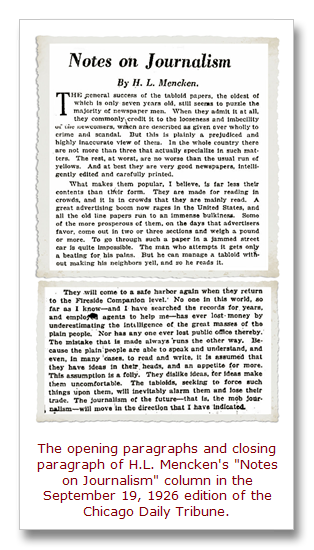
It’s based on something the acerbic journalist, editor and social critic said in his column in the September 18, 1926 edition of Baltimore’s major daily newspaper, The Sun.
Mencken’s column was syndicated and published in many other newspapers after appearing in The Sun. The next day, September 19, 1926, it appeared in the Chicago Daily Tribune and other newspapers around the country.
Mencken titled that entry in his column “Notes on Journalism.”
His topic was a recent trend in the American newspaper business: “tabloid newspapers” that were geared toward uneducated readers, including those Mencken described as “near-illiterates.”
Mencken noted that tabloids had several advantages over traditional daily newspapers like The Baltimore Sun.
They were lighter and less bulky than daily newspapers, which had “two or three sections and weigh a pound or more.”
Thus, in addition to being less formal and easier to read than most dailies, tabloids could be “distributed much more quickly than the larger papers.”
“A boy on a motorcycle,” Mencken wrote, “can carry a hundred copies of even the bulkiest of them to a remote junction in ten or twenty minutes, but the old style papers have to go by truck, which is slower.”
In his usual dry way, Mencken also poked fun at the idea that most people wanted the content of newspapers to be more substantive and intellectual than what tabloids typically offered.
He opined that when a tabloid became successful the owner often tried to make it more respectable and “reach out for customers of a higher sophistication.”
Mencken said that was a mistake and, near the end of column, summed up why by writing the words that were later turned into the shorter famous “quote” about underestimating the intelligence of the American public.
His actual words were:
“No one in this world, so far as I know — and I have searched the records for years, and employed agents to help me — has ever lost money by underestimating the intelligence of the great masses of the plain people. Nor has anyone ever lost public office thereby.”
Over time, this longer quote came to be paraphrased and misquoted, most commonly in the form “No one ever went broke underestimating the intelligence of the American public.”
In the column, Mencken continued his thoughts about the public’s choices in reading matter and politicians by adding:
“The mistake that is made always runs the other way. Because the plain people are able to speak and understand, and even, in many cases, to read and write, it is assumed that they have ideas in their heads, and an appetite for more. This assumption is a folly.”
Looking around at the media and political landscape today, Mencken’s opinion might be deemed more prescient than ever.
Editor’s note: Thanks to reader James C. Morrison Jr. for the note clarifying publication dates of Mencken’s “Notes on Journalism” column!
* * * * * * * * * *
Comments? Corrections? Questions? Email me or post them on my Famous Quotations Facebook page.
Related reading, listening and a Mencken quote coffee mug…
August 13, 2022
“No man is a hero to his valet” – the backstory on a famous proverb and misquote...

Charlotte Aïssé (1693-1733) was quite a celebrity in France in the early 18th Century — part heroine, part sex symbol, part intellectual.
As a child, her father’s palace was raided by the Turks. They took her captive but soon sold her to Count Charles de Ferriol, the French ambassador at Constantinople.
She was raised by Ferriol's sister-in-law in Paris and became a beauty who attracted the attention of several prominent French aristocrats.
After her death, her fame grew.
Three French plays were written about her. The letters she wrote to her friend Madame Calandrini were edited by the eminent French writer Voltaire and published in 1787, in a book titled Lettres de Mademoiselle Aïssé a Madame Calandrini [“Letters of Mademoiselle Aïssé to Madame Calandrini”].
In one of those letters, dated August 13, 1728, Aïssé mentioned a quip she’d heard.
It was a comment by another prominent French lady, Anne-Marie Bigot de Cornuel (1605-1694), who was once the mistress of King Louis XIV.
A simplified English translation of part of what Madame Cornuel said became cited as a famous proverbial quotation:
“No man is a hero to his valet.”
Many books and online posts attribute this quote to Cornuel by way of Aïssé’s letter.

“Je vous renvoie à ce que disoit madame Cornuel, qu’il n’y avoit point de héros pour les valets de chambre, et point de pères de l’Église parmi ses contemporains.”
A literal English translation of her words is something like this:
“I refer to what Madame Cornuel said, that there were no heroes to valets, nor to the Fathers of the Church among their contemporaries.”
Somewhere along the line, in English translations, the valet part of Aïssé’s comment morphed from “there were no heroes to valets” into “No man is a hero to his valet.”
I suspect that is because the saying “No man is a hero to his valet” already existed as a proverbial saying in French.
Indeed, “No man is a hero to his valet” is listed in many sources simply as an old French or English proverb.
The meaning of the proverb is that a servant (such as a valet) does not usually have the same grand, positive view other people may have of the servant’s master or employer.
Why? Because servants get to know the bad sides of their masters better than people who don’t spend time with them on a daily basis. In addition, “underlings” are often treated worse by their masters or employers than other people.
So, Madame Cornuel’s letter is not the origin of the quip about valets. She was using a version of an existing proverb and her line was misquoted in English to fit the saying.
So... Je suis désolé, Madame Cornuel. You apparently don’t deserve credit for coining “No man is a hero to his valet” — or even for saying those exact words.
* * * * * * * * * *
Comments? Questions? Corrections? Post them on the Famous Quotations Facebook page.
Related reading…
May 15, 2018
“A little learning is a dangerous thing.” (A little knowledge, too, but that’s a misquote.)

Most people have heard the old line of poetry: “A little learning is a dangerous thing.”
It became a proverbial saying that has been — and is still is — used and repurposed in many ways.
The common variation is “A little knowledge is a dangerous thing.” However, that’s an misquote of the original line written by British poet Alexander Pope in his work An Essay on Criticism.
This famous “essay” is actually a book-length poem.
Pope first published it anonymously exactly three hundred years ago today on May 15, 1711.
It’s composed in iambic pentameter. That’s the poetic style with words that have an unstressed syllable followed by a stressed one, thus sounding like “da-DUM da-DUM da-DUM da-DUM da-DUM”.
There are two other famous lines in Pope’s An Essay on Criticism almost everyone knows, even they’ve never read the poem.
One is the “To err is human, to forgive divine.” The other is “Fools rush in where angels fear to tread.”
If you have read Pope’s An Essay on Criticism, you know it’s not an easy task.
It’s composed in a flowery, antique style and full of obscure references that make it hard for modern readers to grasp.

For example, here’s a longer passage that includes the famed “little learning” quote:
“A little learning is a dangerous thing
Drink deep, or taste not the Pierian spring:
There shallow draughts intoxicate the brain,
And drinking largely sobers us again.
Fired at first sight with what the muse imparts,
In fearless youth we tempt the heights of arts
While from the bounded level of our mind
Short views we take nor see the lengths behind
But more advanced behold with strange surprise,
New distant scenes of endless science rise!”
This type of poesy is a bit reminiscent of Shakespeare. And, Shakespeare wrote some of his famous sonnets and verses of his plays in iambic pentameter.
But, personally, I find Shakespeare’s work much more enjoyable to read or hear than Pope’s and generally easier to comprehend.
With apologies to my high school and college English teachers, Pope’s poem An Essay on Criticism sounds to me like:
“Blah-BLAH, blah-BLAH...A little learning is a dangerous thing...blah-BLAH, blah-BLAH...To err is human...blah-BLAH, blah-BLAH...fools rush in...blah-BLAH, blah-BLAH.”
Of course, I only absorbed a little learning back in those days. (Hey, it was the Sixties.)
I encourage you to read the entire poem for yourself and draw your own conclusions about its Pierian spring of poetic wisdom.
* * * * * * * * * *
Comments? Corrections? Post them on my Famous Quotations Facebook page or send me an email.
Related reading, listening and stuff…
November 05, 2017
“Spare the rod and spoil the child”

It’s not surprising that many people think the quote “Spare the rod and spoil the child” comes from the Bible.
There are at least five verses in the Bible’s Book of Proverbs that talk about using a rod to beat a child — for his own good, of course.
The most famous is Proverbs 13:24: “He that spareth his rod hateth his son: but he that loveth him chasteneth him betimes.”
An even scarier piece of parenting advice is in Proverbs 23:13-14. It says: “Withhold not correction from the child: for if thou beatest him with the rod, he shall not die. / Thou shalt beat him with the rod, and shalt deliver his soul from hell.”
However, although the saying “spare the rod and spoil the child” was clearly inspired by these Biblical verses, it does not appear in the Bible.
It comes from the epic-length 17th-century poem ”Hudibras”, written by Samuel Butler (1612-1680), a cheeky British poet who enjoyed mocking religious extremists and hypocrites.
Butler’s epic satire follows the trials and tribulations of a character named Sir Hudibras.
Initially, the poem describes Hudibras as a noble and pious knight.
But during the course of the story he is shown to be a buffoonish poseur and nitwit.
Butler published Hudibras in three parts, in 1663, 1664 and 1678. The famous “spare the rod” quote comes in Part II, which was entered into the Stationer’s Registry (Britain’s early version of a copyright office) on November 5, 1663.
At the end of Part I, Sir Hudibras is put in prison after getting into a fracas with a group of locals who were watching a bear baiting “entertainment.”
In Part Two, a widow Hudibras had been wooing comes to visit him in jail and says she’ll get him out if he’ll prove he truly loves her.

When he tries to profess his love, she quickly rejects flowery words as the kind of proof she wants:
“Hold, hold, quoth she; no more of this,
Sir Knight; you take your aim amiss:
For you will find it a hard chapter
To catch me with poetic rapture.”
The widow then suggests that Hudibras could prove his love by attempting suicide. For example, she says, if he tried to hang himself she would believe him and cut him down before he died.
Hudibras thinks that option sounds a bit “too harsh.”
So, the widow suggests that Hudibras could prove his love by whipping himself or by letting her whip him. She then explains the benefits of the “virtuous school of lashing.”
Near the end of her spiel on the joys of the whip, the widow utters the famous “spare the rod” quotation:
“If matrimony and hanging go
By dest’ny, why not whipping too?
What med’cine else can cure the fits
Of lovers when they lose their wits?
Love is a boy by poets stil’d;
Then spare the rod and spoil the child.”
Hudibras promises to enroll in the “school of lashing” if the widow gets him released.
She does. But then Hudibras reneges on his promise, a betrayal that sets up the plot of Part III of the poem, in which Hudibras gets his final comeuppance.
Samuel Butler was almost certainly thinking of the Biblical verses about rods and children when he wrote his own famous line about them.
When read or heard out of context, it may seem like Butler’s “spare the rod and spoil the child” quote has a meaning similar to the Bible verses — i.e., parents should discipline their children with physical punishment if they want them to turn out “right” and keep them from becoming spoiled brats or worse.
But what Butler implied in between the lines of his satiric verse is a bit more bawdy than Biblical.
The obvious theory, given the scene it’s used, in is that it refers to sexual fetishes involving spanking, whipping and a dominatrix.
Another theory is that it’s a reference to an old bit of sexual folklore about how to “spoil” — and thus prevent — a woman from becoming pregnant.
One thing is certain: what Samuel Butler was talking about in that part of his poem Hudibras is a bit different than what the pious authors of the Book of Proverbs had in mind.
* * * * * * * * * *
Comments? Corrections? Questions? Email me or post them on my Famous Quotations Facebook page.
Related reading…


