Showing posts with label Mark Twain. Show all posts

August 23, 2023

“Everybody talks about the weather, but nobody does anything about it.”


In 1897, two of the most famous residents of Hartford, Connecticut were Mark Twain and his friend and fellow writer Charles Dudley Warner, who was then editor of the local newspaper, the Hartford Courant.

They had been close friends for decades.

Back in 1873, they had even written a satirical novel together, titled The Gilded Age. (It was the only novel Twain ever wrote with a collaborator and its title coined the term that came to be used for the greed-fueled, corruption-tinged post-Civil War era it lampooned.)

Twain and Warner are also both connected to a famous joke about the weather that’s commonly given as:

       “Everybody talks about the weather, but nobody does anything about it.”

This line is most widely credited as a quote by Twain. But it doesn’t appear in anything he wrote or in any of his recorded speeches.

It is also widely credited to Warner and there is a published source for that attribution. But that source — an editorial published in the Hartford Courant on August 24, 1897 — doesn’t exactly clarify the facts.

For one thing, the editorial was unsigned.

Warner was writing editorials for the Courant at the time, so he probably did write it.

However, even assuming he did, there are two other quotation accuracy problems: the editorial itself credits the saying to someone else and gives it in a form that’s slightly different than the familiar traditional “quote.”

What the editorial actually says is:  

“A well known American writer said once that, while everybody talked about the weather, nobody seemed to do anything about it.”

It’s likely that the popular version of the “quote” was derived from or popularized by the version in this editorial.

It also seems likely that the “well known American writer” referred to was Warner’s friend Mark Twain.

However, when asked, Twain denied it and credited Warner with writing the quip.

A few years ago, on his Quote Investigator site, Garson O’Toole documented two sources published prior to 1897 that attributed versions of the quote to Warner, thus adding to the evidence that he — rather than Twain — coined, or at least popularized, the saying.

Interestingly, one of those sources claims Warner made the remark with reference to the weather of New England.

That makes me wonder if Charles Dudley Warner may also have inspired another famous saying that’s often mistakenly attributed to Mark Twain:

       “If you don’t like the weather in New  England, just wait a few minutes.”

Many websites and books, including some otherwise authoritative ones, like The Oxford Dictionary of American Quotations, claim that Twain said this in a speech to the New England Society in New York City, on December 22, 1876.

In fact, he didn’t.

If you actually read the speech you find that, while Twain did make several remarks about the unpredictability of New England weather, he did not say the “If you don’t like the weather in New  England…” line. (Or anything close to it.)

My conclusion is that, while thousands of books and websites talk about the famous weather quotations attributed to Mark Twain, nobody has done anything about them that definitively clears up their true origins.

Comments? Corrections? Questions? Email me or post them on my Famous Quotations Facebook page.

Related reading and listening…

June 02, 2018

Reports of Mark Twain’s quip about his death are greatly misquoted...

Mark Twain, the report of my death
In May 1897, the great American humorist, novelist and social critic Samuel Clemens — best known by his pen name, Mark Twain — was in London. It was one of the stops on a round-the-world speaking tour he’d embarked on in 1895.
He hoped to use the fees from speaking engagements to pay off the considerable debts he owed in the United States, due to a series of unsuccessful investments and publishing ventures.

While Twain was in London, someone started a rumor that he was gravely ill. It was followed by a rumor that he had died.


According to a widely-repeated legend, one major American newspaper actually printed his obituary and, when Twain was told about this by a reporter, he quipped:


      “The reports of my death are greatly exaggerated.”

 
Another common variation of the line uses the words “…have been greatly exaggerated.” 


Sometimes the quip is given as “Reports of my death are grossly exaggerated.”
 
In point of fact, all such commonly-heard versions using “greatly exaggerated” and “grossly exaggerated” are misquotes.


It is true that in late May of 1897 the English correspondent for the New York Journal, Frank Marshall White, contacted Twain in London to inquire about his health.


The editors of the newspaper had sent a cable White on May 28, asking him to get Twain’s response to reports that he was on his deathbed in England.


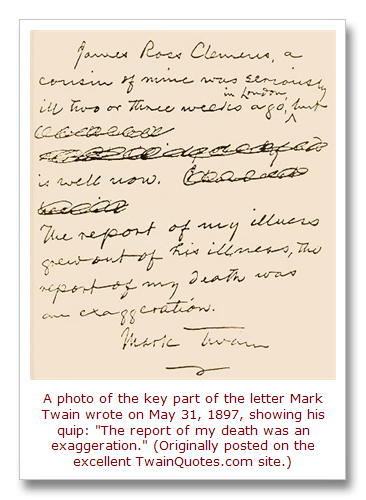
White relayed this request to Twain. On May 31, 1897, Twain wrote down his response and sent it to White.


The next day, White wrote an article that quoted from Twain’s letter. On June 2, 1897, the article was published in the New York Journal. It said, in part:

     Mark Twain was undecided whether to be more amused or annoyed when a Journal representative informed him today of the report in New York that he was dying in poverty in London...
     The great humorist, while not perhaps very robust, is in the best of health. He said:
     “I can understand perfectly how the report of my illness got about, I have even heard on good authority that I was dead. James Ross Clemens, a cousin of mine, was seriously ill two or three weeks ago in London, but is well now. The report of my illness grew out of his illness.
     The report of my death was an exaggeration.”
The origin of the more familiar misquote versions of Twain’s response seems to be the popular biography of Twain written by Albert Bigelow Paine.

Paine’s book was published in 1912, two years after Twain’s death. It includes what is apparently Paine’s own embellished variation of the story about Twain’s death quip.


In Chapter 197 of the biography, Paine said a young reporter had “ferreted out” Twain in London after being assigned to follow up on rumors that the famed humorist was “lying at the point of death.”


According to Paine, the newspaper had sent a cable to the reporter ordering him to send back a five hundred 500-word story if Twain was ill, or a thousand word story if Twain was dead.


Paine claimed that upon being shown the cable, Twain “smiled grimly” and told the young reporter:


      “You don’t need as much as that. Just say the report of my death has been grossly exaggerated.”

 
Most scholarly books of quotations now use or include the quote recorded in the New York Journal article, taken from Twain’s letter to Frank Marshall White.


However, Paine’s “grossly exaggerated” version and “The report of my death has been greatly exaggerated,” which seems to be a colloquial variation of Paine’s line, are better known and commonly assumed to be actual quotes by Twain.


Of course, as Twain wrote in his book Following the Equator, published in November 1897:


       “It is my belief that nearly any invented quotation, played with confidence, stands a good chance to deceive.”


*     *     *     *     *     *     *     *     *     *

Comments? Corrections? Post them on my Famous Quotations Facebook page or send me an email.

Related reading…

Copyrights, Disclaimers & Privacy Policy


Copyright © Subtropic Productions LLC

All original text written for the This Day in Quotes quotations blog is copyrighted by the Subtropic Productions LLC and may not be used without permission, except for short "fair use" excerpts or quotes which, if used, must be attributed to ThisDayinQuotes.com and, if online, must include a link to http://www.ThisDayinQuotes.com/.

To the best of our knowledge, the non-original content posted here is used in a way that is allowed under the fair use doctrine. If you own the copyright to something posted here and believe we may have violated fair use standards, please let us know.

Subtropic Productions LLC and ThisDayinQuotes.com is committed to protecting your privacy. For more details, read this blog's full Privacy Policy.