Showing posts with label Nigel Rees. Show all posts

August 23, 2023

“Everybody talks about the weather, but nobody does anything about it.”


In 1897, two of the most famous residents of Hartford, Connecticut were Mark Twain and his friend and fellow writer Charles Dudley Warner, who was then editor of the local newspaper, the Hartford Courant.

They had been close friends for decades.

Back in 1873, they had even written a satirical novel together, titled The Gilded Age. (It was the only novel Twain ever wrote with a collaborator and its title coined the term that came to be used for the greed-fueled, corruption-tinged post-Civil War era it lampooned.)

Twain and Warner are also both connected to a famous joke about the weather that’s commonly given as:

       “Everybody talks about the weather, but nobody does anything about it.”

This line is most widely credited as a quote by Twain. But it doesn’t appear in anything he wrote or in any of his recorded speeches.

It is also widely credited to Warner and there is a published source for that attribution. But that source — an editorial published in the Hartford Courant on August 24, 1897 — doesn’t exactly clarify the facts.

For one thing, the editorial was unsigned.

Warner was writing editorials for the Courant at the time, so he probably did write it.

However, even assuming he did, there are two other quotation accuracy problems: the editorial itself credits the saying to someone else and gives it in a form that’s slightly different than the familiar traditional “quote.”

What the editorial actually says is:  

“A well known American writer said once that, while everybody talked about the weather, nobody seemed to do anything about it.”

It’s likely that the popular version of the “quote” was derived from or popularized by the version in this editorial.

It also seems likely that the “well known American writer” referred to was Warner’s friend Mark Twain.

However, when asked, Twain denied it and credited Warner with writing the quip.

A few years ago, on his Quote Investigator site, Garson O’Toole documented two sources published prior to 1897 that attributed versions of the quote to Warner, thus adding to the evidence that he — rather than Twain — coined, or at least popularized, the saying.

Interestingly, one of those sources claims Warner made the remark with reference to the weather of New England.

That makes me wonder if Charles Dudley Warner may also have inspired another famous saying that’s often mistakenly attributed to Mark Twain:

       “If you don’t like the weather in New  England, just wait a few minutes.”

Many websites and books, including some otherwise authoritative ones, like The Oxford Dictionary of American Quotations, claim that Twain said this in a speech to the New England Society in New York City, on December 22, 1876.

In fact, he didn’t.

If you actually read the speech you find that, while Twain did make several remarks about the unpredictability of New England weather, he did not say the “If you don’t like the weather in New  England…” line. (Or anything close to it.)

My conclusion is that, while thousands of books and websites talk about the famous weather quotations attributed to Mark Twain, nobody has done anything about them that definitively clears up their true origins.

Comments? Corrections? Questions? Email me or post them on my Famous Quotations Facebook page.

Related reading and listening…

October 15, 2016

About that “giant sucking sound” and what qualifies something as a “famous quotation”…


The huge amount of attention focused on the 2016 presidential debates between Donald Trump and Hillary Clinton made me think of some of the famous quotations from past presidential debates.

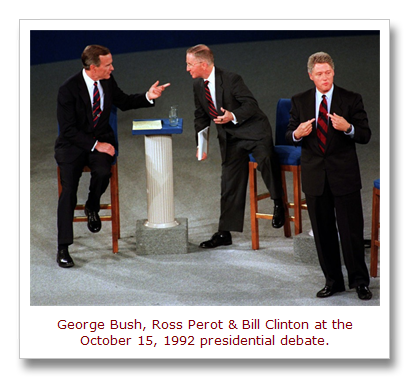
One that coined a phrase still widely used today was uttered by Independent candidate Ross Perot on October 15, 1992, in the three-way presidential debate between Perot, Republican President George H. W. Bush and Democratic nominee Bill Clinton.

During that debate, Perot made a prediction about the effects of the proposed North American Free Trade Agreement (NAFTA). Many people today would view it as prescient.

Perot said:

“If you're paying $12, $13, $14 an hour for factory workers and you can move your factory south of the border, pay $1 an hour for your labor, have no health care, have no environmental controls, no pollution controls and no retirement, and you don't care for anything but making money, then there will be a giant sucking sound going south.”

That quote by Perot was included in hundreds of news reports about the presidential debate. Probably thousands.

Few people remember his entire sentence nowadays, but the catchy phrase “a giant sucking sound” quickly gained what turned out to be long-lasting fame.

It is still regularly used and repurposed.

In fact, on almost any day, if you do a Google news search on “giant sucking sound” you’ll usually find the phrase in dozens of recent news-related stories and blog posts, even though the stories may not mention its source and many readers may be unaware of it — or of Ross Perot.

My own view is that it’s the familiarity of the line or phrase and its longevity that qualifies it as “famous quotation.” It’s not whether most people remember the specific origin or coiner.

It’s often not immediately apparent whether a line or phrase will rise to the level of being a truly famous quote. Many are just “famous for 15 minutes.” 

That’s why one of my favorite quotation mavens, Nigel Rees, has criticized the tendency of some modern quotation reference books, such as the Oxford Dictionary of Quotations, to elevate things like pop song lyrics to the level of other famous quotes simply because they were widely known the year the book was published.

“Remember the dreadful example of the 1999 edition of the Oxford DQ, stuffing in remarks and supposedly quotable lyrics from the Spice Girls?” Rees wrote in an issue of his great “Quote...Unquote” newsletter. “What a surprise that they have mostly gone from the most recent edition.”

On the flip side, many scholarly quotation reference books like Bartlett's Familiar Quotations include hundreds of historical and literary quotes that are not actually familiar to most people.

These less familiar quotes may be worthy bits of wisdom or wit, or worth knowing for the purpose of cultural literacy. But they are not necessarily what I would call “famous quotations.”

My own working definition of a famous quotation is a quote that is both widely known in part or in its entirety and which has had, or is clearly likely to have, a long life in our language — a line or phrase that is frequently and widely cited, quoted, praised, mocked, misquoted, adapted, recycled or repurposed.

In October 2016, everybody heard a lot about a crass quote by Donald Trump, recorded on a “hot mic” when he was getting ready to appear on the TV show Access Hollywood in 2005, after it was revealed to the press at the height of the 2016 presidential campaign.

Trump was heard to say:

"I'm automatically attracted to beautiful [women]—I just start kissing them. It's like a magnet. Just kiss. I don't even wait. And when you're a star they let you do it. You can do anything...Grab them by the pussy. You can do anything."

It’s not clear whether those words will rise to the level of being a long-remembered and oft-cited “famous quotation.”

Hopefully, they won’t become a famous presidential quotation.

*     *     *     *     *     *     *     *     *     *

Comments? Corrections? Post them on my quotations Facebook group.

Related reading…

October 17, 2009

OCTOBER 18 - Nigel Rees’s “Quote…Unquote” Newsletter will soon be available by email

I’m departing from my usual format in today’s post to mention a great quotation resource that’s being made available online to quote buffs.

The venerable “Quote…Unquote” Newsletter, which has been published in printed format for 18 years by the eminent British quotation expert Nigel Rees, is now available exclusively in electronic format.

Rees is Britain's most eminent and prolific quotation expert. He’s written over 50 books on quotations and related subjects, like clichés and epitaphs. He’s also the host of BBC’s long-running “Quote…Unquote” radio quiz show and has hosted and been a guest on many other British radio and TV shows.

Until recently, The “Quote…Unquote” Newsletter was available mainly by snail mail. It was distributed here in the United States thanks to another esteemed language maven, Robert Skovgard, creator of The Executive Speaker Newsletter and a nationally known speechwriting expert.

Recently, Skovgard sent out an email to American subscribers announcing that, with the next quarterly issue in January 2010, The “Quote…Unquote” Newsletter will become a free, electronic-only publication, delivered as an emailed PDF attachment.

You can view a sample issue and and sign up to get the newsletter via email by visiting the “Quote…Unquote” Newsletter website.

The only cost is a small, one-time $5 set-up fee. That incredibly reasonable payment can be made online or arranged by phone.

I’ve been a fan of Nigel Rees’ books and a subscriber to the “Quote…Unquote” Newsletter for years. It’s a terrific and entertaining source of information about quotations.

It’s also engagingly interactive. Subscribers can submit queries on quotes they’re curious about – and can submit facts they may know about the quotes Rees and his readers are trying to track down.

If you enjoy reading and learning about quotations, I have two words for you about the “Quote…Unquote” Newsletter email subscription option: GET IT!

Also, do yourself a favor and buy some of Nigel’s books. They’re all fun to read and full of interesting facts and trivia.

Here are some of the famous quotes and phrases linked to October 18:

“We must love one another or die.” - The well known line from the poem “September 1, 1939” by W.H. Auden (1907-1973). First published in October 18, 1939 issue of The New Republic. This quote was featured here in a recent post.

“If you've seen one city slum you've seen them all.” – One of the infamous quotes by Spiro T. Agnew (1918-1996), President Nixon’s ill-fated V.P. Spoken by Spiro in a campaign speech in Detroit, Michigan on October 18, 1968.

Copyrights, Disclaimers & Privacy Policy


Copyright © Subtropic Productions LLC

All original text written for the This Day in Quotes quotations blog is copyrighted by the Subtropic Productions LLC and may not be used without permission, except for short "fair use" excerpts or quotes which, if used, must be attributed to ThisDayinQuotes.com and, if online, must include a link to http://www.ThisDayinQuotes.com/.

To the best of our knowledge, the non-original content posted here is used in a way that is allowed under the fair use doctrine. If you own the copyright to something posted here and believe we may have violated fair use standards, please let us know.

Subtropic Productions LLC and ThisDayinQuotes.com is committed to protecting your privacy. For more details, read this blog's full Privacy Policy.