October 29, 2018

The Timothy Leary political campaign slogan that became a famous Beatles song…


The best-known slogan coined by Sixties counterculture celebrity Timothy Leary is the one he created to promote the use of LSD and other psychedelic drugs: “Turn on, tune in, drop out.”

He first began popularizing this saying in his public lectures and comments around 1966 and used it as the title of a spoken word album released that year.

In 1969, Leary came up with another slogan that was eventually made famous, though not by him.

Leary seems to have figured that if a Hollywood celebrity like Ronald Reagan could run for Governor and get elected, maybe the times were right for a Hippie celebrity to take a shot at it.

Besides, he loved publicity.

So, he threw his mushroom cap into the ring and announced that he planned to run against Reagan in the 1970 gubernatorial election.

Leary came up with the tongue-in-cheek campaign slogan, “Come together, join the party.”

In June of 1969, while visiting John Lennon and Yoko Ono at their legendary Montreal “Bed-In,” Leary asked Lennon to write a campaign song to go with his slogan.

Lennon agreed. And, during the Montreal Bed-In days, in addition to writing and recording “Give Peace a Chance,” Lennon wrote an initial version of the song “Come Together.”

Although the melody was basically like the Beatles song we know today, the original chorus was different.

It went: “Come together, right now. / Don’t come tomorrow. / Don’t come alone.”

Lennon made a demo tape of the campaign song for Leary. Leary gave copies to local underground radio stations in California and the song got some limited airplay.

Shortly thereafter, Leary’s campaign was derailed by his mounting legal troubles from a past marijuana bust, and he was forced to, er, drop out of the Governor’s race. (Lucky for Ronnie, eh?)

But Lennon liked the song and took it to his bandmates, Paul McCartney, George Harrison and Ringo Starr, when the Beatles were recording their Abbey Road album.

Together, they reworked it a bit and changed the lyrics to those all true Beatles fans are familiar with:

“Here come old flattop, he come groovin’ up slowly
He got ju-ju eyeballs, he one holy roller
He got hair down to his knees
Got to be a joker, he just do what he please
He wear no shoeshine, he got toe-jam football
He got monkey finger, he shoot Coca-Cola
He say, I know you, you know me
One thing I can tell you is you got to be free
Come together, right now, over me.”

The first line of the “Come Together” was Lennon’s homage to a similar line from Chuck Berry’s classic 1956 rock ‘n’ roll song “You Can’t Catch Me.” 

Berry’s song was inspired by an informal car race he once had with some young crew-cut haired dude on the New Jersey Turnpike, who he immortalized with the words: “Up come a flattop, he was movin' up with me.”

Lennon’s variation on that and the chorus of his song — “Come together, right now, over me” — both became well-known pop culture quotations.

“Come Together” was released as a single in the U.S. on October 6, 1970 and reached #1 on the Billboard Hot 100 Chart on November 29, 1969 — which is how, by a trippy route, Tim Leary’s gubernatorial campaign slogan became the subject of posts for those dates on ThisDayinQuotes.com.

*     *     *     *     *     *     *     *     *     *

Comments? Corrections? Post them on my Famous Quotations Facebook page or send me an email.

Related reading, viewing and listening…


September 23, 2018

The story, the man – and the dog – behind the phrase “man’s best friend”


September 23rd is the anniversary of what is said to be the origin of a dog-related saying that’s as or more famous than “Love me, love my dog.”

The saying is generally heard in the form “A dog is a man’s best friend.”

Sometimes it’s given as “A man’s best friend is his dog.”

Either way, almost everyone knows the phrase “man’s best friend.”

The origin of those familiar words is traditionally credited to the closing arguments made by lawyer George Graham Vest in a trial at the Johnson County Courthouse in Warrensburg, Missouri on September 23, 1870.

The case was about a dog named Old Drum.

Old Drum was an unlucky foxhound who crossed paths with a sheep farmer named Leonidas Hornsby in the fall of 1869.

Hornsby had lost some sheep to dogs and had recently vowed to his neighbors that he’d kill any canine he saw on his land. When Old Drum set paw on Hornsby’s property, the farmer kept his vow.

The next morning, Drum’s owner, Charles Burden, went looking for his missing hound dog.

He found him shot dead and figured he knew who did it. So, he filed a lawsuit against Hornsby, asking for compensation.

George Vest served as Burden’s attorney. In his final summation, Vest brought the jury to tears and won the case with these words:

“The best friend a man has in this world may turn against him and become his enemy. His son or daughter that he has reared with loving care may prove ungrateful. Those who are nearest and dearest to us, those whom we trust with our happiness and our good name, may become traitors to their faith…The people who are prone to fall on their knees to do us honor when success is with us may be the first to throw the stone of malice when failure settles its cloud upon our heads. The one absolutely unselfish friend that a man can have in this selfish world, the one that never deserts him and the one that never proves ungrateful or treacherous is his dog.”

The first six words of that paragraph, combined with the last three — “The best friend a man has...is his dog” — is said to be the origin of the dog-lovers’ saying we know today.

It’s likely that “A man’s best friend is his dog” was in use before Vest gave his famous closing arguments in 1870. But the folks who live in the nice little city of Warrensburg, Missouri (population 16,000) have their own opinion.

On September 23, 1958, the 88th anniversary of Vest’s memorable words, a statue of Old Drum was placed with great ceremony in front of the Johnson County Courthouse in Warrensburg, where it can still be seen today.

*     *     *     *     *     *     *     *     *     *

Comments? Corrections? Post them on my Famous Quotations Facebook page or send me an email.

 Related reading…

August 05, 2018

“Carry Me Back to Old Virginny,” the song that made a pioneering Black songwriter famous — and infamous…

 
How will Rap and Hip Hop songs by Black musicians that use the N-word and seemingly glorify the “thug life” be viewed 140 years from now?

I don’t know for sure, of course.

But I’m willing to guess there will be various conflicting views among people who are both Black and White.

That’s certainly the case for the 140-year-old old song “Carry Me Back to Old Virginny,” which was written by the pioneering African American musician James A. Bland (1854-1911) and copyrighted on August 5, 1878.

Bland was in his early twenties at the time. He’d written other songs and was a popular performer in one of the minstrel shows that were common entertainment for both Blacks and Whites at the time.

But “Carry Me Back to Old Virginny” carried Bland to a new level.

It became a megahit and made Bland the first Black international music superstar.

Thanks to that fame, he broke many color barriers in the decades after the Civil War, such as having some of his music published under his own name.

He also helped pave the way for Black musicians and performers who followed him.

However, because Bland wrote and performed minstrel show music, originally sung in blackface makeup by white performers and later by black musicians (including Bland before he became famous), and because some of Bland’s songs romanticized the lives of American slaves, his legacy is mixed.

The controversy over “Carry Me Back to Old Virginny” is the most notable case in point.

You have probably heard the phrase “carry me back to old Virginny,” which Bland’s song popularized (though it was borrowed from an older one).

You may also be familiar with the melody of Bland’s song.

However, few people know much about James Bland or know the full lyrics of the song.

And, unless you live in Virginia, you’re probably unaware of the modern political controversy about the song.

You’ll understand why it became controversial when you read the lyrics.

They’re written in the voice of a former slave who misses his life on the plantation and loved his “Massa” (i.e., the slave-owning master of the plantation).

Here they are, in their original colloquial form:

       [Chorus] “Carry me back to old Virginny.
       James Bland sheet music cover WMThere’s where the cotton and the corn and ‘taters grow.
       There’s where the birds warble sweet in the spring-time.
       There’s where this old darkey’s heart am long’d to go.

       There’s where I labored so hard for old Massa,
       Day after day in the field of yellow corn;
       No place on earth do I love more sincerely
       Than old Virginny, the state where I was born.

       [Chorus repeats]

       Carry me back to old Virginny,
       There let me live till I wither and decay.
       Long by the old Dismal Swamp have I wandered,
       There’s where this old darkey’s life will pass away.

       Massa and Missis have long since gone before me,
       Soon we will meet on that bright and golden shore.
       There we’ll be happy and free from all sorrow,
       There’s where we’ll meet and we’ll never part no more.

       [Chorus repeats]

Bland himself was never a slave and wasn’t from Virginia. He was the son of a highly-educated, free Black man and was born in New York. His father, Allen Bland, moved the family to Philadelphia after graduating from Wilberforce College.

James attended Howard University but didn’t graduate. As a teenager, he’d fallen in love with the banjo and the minstrel music that was popular in the 1870s. By age 14 he was performing it.

By his early 20s, he was a featured member of a local minstrel show and writing songs for himself and other musicians. Among the notable songs he wrote during the ‘70s, in addition to his ode to Virginia, is “Oh! Dem Golden Slippers.” It became and still is the theme song for the famed Philadelphia Mummers Parade.

Bland’s talent and the huge success of “Carry Me Back to Old Virginny,” “Oh! Dem Golden Slippers” and other songs he wrote led him to be billed as “The World’s Greatest Minstrel Man” and “The Prince of Negro Songwriters.”

In 1881, after touring the United States, he spent 20 years performing to wide acclaim in Great Britain and Europe, where he gave command performances for Queen Victoria and the Prince of Wales and other dignitaries.

At his peak, Bland earned the equivalent of hundreds of thousands per year in today’s dollars. By the end of the century, the popularity of minstrel style music had declined and his expensive, proto-rock star lifestyle had drained his resources. (One of his legendary purchases was a 4.75 carat diamond, the largest diamond ever worn by a Black performer at the time.)

In 1901, he returned to the U.S. After that, he wrote songs for one unsuccessful musical, then faded into obscurity.

Bland died of tuberculosis in 1911 in Philadelphia. He was buried in an unmarked grave at Merion Memorial Park in Bala Cynwyd, Pennsylvania.

James Bland’s story might have ended there if not for James Francis Cooke, editor of a magazine for musicians titled The Etude.

In 1938, Cooke became interested in Bland’s work. With the help of Bland’s sister, Cooke — or, according to some accounts, the Lions Club of Virginia or the American Society of Composers, Authors and Publishers (ASCAP) — found Bland’s grave and eventually had a monument placed on it.

In 1939, Cooke published the first notable biography of Bland in The Etude. It was written by Dr. Kelly Miller, a noted African American scholar and professor at Howard University, who called Bland “The Negro Stephen Foster.”
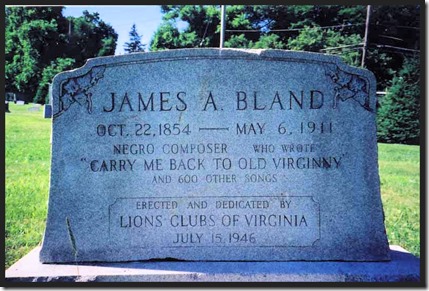
James A. Bland's headstoneThe publicity this generated led the Virginia state legislature to designate Bland’s song about Virginia as the official state song in 1940, though “Virginny” was changed to “Virginia” in the title and lyrics.

The other lyrics remained as Bland wrote them, complete with the nostalgic “darkey” thinking fondly of his “Massa.”

As the Civil Rights Movement of the 1960s gained traction, the song became a target of critics who (understandably) viewed it as racist and demeaning to African Americans.

In 1970, Douglas Wilder became the first African American elected to the Virginia Senate since Reconstruction. That same year, he proposed legislation to have the song retired and replaced.

The majority of White legislators, many of whom liked the rosy picture of slavery the song’s lyrics portrayed, rejected that bill and similar ones for years, including bills introduced after Wilder became the first African American to be elected Governor of Virginia — or any other state — in 1990.

Finally, in 1997, there was a compromise of sorts. The Virginia Senate voted to retire “Carry Me Back to Old Virginia” as the official state song, but designated it as the “State Song Emeritus” and authorized a study committee to create a contest to find and select a new state song.

To make a long story short, that approach continued to generate controversy for the next two decades.

It wasn’t until 2015 that a new state song was selected, based partly on the results of an online poll.

In fact, the legislature approved two songs as the new official state songs.

“Our Great Virginia,” a 19th Century ballad, was designated as the official “Traditional State Song.”

The song “Sweet Virginia Breeze” was named the official “Popular State Song.” It was written in 1978 by Richmond, Virginia musicians and Robbin Thompson and Steve Bassett, who included it on their 1978 album Robbin Thompson & Steve Bassett – Together.

Meanwhile, “Carry Me Back to Old Virginia” is still the “State Song Emeritus.” And, although many people can’t listen to the song without having a negative reaction, music scholars now consider James A. Bland to be not only “The World’s Greatest Minstrel Man,” as he was billed during his lifetime, but also one of the greatest black writers of American folk or popular songs.

In 1970, Bland was inducted into the Songwriters Hall of Fame.

Every year since 1948, the Lions Clubs of Virginia has sponsored the annual Bland Music Scholarships Program’s “Bland Contest.” This program is designed is to promote cultural and educational opportunities for musically talented young people in Virginia by providing scholarships for college tuition, music lessons, summer music programs and other music education endeavors.

I watched YouTube videos of some of the young people who have performed in the Bland Contest in recent years. The music they played or sang tended to be more classical than popular.

But who knows? Maybe someday one of them could become as famous as James Bland was in his day, or write a song that becomes as revered — or reviled — as “Carry Me Back to Old Virginny.”


*     *     *     *     *     *     *     *     *     *

Comments? Corrections? Post them on my Famous Quotations Facebook page or send me an email.

Related reading…

July 14, 2018

“Don’t Bogart that joint, my friend…”


[Reposted by popular demand…]

On June 24, 1968, ABC Records released the self-titled first album by The Fraternity of Man, a California-based rock band whose members included former Mothers of Invention guitarist Elliot Ingber and a young, 17-year-old singer and songwriter named Larry Wagner.

The album wasn’t a big hit. But it was popular with some young people who were in the midst of their pot-smoking Hippie phase (like me).

It included a humorous, country-flavored song that made us laugh. That song included a line that became a pop culture quotation and an idiomatic expression.

The song’s lyrics were written by Wagner, who was nicknamed “Stash” by the band. The music was written by Ingber.

They titled the song “Don’t Bogart Me.”

Today, it’s more commonly (though mistakenly) referred to as “Don’t Bogart That Joint.”

That phrase, from the song’s chorus, became a slang term meaning “don’t keep holding onto that marijuana joint — pass it on and let other people have some.” 

Initially, awareness of the song and the Bogart term was primarily limited to Hippies (a name coined by San Francisco journalist Michael Fallon in 1965).

That changed in 1969, thanks to actor Dennis Hopper, one of the pot-smoking hipsters who knew the song.

Early that year, Hopper was engrossed in editing the new film he’d created with his friend and co-star Peter Fonda — the seminal counterculture classic Easy Rider.

As he edited the movie, Hopper chose some of songs he’d recently been listening to for the soundtrack.

One of them was the Fraternity of Man’s “Don’t Bogart Me.”

Easy Rider premiered in the US on July 14, 1969 at the Beekman Theater in New York, two months after it was unveiled at the Cannes Film Festival.

It soon began appearing in theaters throughout the country.

And, soon, millions of people who’d never heard the 1968 Fraternity of Man album were familiar with the saying “Don’t Bogart that joint,” thus firmly embedding in our language.

In fact, the use of “Bogart” as a verb eventually became an idiom used in association with many things other than marijuana joints.

Today, you get thousands of, er, hits if you Google “don’t Bogart” -joint (using the minus sign to find uses that do not include the word “joint”).

There are various theories about why the last name of actor Humphrey Bogart came to be used as a verb that was originally tied to smoking something or holding onto something.

The one that makes the most sense to me is that, in many of his classic films, Bogart often has a lit cigarette hanging from his lips but is not actively smoking it. He’s just letting it burn and turn to ashes.

Bogart died in 1957 from  esophageal cancer. If he’d lived until 1969, he may or may not have liked the way his name was used in the song.

But somehow, in my mind, I can imagine Bogie and Dennis Hopper in the afterlife gleefully singing “Don’t Bogart Me” together.

And, thinking about that makes me want to sing along.

If you want to join us, light ‘em if you got ‘em, and click the video link at right.

Here are the lyrics…

Don’t Bogart that joint my friend
Pass it over to me
Don’t Bogart that joint my friend
Pass it over to me

Roll another one
Just like the other one
You’ve been hanging on to it
And I sure would like a hit

Ro-o-o-o-o-o-o-o-o-o-o-o-ll another one
Just like the other one
That one’s just about burnt to the end
So, come on and be a real friend.

*     *     *     *     *     *     *     *     *     *

Comments? Corrections? Post them on my Famous Quotations Facebook page or send me an email.

Related listening, viewing and reading…

June 02, 2018

Reports of Mark Twain’s quip about his death are greatly misquoted...

Mark Twain, the report of my death
In May 1897, the great American humorist, novelist and social critic Samuel Clemens — best known by his pen name, Mark Twain — was in London. It was one of the stops on a round-the-world speaking tour he’d embarked on in 1895.

He hoped to use the fees from speaking engagements to pay off the considerable debts he owed in the United States, due to a series of unsuccessful investments and publishing ventures.

While Twain was in London, someone started a rumor that he was gravely ill. It was followed by a rumor that he had died.


According to a widely-repeated legend, one major American newspaper actually printed his obituary and, when Twain was told about this by a reporter, he quipped:


      “The reports of my death are greatly exaggerated.”

 
Another common variation of the line uses the words “…have been greatly exaggerated.” 


Sometimes the quip is given as “Reports of my death are grossly exaggerated.”
 
In point of fact, all such commonly-heard versions using “greatly exaggerated” and “grossly exaggerated” are misquotes.


It is true that in late May of 1897 the English correspondent for the New York Journal, Frank Marshall White, contacted Twain in London to inquire about his health.


The editors of the newspaper had sent a cable White on May 28, asking him to get Twain’s response to reports that he was on his deathbed in England.


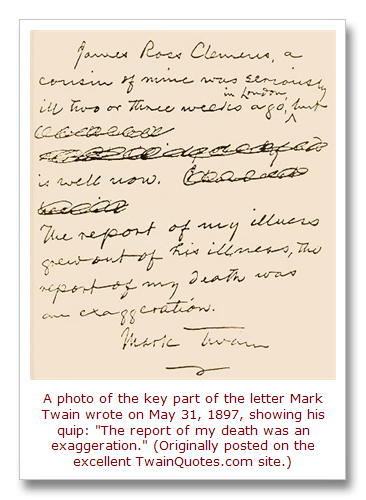
White relayed this request to Twain. On May 31, 1897, Twain wrote down his response and sent it to White.


The next day, White wrote an article that quoted from Twain’s letter. On June 2, 1897, the article was published in the New York Journal. It said, in part:

     Mark Twain was undecided whether to be more amused or annoyed when a Journal representative informed him today of the report in New York that he was dying in poverty in London...
     The great humorist, while not perhaps very robust, is in the best of health. He said:
     “I can understand perfectly how the report of my illness got about, I have even heard on good authority that I was dead. James Ross Clemens, a cousin of mine, was seriously ill two or three weeks ago in London, but is well now. The report of my illness grew out of his illness.
     The report of my death was an exaggeration.”
The origin of the more familiar misquote versions of Twain’s response seems to be the popular biography of Twain written by Albert Bigelow Paine.

Paine’s book was published in 1912, two years after Twain’s death. It includes what is apparently Paine’s own embellished variation of the story about Twain’s death quip.


In Chapter 197 of the biography, Paine said a young reporter had “ferreted out” Twain in London after being assigned to follow up on rumors that the famed humorist was “lying at the point of death.”


According to Paine, the newspaper had sent a cable to the reporter ordering him to send back a five hundred 500-word story if Twain was ill, or a thousand word story if Twain was dead.


Paine claimed that upon being shown the cable, Twain “smiled grimly” and told the young reporter:


      “You don’t need as much as that. Just say the report of my death has been grossly exaggerated.”

 
Most scholarly books of quotations now use or include the quote recorded in the New York Journal article, taken from Twain’s letter to Frank Marshall White.


However, Paine’s “grossly exaggerated” version and “The report of my death has been greatly exaggerated,” which seems to be a colloquial variation of Paine’s line, are better known and commonly assumed to be actual quotes by Twain.


Of course, as Twain wrote in his book Following the Equator, published in November 1897:


       “It is my belief that nearly any invented quotation, played with confidence, stands a good chance to deceive.”


*     *     *     *     *     *     *     *     *     *

Comments? Corrections? Post them on my Famous Quotations Facebook page or send me an email.

Related reading…

Copyrights, Disclaimers & Privacy Policy


Copyright © Subtropic Productions LLC

All original text written for the This Day in Quotes quotations blog is copyrighted by the Subtropic Productions LLC and may not be used without permission, except for short "fair use" excerpts or quotes which, if used, must be attributed to ThisDayinQuotes.com and, if online, must include a link to http://www.ThisDayinQuotes.com/.

To the best of our knowledge, the non-original content posted here is used in a way that is allowed under the fair use doctrine. If you own the copyright to something posted here and believe we may have violated fair use standards, please let us know.

Subtropic Productions LLC and ThisDayinQuotes.com is committed to protecting your privacy. For more details, read this blog's full Privacy Policy.