May 28, 2016

“When you call me that, SMILE!”


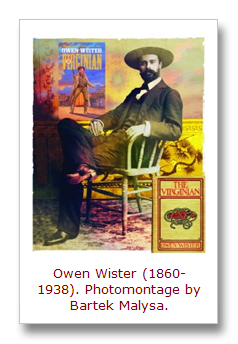
When the groundbreaking Western novel The Virginian by Owen Wister was first published on May 28, 1902, no one could have known that it would become so famous — or that it would create basic formulas used ever since in Western novels, movies, radio and TV shows.

Stories about cowboys, Indians, outlaws, lawmen, gunfighters and settlers were common in the “penny dreadfuls” and “dime novels” published in the last half of the 19th century. They had also appeared in magazines such as Harper’s, which published Wister’s first Western short stories.

But literary scholars generally consider The Virginian to be the first “serious” Western novel and the prototype for the modern cowboy story genre.

Elements of the book are loosely based on the real “Johnson County War” of 1892, a bloody clash between big landowners and small ranchers in Wyoming.

The lead character of Wister's novel is a cowboy simply referred to as “the Virginian.” He's tough, honorable, taciturn and fast on the draw.

Many of the characters, settings and storylines in the book created iconic templates for Westerns that followed in print and on film.

The Virginian also gave us one of the iconic Western quotations: “When you call me that, SMILE!” (commonly misquoted as “Smile when you call me that!”)

This comes from a scene in which the Virginian is playing poker with the novel’s villain, a cowboy named Trampas. Here’s the part that includes the famous warning:

It was now the Virginian’s turn to bet, or leave the game, and he did not speak at once.

Therefore Trampas spoke. “Your bet, you son-of-a--.”

The Virginian’s pistol came out, and his hand lay on the table, holding it unaimed. And with a voice as gentle as ever, the voice that sounded almost like a caress, but drawling a very little more than usual, so that there was almost a space between each word, he issued his orders to the man Trampas: “When you call me that, SMILE.” And he looked at Trampas across the table.

Yes, the voice was gentle. But in my ears it seemed as if somewhere the bell of death was ringing; and silence, like a stroke, fell on the large room.

The classic 1929 film based on Wister’s novel popularized a different version of the “smile” line.

In that film, Gary Cooper stars as the Virginian. His confrontation with Trampas, played by Walter Huston, occurs at the saloon’s bar instead of a poker table.

When Huston calls Cooper a "long-legged son-of-a-", Cooper cuts him off in mid-epithet and says: “If you wanna call me that, smile.”

This 1929 movie adaptation of The Virginian probably led to the “Smile when you call me that!” misquote.

Huston has a great response in the movie that’s not in the book.

“With a gun against my belly,” he says, “I always smile.”

Another classic film adaption of The Virginian was made in 1946. In that one, Joel McCrea plays the title character and the “smile” line he uses is the same as in the novel.

When I was growing up in the 1950s and 1960s, “Smile when you call me that” and “Smile when you say that” were frequently used as joking comebacks.

I remember they were favorites of my father and his old Army buddies.

I don’t often hear people using those once-popular variations of the book and movie lines nowadays.

But whenever I do hear them, it does makes me smile.


*     *     *     *     *     *     *     *     *     *

Comments? Corrections? Post them on the Famous Quotations Facebook page.

Related reading…

April 19, 2016

“Old soldiers never die, they just fade away.”


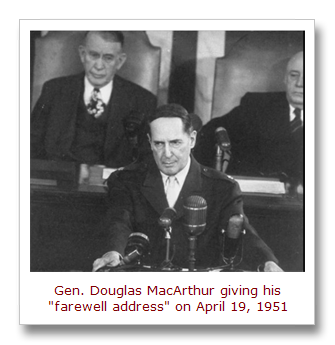
On April 19, 1951, General Douglas MacArthur made a high-profile “farewell address” to a joint meeting of both houses of Congress.

Eight days earlier, he’d been fired as the top commander of the American forces in the Korean War by President Harry Truman, essentially for having the gall to publicly criticize Truman’s denial of his request to nuke Red China (in retaliation for sending troops to fight against the U.S. in Korea).

Truman later famously explained: “I fired him because he wouldn’t respect the authority of the President…I didn’t fire him because he was a dumb son of a bitch, although he was.”

Today, with hindsight, most people would likely support Truman’s decision to avoid World War III and affirm the authority of the Commander-in-Chief.

But in 1951, Truman’s firing of MacArthur was highly controversial — and highly politicized by Truman’s Republican adversaries.

MacArthur was one of America’s most renowned generals during World War II.

Among other things, he was known for making and ultimately keeping the legendary vow “I shall return!” — his promise to return to liberate the Philippines from Japanese control after being forced to escape and leave many of his troops there early in 1942.

On September 2, 1945, MacArthur presided over the official surrender of the Japanese, thus ending that war. He then oversaw the American occupation and initial peacetime revitalization of Japan.

In 1950, when the Korean War broke out, President Truman tapped MacArthur as the Supreme Commander of the Allied Forces who were fighting with South Korea against the North Koreans and their backer, Communist Red China.

MacArthur was well-known and well-liked by most Americans and many believed that the spread of Communism had to be stopped to prevent a “domino effect.”

That didn’t stop the feisty Democratic President from firing him after the general wrote a letter critical of Truman’s decision to avoid further escalation of the war and sent it to Joseph William Martin, Jr., the Republican leader in the House of Representatives.

Martin read the letter aloud on the floor of Congress on April 5th. It was a clear poke in Truman’s eye. Six days later, Truman fired MacArthur.

To poke Truman again, the Republicans invited MacArthur to make a speech to Congress on April 19.

Much of MacArthur’s “farewell address” focused on “the Communist threat.”

He ominously warned that if Communism were allowed to spread in Southeast Asia it would “threaten the freedom of the Philippines and the loss of Japan and might well force our western frontier back to the coast of California, Oregon and Washington.”

Most of that Cold War rhetoric is now forgotten. The thing that is most remembered from MacArthur’s speech is his famous quote: “Old soldiers never die, they just fade away.”

It was part of the closing of his address, in which he said:

“When I joined the Army, even before the turn of the century, it was the fulfillment of all of my boyish hopes and dreams. The world has turned over many times since I took the oath on the plain at West Point, and the hopes and dreams have long since vanished, but I still remember the refrain of one of the most popular barrack ballads of that day which proclaimed most proudly that ‘old soldiers never die, they just fade away.’ And like the old soldier of that ballad, I now close my military career and just fade away, an old soldier who tried to do his duty as God gave him the light to see that duty. Good-bye.”

As MacArthur noted, the line “old soldiers never die, they just fade away” is not something he coined. It comes from a song that was popular with British soldiers during World War I, called “Old Soldiers Never Die.”

The barracks room song was a parody of the hymn “Kind Words Never Die.” And, unlike the ending of MacArthur’s farewell address, the lyrics of the Army song are more satiric than schmaltzy.

There are several different versions. Here are the lyrics recorded by the late, great quote and phrase maven Eric Partridge in his Dictionary of Catch Phrases :

       “Old soldiers never die, 
       Never die, never die, 
       Old soldiers never die —
       They simply fade away. 

       Old soldiers never die, 
       Never die, never die,
       Old soldiers never die —
       Young ones wish they would.”

Ironically, that and other early versions of the song poked fun at Army life and at career soldiers and officers like MacArthur.

However, after MacArthur cited the song in his farewell speech, Gene Autry rewrote the lyrics to create a more respectful version that specifically praised the general. The last verse of Autry’s rendition says:

       “Now somewhere, there stands the man
       His duty o’er and won
       The world will ne’er forget him
       To him we say, ‘Well done.’”

President Truman had a different reaction to MacArthur’s farewell speech.

When asked about it in one of the interviews recorded by Merle Miller for the book Plain Speaking: An Oral Biography of Harry S. Truman (1974), Truman said it was “nothing but a bunch of damn bullshit!”

*     *     *     *     *     *     *     *     *     *

Comments? Corrections? Post them on the Famous Quotations Facebook page.

Related reading and viewing…

April 15, 2016

Oh, the irony! Tax Day is also a legal anniversary of “Plop, plop, fizz, fizz…”


America’s federal income tax was first created by Congress in 1861, to help fund the Union Army during the Civil War.

The original deadline set for paying the tax was June 30.

In 1895, that first Federal income tax law was declared unconstitutional and overturned by the U.S. Supreme Court.

This little legal problem was fixed in 1913 when the Sixteenth Amendment to the United States Constitution was ratified.

The tax deadline was then set as March 1.

In 1918, it was moved to March 15.

Then, in 1955, the traditional date for filing tax returns was changed to April 15, a now long-dreaded date that has come to be known as “Tax Day.”

If the process of filling out and sending your income tax return to the Internal Revenue Service gives you heartburn, then a famous advertising slogan linked to the date April 15th will strike you as appropriate.

In 1976, Miles Laboratories filed a trademark application to protect the slogan it had been using to promote Alka-Seltzer, the “effervescent analgesic alkalizing tablets” the company first began selling in 1931.

The slogan was used in Alka Seltzer TV commercials in the 1960s. But for some reason unknown to me the legal anniversary of it’s use as a “Word Mark” for trademark purposes came later.

The company's official trademark filing in 1976 said this advertising “Word Mark” was “First used in commerce on April 15, 1976.”

I can’t explain why that date was used for legal reasons. But it does strike me as ironic that it’s the same as the legal date for “Tax Day.”

Unless you’re too young, you probably know the words in this “Word Mark.”

They were initially used in a jingle sung by Speedy, the animated star of Alka Seltzer’s TV commercials, and continued to be sung, spoken and printed in Alka Seltzer ads for years:

“Plop, plop, fizz, fizz,
Oh, what a relief it is!”

As some aficionados of obscure rock trivia know, the music for the famed Alka Seltzer jingle was written by Thomas W. Dawes, a founding member of The Cyrkle.

The Cyrkle was the Sixties rock music group best known for their hits “Red Rubber Ball” (written by Paul Simon and Bruce Woodley) and “Turn Down Day.”

Dawes later wrote many other jingles used in ads for other products, including 7-Up (“7Up, the Uncola”), L’Eggs (“Our L’eggs fit your legs), McDonald’s (“You, You’re the One”) and Vidal Sassoon’s hair care line (“If You Don’t Look Good, We Don’t Look Good”).

Anyway, next time you get heartburn as you fill out your federal income taxes, queue up a vintage Alka-Seltzer TV ad on YouTube, pop a couple tablets, and sing along with Speedy.

You could also rewatch one of the later Alka Seltzer ads with equally famous catchphrases, like “Mama mia! That’s a spicy meatball!” (first used in 1969) or “I can't believe I ate that whole thing” (first used in 1972).

It won’t relieve the financial pain.

But at least watching some hokey old Alka Seltzer ad might make you smile.

*     *     *     *     *     *     *     *     *     *

Comments? Questions? Corrections? Post them on the Famous Quotations Facebook page.

Related reading, viewing and listening…

April 13, 2016

Wayne LaPierre’s (in)famous “jack-booted government thugs” quote…

Wayne LaPierre jack-booted thugs quote 1995
For many decades after the National Rifle Association was founded in 1871, a main focus of the group was on urging and teaching gun safety, to help reduce gun-related accidents.

In fact, the famous slogan associated with the NRA — “Guns don’t kill people. People kill people.” — was once used as a cautionary safety warning, rather than as defensive response in the debate over gun control.

In recent decades, the NRA’s primary public focus has been on protecting and expanding Americans’ right to own and carry guns.

Your position on the controversial issue of gun control probably determines how you view the NRA slogan and a famous (and infamous) gun-related quote that’s linked to the date April 13.

In a fundraising letter to NRA members, dated April 13, 1995, NRA Executive Vice President Wayne LaPierre called the federal officials who enforce U.S. gun laws “jack-booted government thugs.”

LaPierre tied the phrase to a law banning certain semi-automatic and automatic weapons, which had passed during President Bill Clinton’s first term in office, with Clinton’s support.

That law is popularly known as The Federal Assault Weapons Ban (AWB).

The AWB is a subsection of the broader Violent Crime Control and Law Enforcement Act of 1994. The provisions in that act which imposed harsher penalties on violent and repeat offenders have recently inspired “Black Lives Matter” protesters to heckle both Hillary and Bill Clinton at their 2016 primary campaign speaking engagements.

Back in 1995, it was Wayne LaPierre who was making news for harshly attacking the measure and its enforcement.

Among other things, LaPierre said in the April 13, 1995 letter to NRA members:

“…the semiauto-auto ban gives jack-booted government thugs more power to take away our constitutional rights, break in our doors, seize our guns, destroy our property, and even injure or kill us.”

The last part of that sentence conjured up images of the fatal confrontations between officials from the Bureau of Alcohol, Tobacco and Firearms (BATF) and Randy Weaver’s family at Ruby Ridge, Idaho in 1992 and the Branch Davidians at Waco, Texas in 1993.

LaPierre’s use of the phrase “jack-booted government thugs” was his metaphorical way of equating BATF officials with Nazis.

During the early part of World War II, before leather shortages developed, German soldiers wore distinctive military “jack boots.”

Since then, the name of those high leather boots has been commonly used as a symbolic reference to totalitarian governments.

On April 19, 1995, just six days after LaPierre sent out his NRA fundraising letter, the Alfred P. Murrah Federal Building in downtown Oklahoma City was destroyed by a bomb, killing 168 people.

It was later discovered that the conspirators behind the Oklahoma City bombing, Timothy McVeigh and Terry Nichols, were also angry over gun control laws and the federal government’s involvement in the Ruby Ridge and Waco tragedies.

Gun control advocates suggested that the inflammatory rhetoric in LaPierre’s letter had encouraged the bombing.

Wayne LaPierre on Fox News-8x6NRA officials denied that there was any link.

However, a few weeks after the Oklahoma bombing, in an interview reported by the Associated Press, LaPierre did publicly apologize for the harshness of his remarks about federal officials.

“If anyone thought the intention was to paint all federal law enforcement officials with the same broad brush,” LaPierre said, “I’m sorry.”

Nonetheless, LaPierre’s use of the phrase “jack-booted government thugs” in his fundraising letter remains notorious among gun control advocates and critics of the NRA.

For example, in 2011, liberal groups harshly criticized Fox News for using LaPierre as a commentator in a segment about the Bureau of Alcohol, Tobacco and Firearms.

An opinion piece on the liberal website Media Matters said:

“LaPierre is the last person a responsible media outlet should have on its airwaves to comment on the Bureau…because LaPierre once referred to ATF agents as ‘jack-booted government thugs.’”

Today, the phrase is still being cited in articles and commentary about gun control, the NRA and LaPierre.

A January 5, 2016 editorial in the New York Daily News about the continued opposition to gun control by the NRA and its political allies, despite the recent wave of mass shootings in schools and other public places, reminded readers:

“Just one month before Timothy McVeigh and Terry Nichols killed 168 people in the Oklahoma City Federal Building, the NRA’s Wayne LaPierre railed against ‘jack-booted government thugs.’”

Of course, in the view of NRA members, guns and ill-advised words don’t kill people — ill people do.

It’s a debate that is likely to continue for many decades to come.

*     *     *     *     *     *     *     *     *     * 

Comments? Questions? Corrections? Post them on the Famous Quotations Facebook page.

Related reading and listening…


April 11, 2016

“A statesman is a politician who’s been dead ten or fifteen years.”


During Harry S Truman’s years as President of the United States, from 1945 to 1954, he was known as a feisty politician.

It earned him the nickname “Give ‘em Hell Harry.”

That nickname emerged during his 1948 campaign as the Democratic presidential nominee, when supporters began yelling “Give ‘em Hell, Harry!” at his campaign events.

It was further cemented by two of Truman’s legendary quotes from that campaign.

He told Alben Barkley, his Vice Presidential running mate: “I’m going to fight hard…I’m going to give them hell.”

Referring to the Republican-dominated Congress (which he memorably dubbed the “Do Nothing Congress”) to and Thomas E. Dewey, his Republican opponent in the 1948 election, Truman purportedly said: “I don’t give them hell. I tell the truth and they think it’s hell.”

Some people today think of Truman as being more of a “statesman” than recent crops of politicians, in the sense of somehow being more above rough-and-tumble political maneuvering and clashes.

Given the craziness of the 2016 presidential campaign, it’s not hard to believe.

However, I suspect that if Truman were still alive and someone asked him about the difference between a politician and a statesman, he would recycle the famous definition he gave in a speech on April 11, 1958.

Speaking that day to the Reciprocity Club in Washington, D.C., the then-retired president said: “A statesman is a politician who’s been dead ten or fifteen years.”

It’s a funny line. But when you know the context, you find that Truman was making a serious point about the pragmatic business of being an effective politician and running a government.

Here’s the full quote, as recorded in the April 12, 1958 edition of The New York World Telegram & Sun:

      “I’m proud that I’m a politician. A politician is a man who understands government, and it takes a politician to run a government. A statesman is a politician who's been dead ten or fifteen years.”

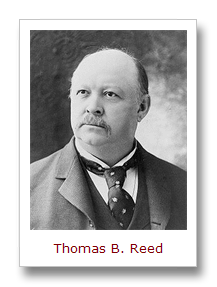
Truman’s remark was a take-off on an earlier famous quotation by another politician, Thomas Brackett Reed.

Reed was a Congressman from Maine who served as Speaker of the U.S. House of Representatives from 1889 to 1891 and again from 1895 to 1899.

In 1892, he received a letter from a citizen who asked him: “What is a statesman?”

Reed replied: “A statesman is a successful politician who is dead.”

This is now sometimes quoted without the word “successful.” The longer version is used by the earlier and more scholarly sources that cite it.

In March of 1892, news reports about Reed’s definition of a statesman prompted a response by a Boston man, who sent him a snide telegram that said: “Why don’t you die and become a statesman?”

Reed sent back a telegram that quoted a proverbial saying about fame.

“Not yet,” he replied. “Fame is the last infirmity of noble minds.”

By the way, there’s another famous quote by Harry Truman that’s linked to the date April 11.

On April 11, 1951, Truman announced his decision to fire General Douglas MacArthur as commander of U.S. forces in Korea, after MacArthur publicly disagreed with Truman’s policy of limiting the expansion of the Korean War.

More than two decades later, when biographer Merle Miller was interviewing Truman for the book Plain Speaking: An Oral Biography of Harry S. Truman (1974), Miller asked the former president to talk about his rationale for firing MacArthur.

Truman’s blunt and salty answer became a famous quote when the book was published. He told Miller:

“I fired him because he wouldn’t respect the authority of the President…I didn’t fire him because he was a dumb son of a bitch, although he was, but that’s not against the laws for generals. If it was, half to three-quarters of them would be in jail.”

To read more background on that Truman quote, see my post about it at this link.

For more on quotes about the difference between a statesman and a politician, see this post by word maven Barry Popik on his “Big Apple” website.

*     *     *     *     *     *     *     *     *     *

Comments? Questions? Corrections? Post them on the Famous Quotations Facebook page.

Related reading…


Copyrights, Disclaimers & Privacy Policy


Copyright © Subtropic Productions LLC

All original text written for the This Day in Quotes quotations blog is copyrighted by the Subtropic Productions LLC and may not be used without permission, except for short "fair use" excerpts or quotes which, if used, must be attributed to ThisDayinQuotes.com and, if online, must include a link to http://www.ThisDayinQuotes.com/.

To the best of our knowledge, the non-original content posted here is used in a way that is allowed under the fair use doctrine. If you own the copyright to something posted here and believe we may have violated fair use standards, please let us know.

Subtropic Productions LLC and ThisDayinQuotes.com is committed to protecting your privacy. For more details, read this blog's full Privacy Policy.