Showing posts with label April 19. Show all posts

April 08, 2022

“The shot heard round the world”

The famous phrase “The shot heard round the world” was coined by American essayist, lecturer and poet Ralph Waldo Emerson (1803-1882) in 1837.

It’s the last line in the first verse of his poem “Hymn: Sung at the Completion of the Concord Monument,” generally referred to as “The Concord Hymn.”

Emerson wrote the poem for the official dedication of the Concord Monument on July 4, 1837. The monument commemorates the “Battle of Concord” that took place at Concord, Massachusetts on April 19, 1775, a seminal event in the American Revolution.

That day, some 700 British Army regulars began marching through Lexington toward Concord to confiscate an illegal weapons arsenal stored there by the Massachusetts militia. When the “Redcoats” got to Lexington, their way was blocked by about 80 local militiamen.

British Major John Pitcairn ordered the Americans to disperse, which they actually began to do.

Then, suddenly, someone fired a shot. Nobody knew who it was. But, when it rang out, both sides started firing at each other and the American Revolution was underway.

Emerson’s name for that first shot comes in the first verse of his poem, which reads:

“By the rude bridge that arched the flood,
Their flag to April’s breeze unfurled,
Here once the embattled farmers stood
And fired the shot heard round the world.”

At the 1837 ceremony to dedicate the monument, the poem was first read to the audience. Then, as planned, it was sung by a choir to the tune of a hymn called “The Old Hundredth,” a.k.a. “The Old 100th” or “The Old Hundred.” (Hence the use of the word “hymn” in the poem’s title.)

The rest of the verses are as follows:

“The foe long since in silence slept;
Alike the conqueror silent sleeps;
And Time the ruined bridge has swept;
Down the dark stream which seaward creeps.

On this green bank, by this soft stream,
We set today a votive stone;
That memory may their deed redeem,
When, like our sires, our sons are gone. 

Spirit, that made those heroes dare,
To die, and leave their children free,
Bid Time and Nature gently spare
The shaft we raise to them and thee.”

Emerson’s poem was widely reprinted in newspapers nationwide, giving him his first major recognition as a poet. Previously, he’d been known primarily as an essayist and lecturer.

It was included in his collection of poetry titled Poems, first published in 1848.

Oddly, in that edition, he misremembered the date of the Concord Monument dedication, since he gave the poem’s title as: “HYMN: SUNG AT THE COMPLETION OF THE CONCORD MONUMENT, April 19, 1836.”

Emerson had apparently confused the April 19, 1775 date of the Concord Battle with the July 4, 1837 date of the monument’s dedication.

In 1894, Massachusetts State Legislature commemorated the battle by making April 19 a state holiday named “Patriots’ Day.” It has remained a state holiday, though it is now celebrated on the third Monday of April, so the date varies.

In Massachusetts, it’s a day off for most people and schools and most businesses are closed. It’s also the day when the venerable Boston Marathon occurs.

Patriots’ Day is also celebrated in Maine and Wisconsin, but it’s not a national holiday.

The national holiday called “Patriot Day” is different from Patriots’ Day.

Patriot Day is an annual observance in remembrance of the Americans who were killed and injured in the 9/11 terrorist attacks on New York City and Washington D.C. on September 11, 2001.

Emerson’s memorable words “the shot heard round the world” created a phrase formula that has been used ever since to refer to various other things that, when seen or heard, generated widespread attention or notoriety.

Recently, for example, NPR TV critic and author Eric Deggans called actor Will Smith’s open-handed sucker punch of comedian Chris Rock at the March 27, 2022 Academy Awards “The Slap Seen Around the World.”

The words Smith yelled at Rock after the slap are at least a temporarily famous quotation: “Keep my wife's name out your f***ing mouth!”

In a post on the NPR website the next day, Deggans (who is black) wrote:

“What bothered me most, after The Slap Seen Around the World, was how the giants of Black Hollywood immediately circled to protect Will Smith...Will anyone famous who stood and applauded Smith after his acceptance speech be asked to explain their actions? Will the Academy or Oscarcast producers explain why they allowed someone to hit a performer — a friend sent me a text joking that Ricky Gervais is lucky he’s not still hosting the Golden Globes — and then collect an award?”

The lists of other things said to have been heard or seen “round the world” or “around the world” since Emerson coined his phrase are enormous.

You can see more than a million examples that use “heard” in the posts shown in the Google search at this link. You can see over a million examples using “seen” in the posts at this link. (Also see the post on my Quote/Counterquote blog here.)

Undoubtedly, there will be many more in the future.

*     *     *     *     *     *     *     *     *     *

Comments? Corrections? Questions? Email me or post them on my Famous Quotations Facebook page.

Related reading and listening…


April 19, 2016

“Old soldiers never die, they just fade away.”


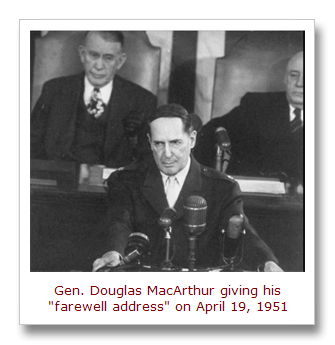
On April 19, 1951, General Douglas MacArthur made a high-profile “farewell address” to a joint meeting of both houses of Congress.

Eight days earlier, he’d been fired as the top commander of the American forces in the Korean War by President Harry Truman, essentially for having the gall to publicly criticize Truman’s denial of his request to nuke Red China (in retaliation for sending troops to fight against the U.S. in Korea).

Truman later famously explained: “I fired him because he wouldn’t respect the authority of the President…I didn’t fire him because he was a dumb son of a bitch, although he was.”

Today, with hindsight, most people would likely support Truman’s decision to avoid World War III and affirm the authority of the Commander-in-Chief.

But in 1951, Truman’s firing of MacArthur was highly controversial — and highly politicized by Truman’s Republican adversaries.

MacArthur was one of America’s most renowned generals during World War II.

Among other things, he was known for making and ultimately keeping the legendary vow “I shall return!”his promise to return to liberate the Philippines from Japanese control after being forced to escape and leave many of his troops there early in 1942.

On September 2, 1945, MacArthur presided over the official surrender of the Japanese, thus ending that war. He then oversaw the American occupation and initial peacetime revitalization of Japan.

In 1950, when the Korean War broke out, President Truman tapped MacArthur as the Supreme Commander of the Allied Forces who were fighting with South Korea against the North Koreans and their backer, Communist Red China.

MacArthur was well-known and well-liked by most Americans and many believed that the spread of Communism had to be stopped to prevent a “domino effect.”

That didn’t stop the feisty Democratic President from firing him after the general wrote a letter critical of Truman’s decision to avoid further escalation of the war and sent it to Joseph William Martin, Jr., the Republican leader in the House of Representatives.

Martin read the letter aloud on the floor of Congress on April 5th. It was a clear poke in Truman’s eye. Six days later, Truman fired MacArthur.

To poke Truman again, the Republicans invited MacArthur to make a speech to Congress on April 19.

Much of MacArthur’s “farewell address” focused on “the Communist threat.”

He ominously warned that if Communism were allowed to spread in Southeast Asia it would “threaten the freedom of the Philippines and the loss of Japan and might well force our western frontier back to the coast of California, Oregon and Washington.”

Most of that Cold War rhetoric is now forgotten. The thing that is most remembered from MacArthur’s speech is his famous quote: “Old soldiers never die, they just fade away.”

It was part of the closing of his address, in which he said:

“When I joined the Army, even before the turn of the century, it was the fulfillment of all of my boyish hopes and dreams. The world has turned over many times since I took the oath on the plain at West Point, and the hopes and dreams have long since vanished, but I still remember the refrain of one of the most popular barrack ballads of that day which proclaimed most proudly that ‘old soldiers never die, they just fade away.’ And like the old soldier of that ballad, I now close my military career and just fade away, an old soldier who tried to do his duty as God gave him the light to see that duty. Good-bye.”

As MacArthur noted, the line “old soldiers never die, they just fade away” is not something he coined. It comes from a song that was popular with British soldiers during World War I, called “Old Soldiers Never Die.”

The barracks room song was a parody of the hymn “Kind Words Never Die.” And, unlike the ending of MacArthur’s farewell address, the lyrics of the Army song are more satiric than schmaltzy.

There are several different versions. Here are the lyrics recorded by the late, great quote and phrase maven Eric Partridge in his Dictionary of Catch Phrases :

       “Old soldiers never die, 
       Never die, never die, 
       Old soldiers never die —
       They simply fade away. 

       Old soldiers never die, 
       Never die, never die,
       Old soldiers never die —
       Young ones wish they would.”

Ironically, that and other early versions of the song poked fun at Army life and at career soldiers and officers like MacArthur.

However, after MacArthur cited the song in his farewell speech, Gene Autry rewrote the lyrics to create a more respectful version that specifically praised the general. The last verse of Autry’s rendition says:

       “Now somewhere, there stands the man
       His duty o’er and won
       The world will ne’er forget him
       To him we say, ‘Well done.’”

President Truman had a different reaction to MacArthur’s farewell speech.

When asked about it in one of the interviews recorded by Merle Miller for the book Plain Speaking: An Oral Biography of Harry S. Truman (1974), Truman said it was “nothing but a bunch of damn bullshit!”

*     *     *     *     *     *     *     *     *     *

Comments? Corrections? Post them on the Famous Quotations Facebook page.

Related reading and viewing

Copyrights, Disclaimers & Privacy Policy


Copyright © Subtropic Productions LLC

All original text written for the This Day in Quotes quotations blog is copyrighted by the Subtropic Productions LLC and may not be used without permission, except for short "fair use" excerpts or quotes which, if used, must be attributed to ThisDayinQuotes.com and, if online, must include a link to http://www.ThisDayinQuotes.com/.

To the best of our knowledge, the non-original content posted here is used in a way that is allowed under the fair use doctrine. If you own the copyright to something posted here and believe we may have violated fair use standards, please let us know.

Subtropic Productions LLC and ThisDayinQuotes.com is committed to protecting your privacy. For more details, read this blog's full Privacy Policy.