June 26, 2022

President Kennedy’s “Ich bin ein Berliner” speech


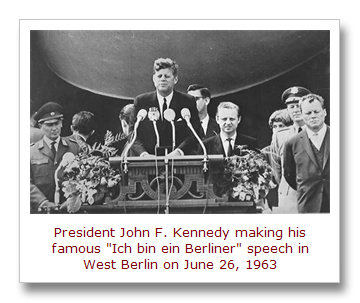
One of the famous quotations linked to the date June 26th is a line President John F. Kennedy spoke in German on June 26, 1963: “Ich bin ein Berliner.”

Kennedy used the line twice that day in a historic speech in West Berlin, which was then separated from Communist-controlled East Berlin by the Berlin Wall.

His intention was to express his solidarity with the people there, by symbolically calling himself a citizen of Berlin. And, the literal translation of “Ich bin ein Berliner” is indeed “I am a Berliner.”

However, there’s been a long-running debate over Kennedy’s grammar.

His use of “ein” is the issue.

Ein” does means “a” in English. But Germans use the word “Berliner” without “ein” to mean “a citizen of Berlin.”

They say “Ich bin Berliner” when they want to say the English equivalent of “I am a Berliner.”

The term “ein Berliner” — when used as a noun — refers to the jelly-filled, doughnut-like pastry Germans call “ein Pfannkuchen Berliner” or “ein Berliner” for short.

Similarly, a citizen of Frankfurt, Germany, would say “Ich bin Frankfurter,” rather than “Ich bin ein Frankfurter.” The latter could theoretically be interpreted to mean “I am a hot dog.”

For this reason, Kennedy’s line “Ich bin ein Berliner” has generated both amusement and heated discussion over the years.

Technically, it’s true that what he said in German could be interpreted as “I am a jelly-filled doughnut.”

That’s why some people claim the quote is laughable.

It has also been claimed that West Germans who were there listening to Kennedy laughed at him when he said the line.

On the flip side, some people have claimed “ein Berliner” is grammatically correct when used by someone who is not really a citizen of Berlin. They say the doughnut theory is an urban legend.

My own view is that Kennedy’s grammar was non-standard.

However, much more importantly, the people of West Berlin knew exactly what Kennedy meant when he said “Ich bin ein Berliner.”

They knew he wasn’t talking about a jelly-filled doughnut. And, they found his words inspiring, not laughable.

You can see why by reading or watching a video of Kennedy’s speech.

It’s one of the most famous speeches in history. And, the crowd of more than 120,000 West Germans who were there on June 26, 1963 were cheering loudly — not laughing.

*     *     *     *     *     *     *     *     *     *

John F. Kennedy’s “Ich bin ein Berliner” speech

Delivered in front of the Berlin Wall at Rudolph Wilde Platz in West Berlin
June 26, 1963

I am proud to come to this city as the guest of your distinguished Mayor, who has symbolized throughout the world the fighting spirit of West Berlin. And I am proud to visit the Federal Republic with your distinguished Chancellor who for so many years has committed Germany to democracy and freedom and progress, and to come here in the company of my fellow American, General Clay, who has been in this city during its great moments of crisis and will come again if ever needed.

John F Kennedy Ich Bin Ein Berliner speechTwo thousand years ago, the proudest boast was “Civis Romanus sum.” [“I am a Roman Citizen”] Today, in the world of freedom, the proudest boast is “Ich bin ein Berliner.”

I appreciate my interpreter translating my German.

There are many people in the world who really don’t understand, or say they don’t, what is the great issue between the free world and the Communist world. Let them come to Berlin.

There are some who say that communism is the wave of the future. Let them come to Berlin.

And there are some who say, in Europe and elsewhere, we can work with the Communists. Let them come to Berlin.

And there are even a few who say that it is true that communism is an evil system, but it permits us to make economic progress. Lass’ sie nach Berlin kommen. Let them come to Berlin.

Freedom has many difficulties and democracy is not perfect. But we have never had to put a wall up to keep our people in — to prevent them from leaving us. I want to say on behalf of my countrymen who live many miles away on the other side of the Atlantic, who are far distant from you, that they take the greatest pride, that they have been able to share with you, even from a distance, the story of the last 18 years. I know of no town, no city, that has been besieged for 18 years that still lives with the vitality and the force, and the hope, and the determination of the city of West Berlin.

While the wall is the most obvious and vivid demonstration of the failures of the Communist system — for all the world to see — we take no satisfaction in it; for it is, as your Mayor has said, an offense not only against history but an offense against humanity, separating families, dividing husbands and wives and brothers and sisters, and dividing a people who wish to be joined together.

What is true of this city is true of Germany: Real, lasting peace in Europe can never be assured as long as one German out of four is denied the elementary right of free men, and that is to make a free choice. In 18 years of peace and good faith, this generation of Germans has earned the right to be free, including the right to unite their families and their nation in lasting peace, with good will to all people.

You live in a defended island of freedom, but your life is part of the main. So let me ask you, as I close, to lift your eyes beyond the dangers of today, to the hopes of tomorrow, beyond the freedom merely of this city of Berlin, or your country of Germany, to the advance of freedom everywhere, beyond the wall to the day of peace with justice, beyond yourselves and ourselves to all mankind.

Freedom is indivisible, and when one man is enslaved, all are not free. When all are free, then we can look forward to that day when this city will be joined as one and this country and this great Continent of Europe in a peaceful and hopeful globe. When that day finally comes, as it will, the people of West Berlin can take sober satisfaction in the fact that they were in the front lines for almost two decades.

All free men, wherever they may live, are citizens of Berlin.

And, therefore, as a free man, I take pride in the words “Ich bin ein Berliner.”

*     *     *     *     *     *     *     *     *     *

Comments? Corrections? Questions? Email me or post them on my Famous Quotations Facebook page.

Related reading, listening and stuff…

June 13, 2022

“You have the right to remain silent.”

You probably know the famed “Miranda Rights” warning police are supposed to recite to someone they are arresting.

Even if you’ve never been arrested and heard it spoken by a law enforcement officer in real life, it’s spoken by characters in thousands of TV shows, movies, and books.

The exact language varies from state to state and in fictional uses, but in most cases the key lines are — or are close to — the following:

     “You have the right to remain silent. Anything you say can and will be used against you in a court of law. You have the right to an attorney. If you cannot afford an attorney, one will be provided for you. Do you understand the rights I have just read to you?”

Since the late 1960s, those words, especially “You have the right to remain silent,” have become famous. But most people know little about their origin.

The Miranda Rights warning dates back to June 13, 1966, when the U.S. Supreme Court issued its decision on the case Miranda v. Arizona.

That case involved a 22-year-old Arizona man named Ernesto Arturo Miranda.

Miranda had a tough life with a checkered past. By 1966, he had previously been arrested for of a number of crimes, including burglary, vagrancy, armed robbery, being a “peeping Tom,” and car theft. As a teenager, he was sentenced to time in an Arizona “reform school” twice and later spent time in jails in California, Texas, Ohio and Arizona.

In the early 1960s, Miranda was a free man who worked as a laborer at various jobs in Phoenix and generally stayed out of trouble.

Then, on March 2, 1963, an 18-year-old Phoenix woman told police a man had abducted her, driven her into the desert and raped her. Her description of the man’s truck led the police to Miranda. The victim failed to identify him in a line-up. But the police decided to take him into custody and interrogate him. After hours of questioning, Miranda signed a confession. He was soon convicted and sent to jail.

However, the American Civil Liberties Union (ACLU) decided to appeal Miranda’s conviction, after he later claimed he was innocent and that his confession had been coerced. The ACLU focused, among other things, on the fact that Miranda had not been aware of his right under the Fifth Amendment to the U.S. Constitution not to say anything that would incriminate him. Nor had the police made him aware of that right.

Under the Fifth Amendment, “No person...shall be compelled in any criminal case to be a witness against himself.” That’s the part people are referring to when they “take the Fifth” and refuse to testify about something.

Miranda v. Arizona was appealed up to the U.S. Supreme Court. The justices ultimately ruled that Miranda’s rights had indeed been violated. The court’s decision included a section that became the basis for what was soon being called “Miranda Rights.”

The relevant text from the court decision says:

“Prior to any questioning, the person must be warned that he has a right to remain silent, that any statement he does make may be used as evidence against him, and that he has a right to the presence of an attorney, either retained or appointed. The defendant may waive effectuation of these rights, provided the waiver is made voluntarily, knowingly and intelligently. If, however, he indicates in any manner and at any stage of the [384 U.S. 436, 445] process that he wishes to consult with an attorney before speaking there can be no questioning. Likewise, if the individual is alone and indicates in any manner that he does not wish to be interrogated, the police may not question him. The mere fact that he may have answered some questions or volunteered some statements on his own does not deprive him of the right to refrain from answering any further inquiries until he has consulted with an attorney and thereafter consents to be questioned.”

This was boiled down to the lines in the standard Miranda Rights warning spoken to suspects by law enforcement officers. The required wording varies slightly from state to state, but always embodies the basic thrust of the Supreme Court decision.

Unfortunately for Ernesto Miranda, the Supreme Court’s ruling didn’t end his long string of bad luck.

It overturned his initial conviction and set a major legal precedent, but it didn’t actually exonerate him.

The State of Arizona decided to retry Miranda on the rape charge. In the second trial, his confession was not used, but his estranged common law wife testified against him. On March 27, 1967, he was convicted again and sent back to prison.

Although Miranda received a harsh sentence of 20 to 30 years, he was paroled in 1972. Over the next few years, he was arrested several times for mostly minor offences, but he stayed out of serious trouble and became something of a celebrity.

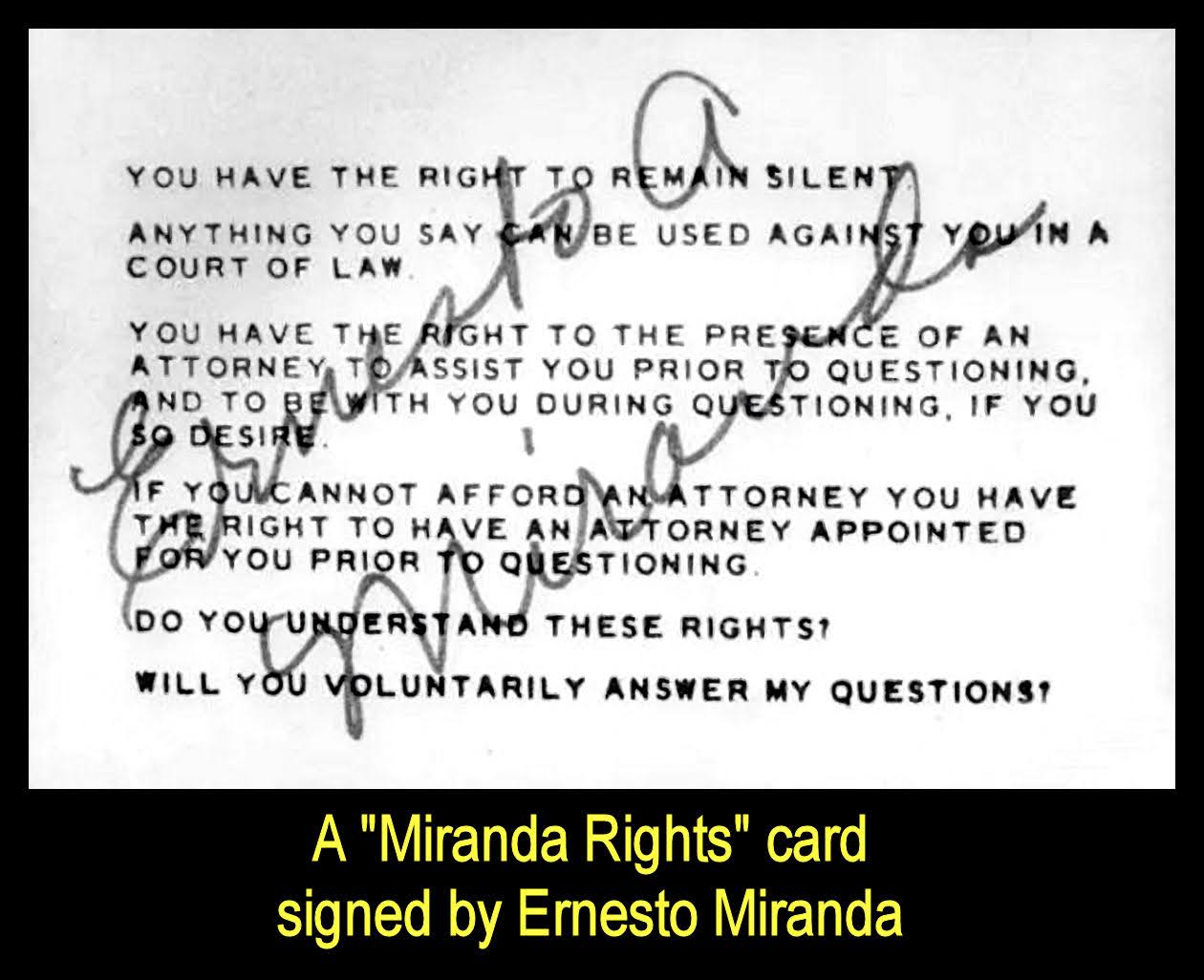
One of the ways he made money in his final years was by selling autographed “Miranda Rights cards” showing the language of the required warning his Supreme Court case had embedded into American law and our language.

In January 1976, Miranda was stabbed to death in the men’s room of a bar in Phoenix, after a dispute over a poker game. A 23-year-old Mexican man who had been there was initially held for the slaying. However, he was not charged due to a lack of evidence and headed back to Mexico.

Among the things found in Ernesto Miranda’s pockets after his death were several autographed Miranda Rights cards.

EDITOR’S NOTE: Another quote linked to June 13 is the famed quip by Baseball Hall of Famer Satchel Paige, “Don’t look back. Something might be gaining on you.” You can read the background on that quotation in my post at this link.

*     *     *     *     *     *     *     *     *     *

Comments? Corrections? Questions? Email me or post them on my Famous Quotations Facebook page.

Related reading, listening and stuff…

June 12, 2022

The origin of the proverbial political “smoke-filled room”


Although smoking is either banned or not tolerated in most meetings today, the idea of a meeting of power brokers making deals behind closed doors “in a smoke-filled room” is still a well-known political image and metaphor.

The now-idiomatic “smoke-filled room” was embedded in our language by an Associated Press article filed on June 12, 1920 by reporter Kirke L. Simpson.

That story dealt with the nomination of former Ohio Governor Warren G. Harding as the Republican Party’s candidate in the 1920 Presidential election.

My grade school and high school history books didn’t delve into the backroom machinations leading to Harding’s nomination.

But like other fans of the HBO television series Boardwalk Empire, I learned a bit about the real life characters involved and the wheeling and dealing that went on from watching some of the show’s Season 1 episodes.

Those episodes suggest that Atlantic City political boss Enoch “Nucky” Thompson (played by actor Steve Buscemi) was instrumental in swinging the nomination to Harding.

While that may be one of a number of fictionalized plot elements in the series, Harding’s nomination was the result of some hard-nosed political deal-making.

In the days leading up to June 12, delegates to the Republican Convention in Chicago had reached an impasse.

Neither of the two leading candidates — former U.S. Army General Leonard Wood and Illinois Governor Frank O. Lowden — could gain a majority of delegate votes.

So, on the night of June 11, a small group of top Republican party officials held a private meeting in Suite 404 in Chicago’s Blackstone Hotel.

Smoke from their cigars filled the room as they discussed the latest ideas on how to break the deadlock.

Sometime after midnight, they decided to push through the nomination of Harding as a compromise candidate who could win in the key state of Ohio and would be friendly to the Captains of Industry.

The AP story filed by Kirke Simpson that morning famously said:

      “Harding of Ohio was chosen by a group of men in a smoke-filled room early today as Republican candidate for President.”

Simpson is often credited with coining the phrase “smoke-filled room,” at least in its political sense.

Some sources say that he got the phrase from Harding’s campaign manager, Harry Daugherty (played by actor Christopher McDonald in Boardwalk Empire).

Daugherty allegedly predicted in remarks to reporters:

“The convention will be deadlocked, and after the other candidates have gone their limit, some twelve or fifteen men, worn out and bleary-eyed for lack of sleep, will sit down about two o'clock in the morning, around a table in a smoke-filled room in some hotel and decide the nomination.  When that time comes, Harding will be selected.”

Safire's Political Dictionary, written by the late, great political quote maven William Safire, notes that Daugherty denied saying this.

Either way, the Kirke Simpson’s news story usually gets credit for making “a smoke-filled room” a common political term.

Simpson went on to win the Pulitzer Prize two years later for his series of articles about the burial and tomb of “The Unknown Soldier.”

Harding went on to be elected President of the United States, though he died in office a few years later, after a series of scandals made him a frequent nominee for lists of the worst presidents in history.     

*     *     *     *     *     *     *     *     *     *

Comments? Corrections? Post them on my Famous Quotations Facebook group.

Related reading… 


May 17, 2022

Mitt Romney’s infamous “47 percent” quote


On May 17, 2012, Republican presidential candidate, Senator Mitt Romney (R-Utah), said something that was later cited as one of the factors that caused him to lose the election to his Democratic opponent, President Barack Obama.

It was put #1 in the list of the “top” quotations of 2012 by Fred Shapiro, associate librarian at Yale Law School and author of the authoritative Yale Book of Quotations

It’s among the most damaging political gaffes ever uttered.

Romney was speaking to a group of wealthy Republican donors at a private fundraiser in Boca Raton, Florida.

At one point, he started talking about people who pay no taxes. And, he wasn’t referring to the rich people and corporations who find ways to avoid paying taxes and are usually Republican supporters.

He was talking about people whose incomes are so low they pay no federal income taxes and receive various types of assistance from the federal government.

In his list of the most notable quotes of 2012, Shapiro used this shortened version of what Romney said:

    “There are 47 percent of the people who will vote for the president no matter what…who are dependent upon government, who believe that they are victims…These are people who pay no income tax…and so my job is not to worry about those people. I’ll never convince them that they should take personal responsibility and care for their lives.”

When reports of what Romney said came to light, the 47 percent number and Romney’s suggestion that he didn’t care about nearly half of all Americans created a media firestorm.

But that firestorm didn’t happen immediately. The May 17th fundraiser was closed to the press.

News about Romney’s 47 percent quote didn’t hit the news until September 17, 2012 when a video secretly recorded on a smartphone by a bartender who was working at the fundraiser was released by Mother Jones magazine.

Here’s a longer portion of Romney’s 47 percent comments, transcribed from the video, which you can watch on YouTube by clicking this link or the image below.

    "There are 47 percent of the people who will vote for the president no matter what. All right, there are 47 percent who are with him, who are dependent upon government, who believe that they are victims, who believe the government has a responsibility to care for them, who believe that they are entitled to health care, to food, to housing, to you-name-it. That that’s an entitlement. And the government should give it to them. And they will vote for this president no matter what. And I mean, the president starts off with 48, 49, he starts off with a huge number.
     These are people who pay no income tax. Forty-seven percent of Americans pay no income tax. So our message of low taxes doesn’t connect. So he’ll be out there talking about tax cuts for the rich. I mean, that’s what they sell every four years. And so my job is not to worry about those people. I’ll never convince them they should take personal responsibility and care for their lives. What I have to do is convince the 5 to 10 percent in the center that are independents, that are thoughtful, that look at voting one way or the other depending upon in some cases emotion, whether they like the guy or not."

Predictably, Republicans and right-leaning political commentators defended Romney and said his comments were essentially true.

And, naturally, Democrats and left-leaning commentators attacked him for his apparent uncaring attitude toward millions of Americans.

They also noted there were the factual errors in what he said. For example, not all of the 47 percent of Americans who have incomes so low they pay no federal income taxes are on “welfare” and not all consistently vote Democratic.

You can read “fact checks” from both sides about the substance of what Romney said in various articles and opinion pieces at this link.

I read Romney’s comments as being, in part, a candid reflection of common campaign strategy. In political campaigns, it makes sense to focus on persuadable “swing voters” who might vote either way and avoid wasting resources trying to convince voters who are part of the hard core base of your opponent.

Regardless, as is often the case in politics, the “facts” and “truth” didn’t matter.

Mitt’s 47 percent gaffe made him seem like he didn’t care about poor and working class voters and was dissing them to a group of rich fat cats he wanted donations from.

That impression helped convince many of the swing voters he wanted to vote for him to vote for President Obama instead. On election day, Obama won the electoral vote by a wide margin: 332 to 206. He had a smaller margin in the nationwide popular vote.

Ironically, 47% of the popular vote was for Romney.

*     *     *     *     *     *     *     *     *     *

Comments? Corrections? Questions? Email me or post them on my Famous Quotations Facebook page.

Related reading and listening…

April 22, 2022

“We have met the enemy and he is us.”


The animal characters
Walt Kelly created for his classic newspaper comic strip Pogo were known for their seemingly simplistic, but slyly perceptive comments about the state of the world and politics.

None is more remembered than Pogo the ‘possum’s quote in the poster Kelly designed to help promote environmental awareness and publicize the first annual observance of Earth Day, held on April 22, 1970:

       “WE HAVE MET THE ENEMY AND HE IS US.”

In the poster, under the quote, Pogo is seen holding a litter pick-up stick and a burlap bag.

He appears to be getting ready to start cleaning up the garbage humans have strewn over Okefenokee Swamp, the part of the planet where he lives.

Kelly used the line again in the Pogo strip published on the second Earth Day in 1971.

The words poignantly highlight a key concept of environmental stewardship: we all share part of the responsibility for the trashing of planet Earth, so we should all do our share to help clean it up.

Pogo’s quip was a pun based on the famous quotation “We have met the enemy and they are ours” — one of two famous quotes made by American Navy Commodore Oliver Hazard Perry on September 10, 1813, after defeating a British naval squadron on Lake Erie during the War of 1812. (Perry’s other famous quote that day was “Don’t give up the ship.” )  

Kelly had used a version of the quote in the foreword to his 1953 book The Pogo Papers, but it was not as pithy or memorable as the line he coined for Earth Day.

The environmental issues we face today are clearly daunting.

However, since the first Earth Day in 1970 many environmental battles have been won and there has been notable progress in addressing some of the problems that seemed daunting in the past.

Back then, for example, it was perfectly legal to dump untreated sewage and industrial waste into local waterways or turn irreplaceable natural areas like Okefenokee Swamp into toxic waste dumps.

Indeed, the types and levels of pollutants and environmental damage allowed in 1970 now seem shocking in retrospect.

Current environmental laws are much stronger. And, with some notable exceptions (like worldwide carbon dioxide emissions), most types of water and air pollution have been significantly reduced during the past four decades.

That is due in part to the grassroots environmental movement which was symbolically launched and celebrated by the first Earth Day.

Walt Kelly died in 1973, just three years after his Earth Day poster was published.

The quote used as the poster’s headline is still famous today — and the concept embodied in the poster still holds true.

We can’t just blame the big bad corporations for the environmental problems we face.

Most of the time, they are just giving us what we “demand” as consumers at a cost we are willing to pay, and abiding by laws created by politicians we elect.

We all need to our own small part, as consumers and voters.

If we do, we can collectively have a significant impact on addressing the environmental problems that threaten our local communities, our country and “Spaceship Earth.”

*     *     *     *     *     *     *     *     *     *

Comments? Corrections? Questions? Email me or post them on my Famous Quotations Facebook page.

Related reading, listening and stuff…

Copyrights, Disclaimers & Privacy Policy


Copyright © Subtropic Productions LLC

All original text written for the This Day in Quotes quotations blog is copyrighted by the Subtropic Productions LLC and may not be used without permission, except for short "fair use" excerpts or quotes which, if used, must be attributed to ThisDayinQuotes.com and, if online, must include a link to http://www.ThisDayinQuotes.com/.

To the best of our knowledge, the non-original content posted here is used in a way that is allowed under the fair use doctrine. If you own the copyright to something posted here and believe we may have violated fair use standards, please let us know.

Subtropic Productions LLC and ThisDayinQuotes.com is committed to protecting your privacy. For more details, read this blog's full Privacy Policy.