January 07, 2018

“We don’t need no stinking badges!” – the misquote that became a famous quote


“We don’t need no stinking badges!” is one of the few famous lines that is both a famous quote and a misquote.

It’s also the source of many variations about stinkin’ things we don’t need.

The evolution of this line began in 1927 with the publication of the novel The Treasure of the Sierra Madre, a tale of greed, betrayal and madness written by the mysterious author and leftist/anarchist B. Traven (c. 1890-1969). 

The main characters are three American prospectors searching for gold in Mexico’s Sierra Madre mountains: Fred C. Dobbs, Bob Curtin and an old-timer named Howard.

In a scene later made famous by the movie version, the prospectors run into a group of shady-looking, heavily-armed Mexicans, who they suspect are bandits. 

Indeed, the Mexicans are bandits and the meeting ends up in a gunfight. But just before the shooting starts, the leader of the bandits tells the prospectors that they are federales — the local “mounted police.”

Dobbs says skeptically of that claim: “If you are the police, where are your badges?”

In Traven’s book, the bandit leader replies angrily (and colorfully):

“Badges, to god-damned hell with badges! We have no badges. In fact, we don’t need badges. I don’t have to show you any stinking badges, you god-damned cabron and ching’ tu madre!”

The answer given by the head bandido in the 1948 movie adaptation of The Treasure of the Sierra Madre is a bit different than that.

Most notably, it leaves out the English and Spanish profanities. (You can look up the meaning of cabron and ching’ tu madre on this web page.)

The famed film was released in the U.S. on January 7, 1948. Some sources say January 6th, but I believe that is either a local premiere date or simply wrong.

In the movie, Fred Dobbs is played by Humphrey Bogart and he asks the same question as in the book: “If you are the police, where are your badges?”

The bandit leader, called “Gold Hat” in the script and played by actor Alfonso Bedoya, responds sneeringly:

      “Badges? We ain’t got no badges! We don’t need no badges!
       I don’t have to show you any stinking badges!”

The Treasure of the Sierra Madre became one of the most highly-praised and popular movies ever made. So, it’s no surprise that Bedoya’s famous “no badges” lines spawned some humorous parodies.

What is unusual is that one of the parody versions became far better known than the lines in the original film.

In fact, many people mistakenly think it comes from the 1948 movie.
That renowned version is, of course:

       “Badges? We don't need no stinking badges!”

If you’re a Mel Brooks fan, you know those lines are in his hilarious movie, Blazing Saddles, which was released on February 7, 1974.

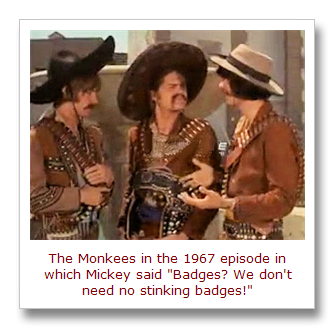
What you may not know is that the same lines were first spoken by Micky Dolenz in 1967, in the TV comedy show The Monkees.

Mickey says it in the episode titled “It’s A Nice Place To Visit” (the first episode of Season 2), which originally aired on September 11, 1967.

In that episode, Mickey and two of his Monkees bandmates, Peter Tork and Michael Nesmith, dress up as Mexican bandits to rescue their singer Davy Jones from a “real” Mexican bandit who has taken him prisoner.

Before they leave to save Davy, Nesmith says: “Wait a minute, don’t you think maybe we oughtta take something out with us, like a club card or some badges?”

Dolenz replies with a heavy Mexican accent (about 9 minutes in): “Badges? We don’t need no stinking badges!”

I don’t know if Mel Brooks was a Monkees fan, but seven years later he made those words immortal by putting them in the script for Blazing Saddles.

In a now famous scene in that movie, the corrupt State Attorney General Hedley Lamarr, played by Harvey Korman, has a sheriff’s badge given to one of his Mexican bandit henchmen, played by Rick Garcia

Korman says to Garcia: “Be ready to attack Rock Ridge at noon tomorrow. Here’s your badge.”

Garcia contemptuously throws the badge on the ground and replies with a thick Spanish accent: “Badges? We don’t need no stinking badges!”

Few people know those same words had been previously used in a Monkees episode.

But because of the huge popularity of Blazing Saddles, they became a famous movie quotation and sparked countless satirical variations based on the linguistic formula “We don’t need no stinking [fill in the blank].”

I’ve posted some of my favorite variations in a post on my Quote/Counterquote blog.

You can also click this link to see some recent examples from news stories and blogs — unless, of course, you don’t need no stinking examples.

*     *     *     *     *     *     *     *     *     *

Comments? Corrections? Questions? Email me or post them on my Famous Quotations Facebook page.

Related reading and viewing…

December 17, 2017

“Strange but true” — there are quotes by Lord Byron you probably didn’t know you knew…


Although Lord Byron (George Gordon Noel Byron) is one of the most famous of all English poets, few of us can recite a lot of lines from his poems.

Thanks to some popular modern biographies, Ken's Russell's movie Gothic (1986), the BBC drama Byron (2003), and other movies and TV shows, many people are aware that Byron had an outrageously wild personal life.

It was a life crammed full of sex (including affairs with both male and female lovers and probably his own sister), drugs (opium in particular) and rocky relations with the British Establishment, which he repeatedly poked in the eye with his scandalous lifestyle and radical liberal politics)

As memorably summed up by one of his many lovers, Lady Caroline Lamb, Byron was “mad, bad and dangerous to know.”

In fact, I’d guess more people are familiar with Byron’s proto-rock ‘n’ roll star reputation than his poetry.

There are some lines from Byron poems which are familiar to almost everyone.

The best-known is “She walks in beauty, like the night,” the opening words of his poem “She Walks in Beauty” (published in 1815).

Another bit of verse written by Byron popularized two idiomatic expressions you undoubtedly know and have probably used, though you may not know they come from one of his poems.

On December 17, 1823, Cantos XII, XIII and XIV of Byron’s epic satirical poem Don Juan were first published.

Canto XIV contains the lines:

“‘Tis strange — but true; for Truth is always strange;
       Stranger than fiction.”

Those words by Byron are generally credited as the origin of the sayings “strange but true” and “truth is stranger than fiction.”

So, while few people know it, they are paraphrasing a quotation by Byron when they use those phrases — both of which could aptly be applied to aspects of Byron’s personal life.

*     *     *     *     *     *     *     *     *     *

Comments? Corrections? Questions? Email me or post them on my Famous Quotations Facebook page.

Related reading and viewing…

December 11, 2017

“Greed is good!” – the famous movie misquote and it’s real life inspiration

Michael Douglas Greed is Good Wall Street (1987)


On December 11, 1987 Oliver Stone’s film Wall Street was released in U.S. theaters.

The movie stars Michael Douglas as Gordon Gekko, a mega-rich, ethically-challenged Wall Street investor who specializes in corporate takeover schemes.

Gekko has no pangs about taking over, gutting, and reselling companies regardless of the impacts on employees and local communities.

In fact, he’s proud of his takeover record, as he explains in the memorable speech he gives that includes the line usually misquoted as “Greed is good,” a shortened version of what Douglas actually says.

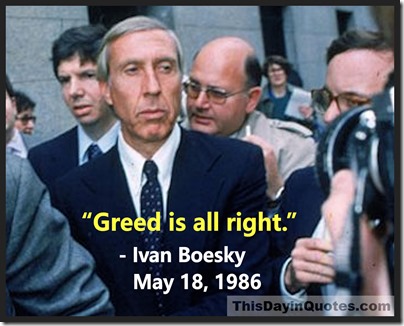
That now familiar saying is partly based on an actual speech given by the real-life Wall Street investor and money manipulator Ivan Boesky.

On May 18, 1986, Boesky gave the commencement address at the UC Berkeley’s School of Business Administration.

At the time, Boesky was a widely admired financial wizard who was riding high.

One of the things he told the students was this proto-Gekko quote.

     “Greed is all right, by the way. I want you to know that. I think greed is healthy. You can be greedy and still feel good about yourself.”

Boesky was feeling a tad less good the following year, when he was convicted of filing false trading records and sentenced to three years in prison, after also paying a record $100 million to settle a conviction for insider trading.

Boesky’s rise and fall and his infamous Berkeley quote were part of Oliver Stone’s inspiration for Wall Street.

Gekko clearly echoes Boesky in the scene in which he calls greed good.

Ivan Boesky, Greed is all rightIn that scene, he’s speaking to a meeting of shareholders of the company Teldar Paper, which he wants to take over.

To encourage them to approve his takeover bid, he tells them he has studied the company and found that the current management is wasting money and shortchanging shareholders.

Then he says:

“I am not a destroyer of companies. I am a liberator of them. The point is, ladies and gentlemen, that greed, for lack of a better word, is good. Greed is right. Greed works. Greed clarifies, cuts through and captures the essence of the evolutionary spirit. Greed, in all of its forms – greed for life, for money, for love, knowledge – has marked the upward surge of mankind and greed, you mark my words, will not only save Teldar Paper but that other malfunctioning corporation called the USA. Thank you.”

The Teldar shareholders like what Gekko says and give him a standing ovation.

And, despite the fact that Gekko is a slimy character who is ultimately goes to prison for insider trading involving another company, and despite the financial scandals and meltdowns that happened before and after Wall Street was released, there are many people who like and essentially agree with the philosophy he expresses in that speech.

It’s fits the Ayn Randian “enlightened self-interest” creed of hard core advocates of business and opponents of “over-regulation” – a subset of people who have increasingly dominated American politics.

The end of Wall Street is somewhat uplifting. Gekko goes to jail and Bud Fox, the young protégé who initially helped him in a crooked takeover scheme (played by Charlie Sheen), blows the whistle on Gordon and redeems himself.

If Gekko existed in real life, he’d probably view the current push to reduce the regulation of businesses and financial markets as uplifting.

Indeed, events of the past few years might remind many people of something else Gordon Gekko says in Wall Street

He explains to Charlie Sheen’s character:

“The richest one percent of this country owns half our country’s wealth, five trillion dollars...We make the rules, pal. The news, war, peace, famine, upheaval, the price per paper clip. We pick that rabbit out of the hat while everybody sits out there wondering how the hell we did it. Now you’re not naive enough to think we’re living in a democracy, are you buddy?”

*     *     *     *     *     *     *     *     *     *

Comments? Corrections? Questions? Email me or post them on my Famous Quotations Facebook page.

Related viewing and reading…

November 23, 2017

“He who destroys a good book kills reason itself.”


In the 1630s, England’s infamous “Star Chamber” (sort of a politically-oriented version of the Spanish Inquisition) banned the printing or sale of “any seditious, scismaticall, or offensive Bookes or Pamphlets.”

The Star Chamber was abolished in 1641.

But two years later, the British House of Commons passed a new censorship law.

Although it was called a book “licensing” law, it was more about limiting free speech and creating publishing monopolies for politically-connected publishers than it was about protecting the rights of authors (or readers).

Books deemed to be in violation of the “Licensing Order of 1643” were seized and destroyed. And, the writers, printers and publishers of those books faced prison sentences.

This angered England’s great poet John Milton and inspired him to write a “speech” urging more liberal publishing laws.

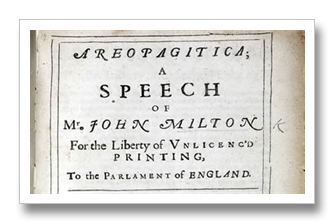
The full title of the printed version was Areopagitica; A Speech of Mr. John Milton For the Liberty of Unlicens’d Printing, To the Parlament of England. (The complete text is online here.)

Now generally referred to as Areopagitica for short, it was first published, in pamphlet form, on November 23, 1644.

Milton’s Areopagitica is among the most famous historical documents advocating freedom of the press ever written. (The title alludes to the ancient Greek judges of Areopagus.)

One line in it is still frequently quoted today and included in many books of quotations:

“As good almost kill a man as kill a good book: who kills a man kills a reasonable creature, God’s image; but he who destroys a good book kills reason itself.”

Milton’s eloquent words failed to persuade Parliament to change its book “licensing” and censorship regulations. They remained in effect until 1694, 20 years after Milton’s death.

Of course, in the centuries since then, censorship of books has significantly and steadily decreased, at least in the United Kingdom, the United States and other Western democracies.

But even in those countries efforts to ban books from public libraries has continued.

For example, during the first decade of the 21st Century, the American Library Association documented more than 4,000 attempts to have various book removed from local libraries here in the US.

Some modern self-appointed censors want to ban books that conflict with their religious or political views. Some want to block access to books they deem “pornographic.”

Other reasons given for requesting books to be banned from American libraries in recent years include things like sexism, “anti-family” content and uses of the N-word, one of the common complaints lodged against Mark Twain’s classic novel Huckleberry Finn.

In fact, the targets of people and groups who want to ban books at their local libraries include many major literary classics, such as: 

The Great Gatsby by F. Scott Fitzgerald
The Grapes of Wrath by John Steinbeck
To Kill a Mockingbird by Harper Lee
The Color Purple by Alice Walker
1984 by George Orwell
Of Mice and Men by John Steinbeck
Catch-22 by Joseph Heller
Brave New World by Aldous Huxley
The Sun Also Rises by Ernest Hemingway
Gone with the Wind by Margaret Mitchell
One Flew Over the Cuckoo's Nest by Ken Kesey
For Whom the Bell Tolls by Ernest Hemingway
The Call of the Wild by Jack London

You can read a longer list of examples on the “Banned & Challenged Classics” page of the ALA’s website.

If John Milton were still around to see that list, I’m pretty sure it he be angered again.

*     *     *     *     *     *     *     *     *     *

Comments? Corrections? Questions? Email me or post them on my Famous Quotations Facebook page.

Related reading…

November 05, 2017

“Spare the rod and spoil the child”


It’s not surprising that many people think the quote “Spare the rod and spoil the child” comes from the Bible.

There are at least five verses in the Bible’s Book of Proverbs that talk about using a rod to beat a child — for his own good, of course.

The most famous is Proverbs 13:24: “He that spareth his rod hateth his son: but he that loveth him chasteneth him betimes.”

An even scarier piece of parenting advice is in Proverbs 23:13-14. It says: “Withhold not correction from the child: for if thou beatest him with the rod, he shall not die. / Thou shalt beat him with the rod, and shalt deliver his soul from hell.”

However, although the saying “spare the rod and spoil the child” was clearly inspired by these Biblical verses, it does not appear in the Bible.

It comes from the epic-length 17th-century poem ”Hudibras”, written by Samuel Butler (1612-1680), a cheeky British poet who enjoyed mocking religious extremists and hypocrites.

Butler’s epic satire follows the trials and tribulations of a character named Sir Hudibras.

Initially, the poem describes Hudibras as a noble and pious knight.

But during the course of the story he is shown to be a buffoonish poseur and nitwit.

Butler published Hudibras in three parts, in 1663, 1664 and 1678. The famous “spare the rod” quote comes in Part II, which was entered into the Stationer’s Registry (Britain’s early version of a copyright office) on November 5, 1663.

At the end of Part I, Sir Hudibras is put in prison after getting into a fracas with a group of locals who were watching a bear baiting “entertainment.”

In Part Two, a widow Hudibras had been wooing comes to visit him in jail and says she’ll get him out if he’ll prove he truly loves her.

When he tries to profess his love, she quickly rejects flowery words as the kind of proof she wants:

       “Hold, hold, quoth she; no more of this,
       Sir Knight; you take your aim amiss:
       For you will find it a hard chapter                         
       To catch me with poetic rapture.”

The widow then suggests that Hudibras could prove his love by attempting suicide. For example, she says, if he tried to hang himself she would believe him and cut him down before he died.

Hudibras thinks that option sounds a bit “too harsh.”

So, the widow suggests that Hudibras could prove his love by whipping himself or by letting her whip him. She then explains the benefits of the “virtuous school of lashing.”

Near the end of her spiel on the joys of the whip, the widow utters the famous “spare the rod” quotation:

       “If matrimony and hanging go
       By dest’ny, why not whipping too?                           
       What med’cine else can cure the fits
       Of lovers when they lose their wits?
      
Love is a boy by poets stil’d;
       Then spare the rod and spoil the child.”

Hudibras promises to enroll in the “school of lashing” if the widow gets him released.

She does. But then Hudibras reneges on his promise, a betrayal that sets up the plot of Part III of the poem, in which Hudibras gets his final comeuppance.

Samuel Butler was almost certainly thinking of the Biblical verses about rods and children when he wrote his own famous line about them.

When read or heard out of context, it may seem like Butler’s “spare the rod and spoil the child” quote has a meaning similar to the Bible verses — i.e., parents should discipline their children with physical punishment if they want them to turn out “right” and keep them from becoming spoiled brats or worse.

But what Butler implied in between the lines of his satiric verse is a bit more bawdy than Biblical.

The obvious theory, given the scene it’s used, in is that it refers to sexual fetishes involving spanking, whipping and a dominatrix.

Another theory is that it’s a reference to an old bit of sexual folklore about how to “spoil” — and thus prevent — a woman from becoming pregnant.

One thing is certain: what Samuel Butler was talking about in that part of his poem Hudibras is a bit different than what the pious authors of the Book of Proverbs had in mind.

*     *     *     *     *     *     *     *     *     *

Comments? Corrections? Questions? Email me or post them on my Famous Quotations Facebook page.

Related reading…

Copyrights, Disclaimers & Privacy Policy


Copyright © Subtropic Productions LLC

All original text written for the This Day in Quotes quotations blog is copyrighted by the Subtropic Productions LLC and may not be used without permission, except for short "fair use" excerpts or quotes which, if used, must be attributed to ThisDayinQuotes.com and, if online, must include a link to http://www.ThisDayinQuotes.com/.

To the best of our knowledge, the non-original content posted here is used in a way that is allowed under the fair use doctrine. If you own the copyright to something posted here and believe we may have violated fair use standards, please let us know.

Subtropic Productions LLC and ThisDayinQuotes.com is committed to protecting your privacy. For more details, read this blog's full Privacy Policy.