Showing posts with label May 18. Show all posts

May 18, 2019

“Greed is all right” — the forerunner of “Greed is good”

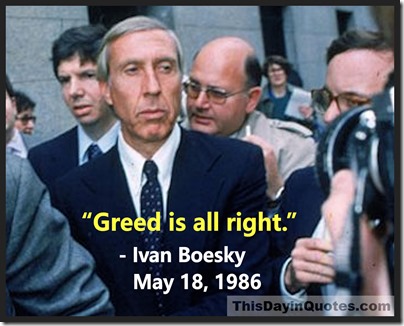
Ivan Boesky, Greed is all rightWall Street whiz Ivan Boesky was riding high in 1986.

During the early 1980s, he’d made hundreds of millions of dollars trading stocks, doing real estate deals and masterminding leverage buyouts of distressed businesses.

He was lauded as a financial genius in many magazine and newspaper articles and often invited to speak at business seminars, colleges and universities.

On May 18, 1986, Boesky gave the commencement address at the UC Berkeley’s School of Business Administration. 

One of the things he told the students in that speech became a famous (and infamous) quotation that led to an even more famous movie quote.

“Greed is all right, by the way,” he said blithely. “I want you to know that. I think greed is healthy. You can be greedy and still feel good about yourself.”

Boesky was feeling less good the following year.

Federal SEC investigators had discovered that many of Boesky’s huge stock profit windfalls were based on illegal insider information.

In November 1986, he was arrested and eventually convicted, after providing evidence that led to the downfall of some of his other ethically-challenged Wall Street friends, including financier Michael Milken.

Based on a plea deal, Boesky was sentenced to 3 1/2 years in prison and required to pay a record-breaking fine of $100 million.

Boesky’s rise and fall and his “Greed is all right” speech were part of filmmaker Oliver Stone’s inspiration for the movie Wall Street.

Stone co-wrote the script and directed the film, which was released on December 11, 1987 in U.S. theaters.  

The movie stars Michael Douglas as Gordon Gekko, a ruthless Wall Street investor who specializes in hostile takeovers, leveraged buyouts, and junk bond financing.

Michael Douglas Greed is Good Wall Street (1987)Gekko has no pangs about taking over, gutting, and reselling companies regardless of the impacts on employees and local communities.

In fact, he’s proud of his takeover record, as he explains in the memorable speech he gives that includes the line usually misquoted as “Greed is good.” It’s a pithier, shortened version of what Douglas actually says.

In that scene, he’s speaking to a meeting of shareholders of the company Teldar Paper, which he wants to take over.

To encourage them to approve his takeover bid, he tells them he has studied the company and found that the current management is wasting money and shortchanging shareholders.

Then he says:

“I am not a destroyer of companies. I am a liberator of them. The point is, ladies and gentlemen, that greed, for lack of a better word, is good. Greed is right. Greed works. Greed clarifies, cuts through and captures the essence of the evolutionary spirit. Greed, in all of its forms – greed for life, for money, for love, knowledge – has marked the upward surge of mankind and greed, you mark my words, will not only save Teldar Paper but that other malfunctioning corporation called the USA. Thank you.”

The Teldar shareholders like what Gekko says and give him a standing ovation.

Despite the fact that Gekko is a slimy character who, like Boesky, ultimately goes to prison for insider trading — and despite the financial scandals and meltdowns that happened before and after Wall Street was released — there are still those who essentially agree with what he and Boesky said about greed.

It’s fits the Ayn Randian “enlightened self-interest” creed of the wealthy 1%ers and others who support the ideal of unfettered capitalism and oppose “over-regulation” of businesses — a subset of people who have increasingly dominated American politics.

Indeed, the economic and political trends of the past few decades could be summed up by something else Gordon Gekko says in Wall Street

He explains to his protégé in the film, played by Charlie Sheen:

“The richest one percent of this country owns half our country’s wealth, five trillion dollars...We make the rules, pal. The news, war, peace, famine, upheaval, the price per paper clip. We pick that rabbit out of the hat while everybody sits out there wondering how the hell we did it. Now you’re not naïve enough to think we’re living in a democracy, are you buddy?”

Flash forward to Ivan Boesky three decades later. 

After being busted in 1987, he spent a mere two years in the Lompoc Federal Prison Camp in California.

And, although he was permanently prohibited from involvement in the realm of stocks and finance and was required to pay out much of his past fortune in fines, he’s still better off than most of us.

In 1991, he divorced his wife Seema, who came from a wealthy family and had her own fortune.

She agreed to pay him $23 million and $180,000 a year for life. She also gave him one of their mansions, in La Jolla, California.

As of 2019, at age 82, Boesky still lives there. According one recent article, he is now “a wild-haired Rasputin-like recluse.”

I imagine him looking at the continuing wealth gap in America and who's in the White House and thinking, with some chagrin, that our country is clearly still run by people who believe in the greed principle he espoused. People who, like him, may have bent or broken a few laws to become rich and powerful.

He’s just one of the few who got caught and punished for it.

*     *     *     *     *     *     *     *     *     *

Comments? Corrections? Questions? Email me or post them on my Famous Quotations Facebook page.

Related viewing and reading…

December 11, 2017

“Greed is good!” – the famous movie misquote and it’s real life inspiration

Michael Douglas Greed is Good Wall Street (1987)


On December 11, 1987 Oliver Stone’s film Wall Street was released in U.S. theaters.

The movie stars Michael Douglas as Gordon Gekko, a mega-rich, ethically-challenged Wall Street investor who specializes in corporate takeover schemes.

Gekko has no pangs about taking over, gutting, and reselling companies regardless of the impacts on employees and local communities.

In fact, he’s proud of his takeover record, as he explains in the memorable speech he gives that includes the line usually misquoted as “Greed is good,” a shortened version of what Douglas actually says.

That now familiar saying is partly based on an actual speech given by the real-life Wall Street investor and money manipulator Ivan Boesky.

On May 18, 1986, Boesky gave the commencement address at the UC Berkeley’s School of Business Administration.

At the time, Boesky was a widely admired financial wizard who was riding high.

One of the things he told the students was this proto-Gekko quote.

     “Greed is all right, by the way. I want you to know that. I think greed is healthy. You can be greedy and still feel good about yourself.”

Boesky was feeling a tad less good the following year, when he was convicted of filing false trading records and sentenced to three years in prison, after also paying a record $100 million to settle a conviction for insider trading.

Boesky’s rise and fall and his infamous Berkeley quote were part of Oliver Stone’s inspiration for Wall Street.

Gekko clearly echoes Boesky in the scene in which he calls greed good.

Ivan Boesky, Greed is all rightIn that scene, he’s speaking to a meeting of shareholders of the company Teldar Paper, which he wants to take over.

To encourage them to approve his takeover bid, he tells them he has studied the company and found that the current management is wasting money and shortchanging shareholders.

Then he says:

“I am not a destroyer of companies. I am a liberator of them. The point is, ladies and gentlemen, that greed, for lack of a better word, is good. Greed is right. Greed works. Greed clarifies, cuts through and captures the essence of the evolutionary spirit. Greed, in all of its forms – greed for life, for money, for love, knowledge – has marked the upward surge of mankind and greed, you mark my words, will not only save Teldar Paper but that other malfunctioning corporation called the USA. Thank you.”

The Teldar shareholders like what Gekko says and give him a standing ovation.

And, despite the fact that Gekko is a slimy character who is ultimately goes to prison for insider trading involving another company, and despite the financial scandals and meltdowns that happened before and after Wall Street was released, there are many people who like and essentially agree with the philosophy he expresses in that speech.

It’s fits the Ayn Randian “enlightened self-interest” creed of hard core advocates of business and opponents of “over-regulation” – a subset of people who have increasingly dominated American politics.

The end of Wall Street is somewhat uplifting. Gekko goes to jail and Bud Fox, the young protégé who initially helped him in a crooked takeover scheme (played by Charlie Sheen), blows the whistle on Gordon and redeems himself.

If Gekko existed in real life, he’d probably view the current push to reduce the regulation of businesses and financial markets as uplifting.

Indeed, events of the past few years might remind many people of something else Gordon Gekko says in Wall Street

He explains to Charlie Sheen’s character:

“The richest one percent of this country owns half our country’s wealth, five trillion dollars...We make the rules, pal. The news, war, peace, famine, upheaval, the price per paper clip. We pick that rabbit out of the hat while everybody sits out there wondering how the hell we did it. Now you’re not naive enough to think we’re living in a democracy, are you buddy?”

*     *     *     *     *     *     *     *     *     *

Comments? Corrections? Questions? Email me or post them on my Famous Quotations Facebook page.

Related viewing and reading…

May 18, 2017

“Never play cards with a man called Doc” — and other advice from Nelson Algren…

Nelson Algren (1909-1981)
The
copyright record for the novel A Walk on the Wild Side by Nelson Algren says it was copyrighted on May 18, 1956.

Traditionally, the copyright date is also a book’s initial publication date.

Algren’s novel might have been released sooner if not for a dispute he had with his publishing company, Doubleday.

Doubleday had published Algren’s breakthrough book of short stories, The Neon Wilderness, in 1947.

In 1949 it published his blockbuster novel The Man with the Golden Arm, which won the National Book Award in 1950 and was later made into a hit film starring Frank Sinatra.

The next novel Algren wrote was A Walk on the Wild Side.

After reviewing its story about a drifter from Texas who, among other things, rapes a woman, works in a condom factory and then in a whorehouse in New Orleans, the editorial powers that be at Doubleday decided it was a bit too risqué.

As noted by book news journalist Frederick Babcock in his column in the Chicago Tribune on February 26, 1956, they told Algren to tone it down.

Algren made a few minor token changes. Doubleday pushed for more. Algren took a walk, so to speak, and gave the novel to Farrar, Straus & Cudahy to publish. 

Newsclip about Nelson Algren, 1956Given the eventual lasting fame of the book and its title, you could say the editors at Doubleday make a big mistake. But in 1956 the novel was panned by critics and initial sales were low. Algren was so devastated he tried to commit suicide.

He survived. He continued to write and he taught writing at several universities. But he didn’t publish another book until 1962.

He didn’t write another novel until 1974. Titled The Devil’s Stocking, it wasn’t published until 1983 — two years after Algren died from a heart attack.

A Walk on the Wild Side has lived on as a book that continues to be reprinted and is now more favorably viewed by critics.

In 1962, it was adapted into a film with a star-studded cast, including Laurence Harvey, Capucine, Jane Fonda, Anne Baxter and Barbara Stanwyck.

The title song for the film, scored by Elmer Bernstein with lyrics by Mack David, was nominated for an Academy Award and is on the American Film Institute’s list of greatest film music.

In 1972, Lou Reed released his catchy song “A Walk on the Wild Side” (produced by David Bowie and Mick Ronson).

By that time those words were already a common idiomatic expression meaning to do things that are risky or morally questionable.

Reed’s song made the phrase even more famous and familiar to new generations.

Algren’s novel A Walk on the Wild Side also includes his best known quote. It’s some memorable advice about certain things you should never do that shows up in many books of famous quotations:

       “Never play cards with a man called Doc. Never eat at a place called Mom’s. Never sleep with a woman whose troubles are worse than your own.”

These rules are imparted to the novel’s central character, Dove Linkhorn, by a career criminal named “Cross-Country” Kline, while the two are spending time in jail together.

A Walk on the Wild Side, Nelson Algren Ace edition 1960Kline also shares other life lessons he’d learned with Dove.

Here’s a longer excerpt from A Walk on the Wild Side in which he recites them:

      “But blow wise to this, buddy, blow wise to this: Never play cards with a man called Doc. Never eat at a place called Mom’s. Never sleep with a woman whose troubles are worse than your own. Never let nobody talk you into shaking another man’s jolt. And never you cop another man’s plea. I’ve tried ‘em all and I know. They don’t work.
       “Life is hard by the yard, son. But you don’t have to do it by the yard. By the inch it’s a cinch. And money can’t buy everything. For example: poverty.”

Not long after A Walk on the Wild Side was published, the first three rules mentioned by Cross-Country Kline in that excerpt began to be cited as a famous quote by Algren.

With slight wording changes, Algren often cited them himself in speaking engagements and interviews. He also used them in an essay titled “What Every Young man Should Know.”

Quote mavens like Ralph Keyes and Barry Popik have pointed out that Algren probably didn’t coin the three famous rules himself.

They have both noted that an actor friend of Algren named Dave Peltz claimed to have created the rules. He said he wrote them down in a letter he sent to Algren.

Algren told biographer H. E. F. Donohue he got them from “a nice old Negro lady.”

In the foreword to the 1964 book Conversations with Nelson Algren, Donohue wrote:

“He [Algren] shunts aside all rules regulations and dicta except for three laws he says a nice old Negro lady once taught him: Never play cards with any man named ‘Doc’. Never eat at any place called ‘Mom’s’. And never ever, no matter what else you do in your whole life, never sleep with anyone whose troubles are worse than your own.”

Several years ago, in a post on his “Black Cracker” blog, writer and musician Josh Alan Friedman recorded an additional rule of life Algren once mentioned to him.

Josh is the son of the novelist and playwright Bruce Jay Friedman and brother of cartoonist Drew Friedman. (He’s also one of my co-editors on an anthology of vintage men’s adventure stories, titled Weasels Ripped My Flesh!)

In July of 1964, Nelson Algren spent a week with the Friedman family at their rented summer house on Fire Island.

Josh recalled:

“Algren went apeshit over our elderly nanny, Mrs. Sullivan (the ‘Mrs. O’Leary’ character in my book, Black Cracker). She would break into a put-on Irish brogue to his delight. For years afterward, whenever Algren called my father and Mrs. Sullivan answered the phone, he’d chat with Mrs. Sullivan for an hour...Another other thing I recall from that week with Nelson in the house: He advised us that the pot handles be turned inward on the stove, rather than sticking out where they could be knocked over.”

So, there’s one more sensible Nelson Algren rule of life to remember — while you avoid playing cards with anyone named Doc, eating at a place called Mom’s and sleeping with anyone whose troubles are worse than your own. Never turn the pot handles outward on the stove.

*     *     *     *     *     *     *     *     *     *

Comments? Corrections? Questions? Email me or post them on my Famous Quotations Facebook page.

Related reading…

Copyrights, Disclaimers & Privacy Policy


Copyright © Subtropic Productions LLC

All original text written for the This Day in Quotes quotations blog is copyrighted by the Subtropic Productions LLC and may not be used without permission, except for short "fair use" excerpts or quotes which, if used, must be attributed to ThisDayinQuotes.com and, if online, must include a link to http://www.ThisDayinQuotes.com/.

To the best of our knowledge, the non-original content posted here is used in a way that is allowed under the fair use doctrine. If you own the copyright to something posted here and believe we may have violated fair use standards, please let us know.

Subtropic Productions LLC and ThisDayinQuotes.com is committed to protecting your privacy. For more details, read this blog's full Privacy Policy.