February 07, 2015

“It became necessary to destroy the town to save it.”


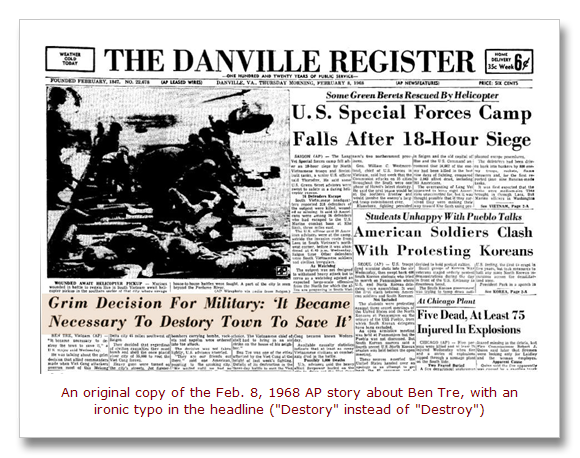
On February 7, 1968, American bombs, rockets and napalm obliterated much of the South Vietnamese town of Ben Tre — killing hundreds of civilians who lived there.

Later that day, an unidentified American officer gave Associated Press reporter Peter Arnett a memorable explanation for the destruction.

Arnett used it in the opening of the story he wrote:

   “It became necessary to destroy the town to save it,” a U.S. major said Wednesday.
   He was talking about the grim decision that allied commanders made when Viet Cong attackers overran most of this Mekong Delta city 45 miles southwest of Saigon. They decided that regardless of civilian casualties they must bomb and shell the once placid river city of 35,000 to rout the Viet Cong forces.

After Arnett’s story was published in newspapers the next morning, February 8, 1968, the unnamed major’s remark became one of the most infamous war-related quotes in modern history.

To this day, it is still used as a quotation that epitomizes the brutal absurdities of war in general and of the Vietnam War in particular.

The veracity of the quote has also been a subject of controversy. Since Arnett did not identify the officer who supposedly used the line, some people have questioned whether anyone actually said it.

In 2006, a Vietnam veteran named Michael D. Miller created a website titled “Saving Ben Tre.” On that site, Miller claims to have been present when a “Major Booris” said something very close to what Arnett reported.

Miller gives the quote as: “We had to destroy Ben Tre in order to save it.”

However, like Arnett’s report, Miller’s version has been disputed.

More significant to the people of Vietnam is the issue of whether Ben Tre actually had to be destroyed.

The U.S. military’s official explanation of why “it became necessary to destroy the town” is that it had been infiltrated by thousands of Viet Cong.

Thus, their rationale went, trying to oust the VC in ground-level fighting, from street to street, would have caused a high number of American casualties and even more civilian casualties.

Perhaps they were right. But the outcome described in Arnett’s news story doesn’t quite smell like victory:

U.S. advisers said the heavy allied firepower hurled on the city to drive out the Viet Cong probably contributed largely to the deaths of at least 500 civilians and possibly 1,000. South Vietnamese officials say the enemy dead totaled 451. About 50 Vietnamese soldiers died, along with more than 20 Americans...Lt. Col James Dare of Chicago, commander of U.S. Advisory Team 93, said “we will never know for sure” the number of civilians who died…Maj. Chester L. Brown of Erie, Pa., spent hours over the city as an Air Force forward air controller directing helicopter and fighter-bomber attacks. “It is always a pity about the civilians,” he said.

The story went on to say:

U.S. officials reported it was impossible to determine the attitude of the city’s residents to the bombing and artillery fire. “Most of those we see around appear mighty relieved that they survived,” one official said, “But I know that there are lots of refugees, maybe 10,000 to 15,000, outside of town in a camp and they may not be so happy.”

I suspect that last quote was a bit of an understatement.

Related post: Variations on “It became necessary to destroy the town…” – from Vietnam to Afghanistan

*     *      *     *     *     *     *     *     *     *

Comments? Corrections? Post them on the Famous Quotations Facebook page.

Related reading and viewing…

February 02, 2015

An update on the origin of the term “a self-made man”…


If you start looking into claims about the origins of common phrases, you find that many of those claims are myths that have simply been repeated so long that they came to be cited as true.

Some of these bogus phrase “origins” are based on the earliest example recorded in the venerable Oxford English Dictionary or some other authoritative source.

Now, by searching resources like Google Books it is much easier to verify — or disprove — claims about the “first use” of phrases.

And, it’s not uncommon for modern researchers to find out that what has long been called the origin or earliest recorded use of a phrase is neither.

For example, many books and websites say the term “a self-made man” was coined by the American politician Henry Clay (1777-1852).

While serving as the U.S. Senator for Kentucky, Clay made a speech on the floor of the Senate on February 2, 1832 in which he said:

“In Kentucky, almost every manufactory known to me, is in the hands of enterprising and self-made men, who have acquired whatever wealth they possess by patient and diligent labor.”

The Oxford English Dictionary lists this as the first recorded use of the term “self-made men.”

Thus, writers of a number of books and Internet posts have assumed that this was the origin of both “self-made men” and the singular version “self-made man.” 

But, in fact, it wasn’t.

I discovered this by using another great online research tool, Newspaper Archive.com, has searchable PDF copies of American newspapers going back to the early 1700s.

I did a search in NewspaperArchive.com and quickly found an earlier use of “self-made man.”

It’s in a letter signed by a “Prof. Newman” that was published in the October 9, 1828 issue of the Delaware Advertiser and Farmer's Journal.

The heading above the letter is “A SELF MADE MAN” (with no hyphen).

Newman’s letter is about Roger Sherman (1721–1793), the Connecticut statesman and politician who served on the “Committee of Five” that drafted the Declaration of Independence and later served as Connecticut’s Senator in the new U.S. Congress.

Professor Newman’s letter notes that Sherman rose from humble beginnings to “the Halls of our Congress” and “was a self made man.”

So, while the term “a self-made man” is associated with the date February 2nd, the reason for the association is that it has long been believed that Henry Clay’s speech on February 2, 1932 was the origin of the term.

I have now disproved that belief.

Stop the presses on the next edition of the Oxford English Dictionary! I have an edit…

*     *     *     *     *     *     *     *     *     *

Comments? Corrections? Post them on the Famous Quotations Facebook page.

Related reading…

January 26, 2015

The ironic dual anniversary of two famous Clinton quotations


Hillary Clinton looms so large in the political landscape today, it’s hard to remember when she didn’t.

But, in fact, she was relatively unknown to most Americans until January 26, 1992.

On that Sunday night, Hillary and her husband Bill Clinton appeared together on 60 Minutes, in a heavily watched interview with Steve Kroft that aired right after the Superbowl.

Their goal was to defuse “rumors” about Bill’s extramarital affairs with Gennifer Flowers and other women while he was Governor of Arkansas.

They didn’t quite directly address the “bimbo eruption” issue.

However, Bill did admit he had “caused pain” in their marriage. And they both tried to make it clear that they loved each other and their marriage was sound. 

The most remembered quote from the interview was uttered by Hillary, when she said (emphatically):

“You know, I’m not sitting here as some little woman standing by my man, like Tammy Wynette. I’m sitting here because I love him and I respect him and I honor what he’s been through and what we’ve been through together. And, you know, if that’s not enough for people, then, heck, don’t vote for him.”

In other words, Hillary was standing by man — like in Tammy Wynette’s hit 1968 country music song “Stand By Your Man.” 

The Clintons’ politically-adept performance that night boosted their public profile and Bill’s campaign. He went on to receive the Democratic nomination and get elected as President.

But the way Hillary stated her “standing by my man” position was highly offensive to fans of Tammy Wynette and to Tammy herself.

Tammy made it known to Hillary and the press that she was “mad as hell” about Hillary’s insulting comment on 60 Minutes.

TIME magazine quoted her as saying: “Nowhere in that song did I say, ‘be a doormat, take any abuse.’”

Other news stories quoted Tammy using variations of that line, including: “That song doesn't say be a doormat”; “Nowhere does it say be a doormat and let this man walk on you”; and, “That song doesn't say be a doormat for anybody.”

She also wrote a letter to Hillary that said: “With all that is in me, I resent your caustic remark. I believe you have offended every true country-music fan and every person who has made it on their own with no one to take them to the White House.”

The soon-to-be First Lady of the United States quickly apologized to “The First Lady of Country Music.”

Hillary told reporters: “I didn’t mean to hurt Tammy Wynette as a person. I happen to be a country-western fan, If she feels like I’ve hurt her feelings, I'm sorry about that.”

Hillary also telephoned Tammy to apologize directly. It apparently worked. Wynette later performed at a fundraiser for Bill, at Hillary’s request.

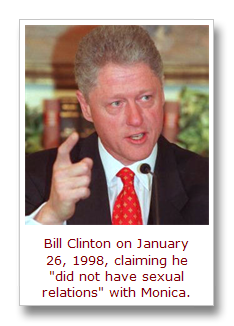
Six years later, Bill Clinton was back in the hot seat over a new bimbo eruption. Reports had surfaced that he’d been having an affair with a young White House intern named Monica Lewinsky.

So, on January 26, 1998 — exactly six years after Hillary made her famous Tammy-bashing remark — Bill held a press conference to address the issue.

In it, he created an ironic dual anniversary of two famous Clinton quotes when he forcefully claimed:

       “I did not have sexual relations with that woman, Miss Lewinsky!”

Of course, as we all learned later, he did — depending on what the meaning of did is.

*     *     *     *     *     *     *     *     *     *

Comments? Corrections? Post them on the Famous Quotations Facebook page.

Related reading, viewing and listening…


January 11, 2015

The origin of the movie cliché “We have ways of making you talk!”


The threatening words “We have ways of making you talk” are now a familiar cliché in movies.

It’s usually said for comedic effect, often with a heavy foreign accent, like: “Ve haf vays of making you talk!”

If you’re a classic film buff you may know that the origin of this movie quote is a line in an old Gary Cooper movie titled The Lives of a Bengal Lancer.

If you’re a major film quote geek you may know that the familiar version used today is actually a misquote of the actual line in the film.

The Lives of a Bengal Lancer is a Rudyard Kipling-style tale set in India during the days when it was a British colony.

It premiered in New York City on January 11, 1935.

The film is loosely based on an autobiographical book of the same name, written by British Army officer and author Francis Yeats-Brown in 1930.

The heroes of the movie are three British officers in the famed Bengal Lancers: Lieutenant McGregor, played by Cooper; Lieutenant Forsythe, played by Franchot Tone; and, Lieutenant Stone, played by Richard Cromwell.

The plot deals with their efforts to thwart a revolt against British rule by an Indian leader named Mohammed Khan, played by the great character actor Douglas Dumbrille.

When Stone is taken captive by Khan, McGregor and Forsythe go undercover to try to find and rescue him. But they are also captured by Khan.

The famous quote from the film comes during a scene in which Mohammed Khan has the three officers brought to him for what starts out as a deceptively cordial dinner.

Soon, Mohammed Khan gets to the point.

He offers to let them go free if they tell him the location of a huge supply of British ammunition he needs to provide firepower for his planned rebellion.

Khan explains: “You have only to answer two very simple questions. By what route is the ammunition train coming? And, just where does the regiment plan to meet it for convoy?"

Forsythe says flippantly: “Well, when the furry little animal jumped out of the bag he really jumped, didn’t he?”

Khan responds by making his ominously memorable threat — in perfectly good English, with no silly accent:

       “Well, gentlemen? We have ways to make men talk.”

The Lancers refuse to give Khan the information he wants.

So, as threatened, Khan uses his ways of encouraging answers.

One by one, starting with Gary Cooper, sharp slivers of bamboo are inserted under their fingernails. Then the bamboo slivers are set on fire.

Lieutenant Stone eventually spills the beans. But by the end of the film he redeems himself heroically and gets his revenge by killing Khan.

Somehow, over the decades Mohammed Khan’s sinister line from The Lives of a Bengal Lancer morphed into a comedic cliché, usually in misquoted form.

Nowadays, most people who aren’t classic film buffs are totally unaware of its origin.

*     *     *     *     *     *     *     *     *     *

Comments? Corrections? Post them on the Famous Quotations Facebook page.

Related reading and viewing…

January 06, 2015

“The Mother of All Battles”


In the Middle East and Greece, the idiomatic expression “the mother of all ---” has been used to describe the biggest, most extreme or ultimate examples of various things for more than two thousand years.

However, it wasn’t a common phrase in the United States until Iraq dictator Saddam Hussein uttered his famous line about “The mother of all battles” shortly before the First Gulf War in 1991.

In August 1990, Saddam had ordered Iraqi troops to invade Kuwait.

For the next five months, the United States and United Nations tried using sanctions and threats to get Saddam to withdraw, ultimately giving him a mid-January deadline.

Saddam was not impressed.

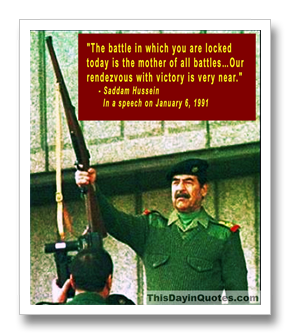
On January 6, 1991, in a speech marking the 70th anniversary of the modern Iraqi Army, he boasted that Kuwait was eternally part of Iraq and predicted a long struggle in the Persian Gulf against the “tyranny represented by the United States.”

Saddam told the people of Iraq: “The battle in which you are locked today is the mother of all battles…Our rendezvous with victory is very near, God willing.”

US Air Force video about Operation Desert Storm
News reports about this speech immediately made “the mother of all battles” a famous quote and soon gave rise to many variations.

On January 17, 1991, American military forces and troops from a coalition of other countries, launched Operation Desert Storm with massive airstrikes on Iraq.

That day, Saddam claimed to be confident that Iraq would repel the coalition forces. Once again he used his newly famous catchphrase, boasting “The great showdown has begun; the mother of all battles is under way!”

Saddam went on to predict that “the dawn of victory nears as this great showdown begins...The evil and satanic intentions of the White House will be crushed and so will all the blasphemous and oppressive forces.”

Of course, Saddam was wrong. Iraq lost the First Gulf War, amazingly quickly.

President George H.W. Bush decided not to force Saddam out of power. But his son President George W. Bush decided to fix that “mistake” during the Second Gulf War, which he launched in 2003.

Not long after that war began, Saddam was captured. He was eventually tried for “crimes against humanity,” convicted and executed by hanging in 2006.

Today, in addition to being remembered as a brutal dictator, Saddam Hussein is known as the father of the “mother of all battles” and its many linguistic offspring.

*     *     *     *     *     *     *     *     *     *

Comments? Corrections? Post them on the Famous Quotations Facebook page.

Related reading and viewing…

Copyrights, Disclaimers & Privacy Policy


Copyright © Subtropic Productions LLC

All original text written for the This Day in Quotes quotations blog is copyrighted by the Subtropic Productions LLC and may not be used without permission, except for short "fair use" excerpts or quotes which, if used, must be attributed to ThisDayinQuotes.com and, if online, must include a link to http://www.ThisDayinQuotes.com/.

To the best of our knowledge, the non-original content posted here is used in a way that is allowed under the fair use doctrine. If you own the copyright to something posted here and believe we may have violated fair use standards, please let us know.

Subtropic Productions LLC and ThisDayinQuotes.com is committed to protecting your privacy. For more details, read this blog's full Privacy Policy.