June 24, 2015

“Back in the Saddle Again”


The idiom “back in the saddle again” was already in use before it was immortalized in song by the singing cowboy star Gene Autry.

It was originally applied to cowboys and jockeys who were returning to work, riding on their horses again, after taking a break or recovering from an injury.

By the late 1800s and early 1900s it was being used more broadly as an idiom meaning “a return to normal activities or duties.”

In popular culture, the most famous use is by Autry in the song “Back in the Saddle Again.” He is often credited with writing it.

But, in fact, this familiar cowboy song was not created or first performed by Gene.

Those credits go to Ray Whitley (1901-1979), another early Country Western musician and actor who was inducted into the Nashville Songwriters Hall of Fame in 1981.

A short version of the story of how Whitley wrote the song is included in the current page about Whitley on the Hall of Fame’s website.

An older version of that web page had some additional detail.

It said:

Whitley awakened at 5:00 a.m. (in 1938) by a phone call. Coming back into the bedroom he said to his wife, “Well, I'm back in the saddle again” and explained that RKO-Radio studio had called asking him for a new song to use in a film. She said to him “You’ve got the title for one right there...‘I’m back in the saddle again.’” He sat down on the edge of the bed and wrote one verse and went to the studio where he performed it in the film “Border G-Man” and also recorded it. Gene Autry heard it and loved it. He and Whitley rewrote it and Autry recorded it, sang it in the films “Rovin’ Tumbleweeds” [1939] and “Back in the Saddle” [1941]. It became Autry's theme song.

Ray Whitley’s film, Border G-Man, which introduced “Back in the Saddle Again,” was released to movie theaters nationwide on June 24, 1938.

The main stars of the movie are George O'Brien, Laraine Johnson and Whitley, who sings the song at a party in the film.

Of course, “Back in the Saddle Again” was given much wider fame by Gene Autry, who made it his signature song.

Autry actually sang it in three of his movies: Rovin' Tumbleweeds (1939), Back in the Saddle (1941) and Wagon Team (1952).

He also sang it in episodes of his 1950s Western TV series The Gene Autry Show and used it as the theme song for his Melody Ranch TV musical variety show, which aired California on KTLA from 1964 to the early 1970s.

When Autry wrote his biography in 1978, he used Back in the Saddle Again as the title.

You probably know the song or at least the opening lyrics.

So, come on, podner, click on the video at left and sing along with Gene...

       “I’m back in the saddle again
        Out where a friend is a friend
        Where the longhorn cattle feed
        On the lowly jimson weed
        I’m back in the saddle again.

        Riding the range once more
        Toting my old .44
        Where you sleep out every night
        And the only law is right
        Back in the saddle again

        Whoopey-tie-aye-oh
        Rocking to and fro
        Back in the saddle again
        Whoopey-tie-aye-yay
        I go my way
        Back in the saddle again”

Now check out the updated use of the phrase “back in the saddle” in the steamy novel series by bestselling author K.F. Breene. She appears to have popularized it with a whole new audience.

Yee-Haw!!!

*     *     *     *     *     *     *     *     *     * 

Comments? Questions? Corrections? Post them on the Famous Quotations Facebook Page.

Related listening and reading…

June 16, 2015

“A boy’s best friend is his mother.”


When Alfred Hitchcock’s film Psycho was first released to movie theaters on June 16, 1960, it wasn’t immediately embraced by critics.

For example, in a review published the next day by the New York Times, film critic Bosley Crowther sniffed that the ending “falls quite flat.”

“But,” he added generously,the acting is fair.”

Of course, in the decades since then, Psycho has been recognized as one of the greatest and most influential films ever made.

The performance of Anthony Perkins as the shy but homicidal schizophrenic Norman Bates has become legendary, as has the famed “shower scene” in which Janet Leigh’s character is stabbed to death with a butcher knife.

Leigh’s performance garnered her an Oscar nomination and a lifetime supply of interviews about the film.

Psycho also includes one of the most famous movie quotes of all time:

       “A boy’s best friend is his mother.”

In context, the line is a witty double-entendre, as are many others in the script.

The saying “A boy’s best friend is his mother” is actually an old proverb of uncertain origin.

It wasn’t coined by Psycho scriptwriter Joseph Stefano, or by Robert Bloch in his 1959 novel that inspired the film.

And, it had been used less memorably in previous movies, such as The Awful Truth (1937), and later ones.

But in Psycho the creepy relationship between lead character Norman Bates and his mother gives the saying an especially dark, drily humorous significance that is apparent once the plot unfolds.

It’s spoken by Perkins to Leigh early in the film. Perkins added his own quirky verbal stamp on the scripted line, which is why you sometimes see it quoted as “A boy’s best friend is his mother” (as written) and sometimes as “Well, a boy’s best friend is his mother.”

To be precise, what Perkins actually stammers out is “Well, uh – a boy’s best friend is his mother.”

The scene starts when Norman brings Marion a tray of food and invites her to eat it in his back room behind the office, where the walls are covered with dead birds he has stuffed.

Here’s a transcript of the conversation leading up to the famous quote.

MARION: I’ve caused you some trouble.

NORMAN: No. Uh – Mother – m-my mother, uh – what is the phrase? – she isn’t quite herself today…

MARION: (Indicating the tray) You shouldn’t have bothered. I really don’t have that much of an appetite.

NORMAN: It’s all for you. I’m not hungry. Go ahead. (Delightedly watching her eat) You – you eat like a bird.

MARION: (Nodding to the stuffed birds) You’d know, of course.

NORMAN: No, not really. Anyway, I hear the expression ‘eats like a bird’– is really a fals- fals- falsity. Because birds really eat a tremendous lot. But I don’t really know anything about birds. My hobby is stuffing things – you know – taxidermy...

MARION: A man should have a hobby.

NORMAN: (Sitting back) Well, it’s – it’s more than a hobby. A hobby’s supposed to pass the time – not fill it.

MARION: Is your time so empty?

NORMAN: No, uh – well, I run the office, and uh, tend the cabins and grounds, and – and do little, uh, errands for my mother – the ones she allows I might be capable of doing.

MARION: Do you go out with friends?

NORMAN: (Pause) Well, uh – a boy’s best friend is his mother.

Once you’ve seen Psycho and know how it ends, watching this scene makes it even more clear just how amazingly smart and subtly funny it actually is.

*     *     *     *     *     *     *     *     *     *

Comments? Corrections? Post them on the Famous Quotations Facebook page.

Related viewing and reading…


June 07, 2015

“Never let them see you sweat” was launched into our language on this day in 1984…


In 1984, the Gillette Company launched a new series of TV commercials for its Dry Idea antiperspirants that introduced what eventually became one of the famous ad slogans of all time:

     “Never let them see you sweat.”

According to the Gillette’s trademark registration for the slogan, it was “first used in commerce” on June 7, 1984. (Given as “19840607” in the official listing in the United States Patent and Trademark Office database.)

The TV commercials and companion magazine print ads featured celebrities who each mentioned three “nevers” for their profession — the last of which always included “never let them see you sweat.”

This highly catchy slogan is credited to veteran ad man Phil Slott.

Slott was especially hot at the time, having also recently coined the Navy recruiting ad slogan: “It’s not just a job, it’s an adventure.”

The Dry Idea commercials were memorable not only for their tagline, but also because they were witty and well-performed by the celebrities who were featured.

In case you missed them, here are the scripts for some of the commercials in the series that have been posted on YouTube (click the links to view the ads)...

DONNA KARAN (Fashion Designer): [NOTE: This ad is in the clip at about the 3 minute mark.] There are three nevers in fashion design. Never confuse fad with fashion. Never forget it’s your name on every label. And, when showing your lines to the press, never let them see you sweat.  ANNOUNCER: That’s what new Dry Idea solid is all about. Maximum control. It keeps you drier than any other solid.  KARAN: Feeling tense is understandable. Looking tense is unfashionable.  ANNOUNCER: Dry Idea. Never let them see you sweat.

DAN REEVES (Head Coach, Denver Broncos): I think there’s three nevers to being a winning coach. Never let the press pick your starting quarterback. Never take a last place team lightly. And, really, no matter what the score, never let ‘em see you sweat.  ANNOUNCER: That’s what new Dry Idea aerosol is all about. It keeps you drier than the leading aerosol.  REEVES: Everyone feels pressure. Winners don’t let it show.  ANNOUNCER: Dry Idea. Never let them see you sweat.

LAUREN HUTTON (Actress): There are three nevers to getting older in Hollywood. Never audition first thing in the morning. Never try to play a character half your age. And, even if your leading man is prettier than you are, never, never let ‘em see you sweat.  ANNOUNCER: When the spotlight’s on, no other solid keeps you drier than Dry Idea solid.  HUTTON: Believe me, Dry Idea handles sweat a whole lot better than some people handle birthdays.  ANNOUNCER: Dry Idea. Never let them see you sweat.

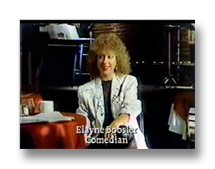
ELAINE BOOSLER (Comedian): Well, there are three nevers in comedy. Never follow a better comedian. Never give a heckler the last word. And, no matter how bad a joke bombs, though it’s never happened to me personally, never let ‘em see you sweat.  ANNOUNCER: When you're center stage, new dry Idea roll-on is the best roll-on there is.  BOOSLER: In comedy, being nervous is natural. And, looking nervous is deadly.  ANNOUNCER: Dry Idea. Never let them see you sweat.

By mid-1990s, the ad series had run it’s course.

Eventually, Gillette let its trademark for the famed slogan expire and sold the Dry Idea line to the Dial Corporation (now a US division of the German consumer goods conglomerate, Henkel).

But the line “Never let them see you sweat” is still quoted, repurposed and parodied today.

*     *     *     *     *     *     *     *     *     *

Comments? Corrections? Post them on the Famous Quotations Facebook page.

Related reading…

February 07, 2015

“It became necessary to destroy the town to save it.”


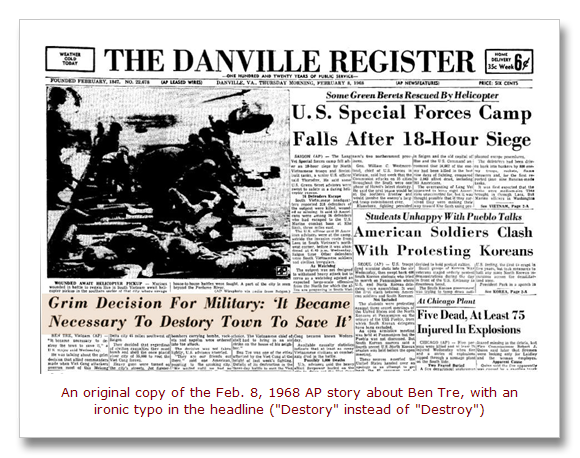
On February 7, 1968, American bombs, rockets and napalm obliterated much of the South Vietnamese town of Ben Tre — killing hundreds of civilians who lived there.

Later that day, an unidentified American officer gave Associated Press reporter Peter Arnett a memorable explanation for the destruction.

Arnett used it in the opening of the story he wrote:

   “It became necessary to destroy the town to save it,” a U.S. major said Wednesday.
   He was talking about the grim decision that allied commanders made when Viet Cong attackers overran most of this Mekong Delta city 45 miles southwest of Saigon. They decided that regardless of civilian casualties they must bomb and shell the once placid river city of 35,000 to rout the Viet Cong forces.

After Arnett’s story was published in newspapers the next morning, February 8, 1968, the unnamed major’s remark became one of the most infamous war-related quotes in modern history.

To this day, it is still used as a quotation that epitomizes the brutal absurdities of war in general and of the Vietnam War in particular.

The veracity of the quote has also been a subject of controversy. Since Arnett did not identify the officer who supposedly used the line, some people have questioned whether anyone actually said it.

In 2006, a Vietnam veteran named Michael D. Miller created a website titled “Saving Ben Tre.” On that site, Miller claims to have been present when a “Major Booris” said something very close to what Arnett reported.

Miller gives the quote as: “We had to destroy Ben Tre in order to save it.”

However, like Arnett’s report, Miller’s version has been disputed.

More significant to the people of Vietnam is the issue of whether Ben Tre actually had to be destroyed.

The U.S. military’s official explanation of why “it became necessary to destroy the town” is that it had been infiltrated by thousands of Viet Cong.

Thus, their rationale went, trying to oust the VC in ground-level fighting, from street to street, would have caused a high number of American casualties and even more civilian casualties.

Perhaps they were right. But the outcome described in Arnett’s news story doesn’t quite smell like victory:

U.S. advisers said the heavy allied firepower hurled on the city to drive out the Viet Cong probably contributed largely to the deaths of at least 500 civilians and possibly 1,000. South Vietnamese officials say the enemy dead totaled 451. About 50 Vietnamese soldiers died, along with more than 20 Americans...Lt. Col James Dare of Chicago, commander of U.S. Advisory Team 93, said “we will never know for sure” the number of civilians who died…Maj. Chester L. Brown of Erie, Pa., spent hours over the city as an Air Force forward air controller directing helicopter and fighter-bomber attacks. “It is always a pity about the civilians,” he said.

The story went on to say:

U.S. officials reported it was impossible to determine the attitude of the city’s residents to the bombing and artillery fire. “Most of those we see around appear mighty relieved that they survived,” one official said, “But I know that there are lots of refugees, maybe 10,000 to 15,000, outside of town in a camp and they may not be so happy.”

I suspect that last quote was a bit of an understatement.

Related post: Variations on “It became necessary to destroy the town…” – from Vietnam to Afghanistan

*     *      *     *     *     *     *     *     *     *

Comments? Corrections? Post them on the Famous Quotations Facebook page.

Related reading and viewing…

February 02, 2015

An update on the origin of the term “a self-made man”…


If you start looking into claims about the origins of common phrases, you find that many of those claims are myths that have simply been repeated so long that they came to be cited as true.

Some of these bogus phrase “origins” are based on the earliest example recorded in the venerable Oxford English Dictionary or some other authoritative source.

Now, by searching resources like Google Books it is much easier to verify — or disprove — claims about the “first use” of phrases.

And, it’s not uncommon for modern researchers to find out that what has long been called the origin or earliest recorded use of a phrase is neither.

For example, many books and websites say the term “a self-made man” was coined by the American politician Henry Clay (1777-1852).

While serving as the U.S. Senator for Kentucky, Clay made a speech on the floor of the Senate on February 2, 1832 in which he said:

“In Kentucky, almost every manufactory known to me, is in the hands of enterprising and self-made men, who have acquired whatever wealth they possess by patient and diligent labor.”

The Oxford English Dictionary lists this as the first recorded use of the term “self-made men.”

Thus, writers of a number of books and Internet posts have assumed that this was the origin of both “self-made men” and the singular version “self-made man.” 

But, in fact, it wasn’t.

I discovered this by using another great online research tool, Newspaper Archive.com, has searchable PDF copies of American newspapers going back to the early 1700s.

I did a search in NewspaperArchive.com and quickly found an earlier use of “self-made man.”

It’s in a letter signed by a “Prof. Newman” that was published in the October 9, 1828 issue of the Delaware Advertiser and Farmer's Journal.

The heading above the letter is “A SELF MADE MAN” (with no hyphen).

Newman’s letter is about Roger Sherman (1721–1793), the Connecticut statesman and politician who served on the “Committee of Five” that drafted the Declaration of Independence and later served as Connecticut’s Senator in the new U.S. Congress.

Professor Newman’s letter notes that Sherman rose from humble beginnings to “the Halls of our Congress” and “was a self made man.”

So, while the term “a self-made man” is associated with the date February 2nd, the reason for the association is that it has long been believed that Henry Clay’s speech on February 2, 1932 was the origin of the term.

I have now disproved that belief.

Stop the presses on the next edition of the Oxford English Dictionary! I have an edit…

*     *     *     *     *     *     *     *     *     *

Comments? Corrections? Post them on the Famous Quotations Facebook page.

Related reading…

Copyrights, Disclaimers & Privacy Policy


Copyright © Subtropic Productions LLC

All original text written for the This Day in Quotes quotations blog is copyrighted by the Subtropic Productions LLC and may not be used without permission, except for short "fair use" excerpts or quotes which, if used, must be attributed to ThisDayinQuotes.com and, if online, must include a link to http://www.ThisDayinQuotes.com/.

To the best of our knowledge, the non-original content posted here is used in a way that is allowed under the fair use doctrine. If you own the copyright to something posted here and believe we may have violated fair use standards, please let us know.

Subtropic Productions LLC and ThisDayinQuotes.com is committed to protecting your privacy. For more details, read this blog's full Privacy Policy.