September 22, 2014

Is Nathan Hale’s legendary line “I only regret that I have but one life to lose for my country” a true quote, a misquote or pure fiction?


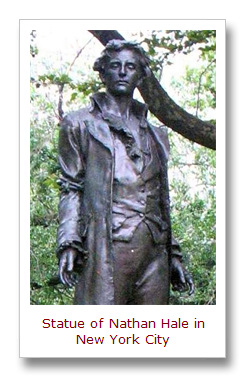
On September 22, 1776, during the Revolutionary War, a former school teacher named Nathan Hale was hanged by the British for being a rebel spy.

According to legend, Hale uttered a stirring, patriotic line just before his death:

       “I only regret that I have but one life to lose for my country.”

Hale was certainly a spy. But there’s no historical certainty about what he said just before he died.

In 1776, Hale was an officer in General George Washington’s Continental Army.

That September, after the British captured New York City, Washington asked for a volunteer to go behind the British lines to gather intelligence.

Hale volunteered. And, on September 12, wearing civilian clothes, he took a boat from Stamford, Connecticut to Long Island to carry out his secret mission.

A week later, he was detained and searched by British troops. They discovered he was carrying incriminating papers indicating that he was part of General Washington’s growing ring of spies.

British General William Howe quickly ordered Hale to be executed.

According to the eyewitness account recorded in the diary of British officer Frederick Mackenzie (sometimes spelled Mackensie), Hale did say some brave last words on the day he was hung.

But Mackenzie doesn’t mention the classic “I only regret…” quotation. Nor does any other eyewitness account.

Mackenzie’s diary does note:

“He behaved with great composure and resolution, saying he thought it the duty of every good Officer to obey any orders given him by his Commander-in-Chief; and desired the Spectators to be at all times prepared to meet death in whatever shape it might appear.”

Nearly five years later, on May 17, 1781, the Boston Independent Chronicle ran a story about Hale’s execution. It quoted him as saying:

“I am so satisfied with the cause in which I have engaged, that my only regret is, that I have not more lives than one to offer in its service.”

In the book The History of New England, published in 1799, author Hannah Adams wrote that Hale “lamented that he had but one life to lose for his country.”

Adams credited William Hull for her account. He was a former American general who may have been the source for the 1781 story in the Boston Independent Chronicle.

Hull claimed to have heard about Hale’s last words from a British soldier who witnessed the hanging.

In 1848, Hull’s daughter published his memoirs. Apparently, it is that book which first included the line that became famous.

According to Hull’s memoir, shortly before Hale was hung:

“…Few persons were around him, yet his characteristic dying words were remembered. He said, ‘I only regret that I have but one life to lose for my country.’”

It’s questionable whether Hale spoke those exact words. But it’s plausible that he said something like them.

Hale was a Yale graduate and a teacher. He was undoubtedly familiar with the play Cato, a tragedy about the Roman leader called “Cato the Younger,” written by the English playwright and poet Joseph Addison.

The play was written in 1712, but it was still highly popular in America in the late 1700s.

In Act IV, scene 4, Cato says:

“How beautiful is death, when earn’d by virtue!
Who would not be that youth? What pity is it
That we can die but once to serve our country.”

That last sentence, penned by Addison, is now widely believed to be the origin of the legendary patriotic quote (or misquote) later attributed to Nathan Hale.

Whatever Hale actually did say before being hanged, at age 21, he said it on today’s date in 1776.

*     *     *     *     *     *     *     *     *     *

Comments? Corrections? Post them on the Famous Quotations Facebook page.

Related reading…

September 12, 2014

The ironic dual anniversary of “subliminal advertising” and the Bushism “subliminable”…


On September 12, 1957, market researcher James Vicary held a press conference that made a new term famous.

Vicary claimed to have developed “hidden” ads that could be used in movies and TV shows. Ads that flashed by so quickly they were not consciously noticed by viewers, but affected their buying habits.

He coined the term subliminal advertising to describe this technique.

The term and concept generated widespread attention from claims he made at his press conference.

Vicary said he’d conducted a six-week experiment at a movie theater in Fort Lee, New Jersey.

As viewers watched the movie Picnic, he supposedly used special equipment to flash two phrases on the screen for one three-thousandth of a second every five seconds – so fast that they were below the threshold of conscious perception.

One hidden message was “Hungry? Eat popcorn.” The other was “Drink Coca-Cola.”

Vicary claimed his subliminal ads increased Coke sales at the theater by 18% over normal levels and boosted popcorn sales by 57%!

This revelation may have sounded good product manufacturers, but alarmed and outraged the public and the media.

In 1958, the National Association of Broadcasters proactively banned the broadcast of subliminal ads.

But scientists who looked into Vicary’s research soon debunked the idea that such ads have any real effect.

Vicary later admitted he had falsified the data. In fact, it’s questionable whether he actually even conducted the Ft. Lee movie experiment.

Despite that, the bogeyman of “subliminal advertising” was launched into our language and cultural consciousness.

The issue of subliminal advertising made headlines again during the 2000 presidential campaign that pitted Republican George W. Bush against Democratic nominee Al Gore.

In September, a Republican attack ad aired on national television briefly flashed the word “RATS” on screen right after showing a photo of Gore, as the announcer ominously warns that under Gore’s health care plan “bureaucrats” would make  medical decisions.

If you watch the “RATS” ad very closely on YouTube, you will see that those four letters actually seem to be the tail end of the word “BUREAUCRATS” as that word is “flown into” the screen.

Is that true “subliminal” advertising? Maybe. Maybe not.

But the “RATS” ad drew outraged complaints from Democrats and created a media uproar.

So, on September 12, 2000, Bush responded to the controversy by uttering a classic Bushism :

“I wanna make it clear to people that, you know, the idea of putting subliminable messages into ads is, is ridiculous.”

Yes. He actually said “subliminable.”

In fact, he said it several times that day when addressing the ad hubbub.

And, that’s why the date September 12th is linked to both the original term “subliminal advertising” and to the newer, um, word “subliminable.”

It’s an incredidable coincidence!

*     *     *     *     *     *     *     *     *     *

Comments? Corrections? Post them on the Famous Quotations Facebook page.

Related reading and viewing…

September 10, 2014

On this date in 1813, Oliver Hazard Perry launched two immortal naval quotations...


On September 10, 1813, American ships under the command of Commodore Oliver Hazard Perry engaged a British naval squadron on Lake Erie during the War of 1812.

Perry’s flagship was a 20-gun brig that had recently been renamed The Lawrence, in honor of his fallen friend, U.S. Navy Captain James Lawrence.

On June 1, 1813, Capt. Lawrence was mortally wounded during a fight between American and British ships near Boston.

It was reported that, as he lay dying, Lawrence said: “Tell the men to fire faster and not give up the ship. Fight her till she sinks.”

Commodore Perry helped immortalize the pithier, more famous version of this quote.

He had a special battle flag made that said “DON’T GIVE UP THE SHIP.” And, during the September 10th battle on Lake Erie, it was defiantly unfurled on The Lawrence.

It the June naval engagement that the took the life of Capt. Lawrence, the British had prevailed.

But in the Battle of Lake Erie, the Americans won a decisive victory and captured all of the British ships.

Commodore Perry quickly scrawled a brief report on the back of an envelope and had it sent to U.S. General William Henry Harrison.

He wrote:

Dear General:
We have met the enemy and they are ours. Two ships, two brigs, one schooner and one sloop. Yours with great respect and esteem, 
O.H. Perry

The first line of his message, “We have met the enemy and they are ours,” became one of the most famous Naval quotations in US history.

And, the special battle flag Perry flew that day made turned short version of Capt. Lawrence’s dying words an immortal naval motto.

Perry’s flag is now on display at The United States Naval Academy Museum in Annapolis, Maryland.

*     *     *     *     *     *     *     *     *     *

Comments? Corrections? Post them on the Famous Quotations Facebook page.

Related reading…

August 25, 2014

“The Father, the Son and the Holy Ghost” become official


The fracturing of the Christian religion into various churches and doctrines with different beliefs started in the early centuries of Christianity.

One source of division was a debate between Christians who believed in Trinitarianism and those who believed in Arianism.

Trinitarianism was based in part on Matthew 28:19, a verse in the Bible which says:

     “Go ye therefore, and teach all nations, baptizing them in the 
        name of the Father, and of the Son, and of the Holy Ghost.”

In the fourth century A.D., some Christian leaders used this and other Biblical verses to develop the doctrine of the Holy Trinity, or Trinitarianism.

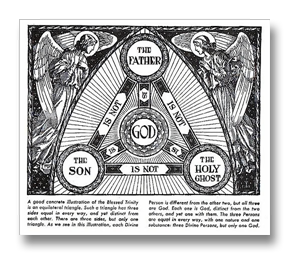
Trinitarianism maintains that, although there is only one God, he has three forms: God the Father, God the Son (Jesus) and God the Holy Ghost, aka “the Holy Spirit.”

Another early Christian leader named Arius disagreed with that view. Arius and his followers, called Arianists, believed Jesus was the Son of God but was himself human, not divine like God.

The Roman Emperor Constantine I, who had converted to Christianity, was annoyed by this doctrinary dispute. So in 325 A.D. he convened a meeting of more than 300 Christian bishops in the Turkish city of Nicaea (now named Iznik) and charged them with clarifying what the official Christian beliefs would be.

The meeting came to be called the First Council of Nicaea.

On August 25, 325, after two months of discussion, the Council issued what is referred to as the original or first Nicene Creed.

It established the doctrine of the Holy Trinity as the official Christian doctrine and Trinitarianism was adopted by the Catholic Church, the Eastern Orthodox Church and several smaller Christian subgroups.

The First Council of Nicaea also condemned Arianism as heretical anathema and ordered all Arianist writings to be burned. Arius himself was banished from the Roman Empire and took refuge in Palestine.

Despite all that, some Christians refused to reject Arius’ teachings. Arianism continued to have its followers and, in one form or another, still does today.

In 336 A.D., Arius was pardoned by Constantine I and invited to come to Constantinople. While traveling there he died unexpectedly under suspicious circumstances.

According to a contemporary account: “his bowels protruded, followed by a copious hemorrhage, and the descent of the smaller intestines: moreover portions of his spleen and liver were brought off in the effusion of blood.”

Some historians theorize that Arius was poisoned by anti-Arianist Christian zealots.

If that’s what happened, I suspect Jesus would have disapproved.

*     *     *     *     *     *     *     *     *     *

Comments? Corrections? Post them on the Famous Quotations Facebook page.

Related reading…

August 03, 2014

“I’ll die young, but it’s like kissing God.”


On August 3, 1966, the brilliant, boundary-stretching and, unfortunately, drug-addicted American comedian Lenny Bruce was found dead in the bathroom of his home in Hollywood, California.

A syringe and other drug paraphernalia were on the floor next to him. The cause of death was ruled to be an accidental overdose of morphine.

Bruce was just 40 years old.

It was the sad fulfillment of a famous quote about the peril and pleasure of drug addiction that is widely credited to Bruce:

       “I’ll die young, but it’s like kissing God.”

Many books of quotations simply cite the quote as “attributed.”

Those that give a specific source for the attribution cite the 1970 book Play Power: Exploring the International Underground by Richard Neville.

Neville is himself a legendary 1960s counterculture celebrity.

He initially gained notoriety in Australia as editor of the underground magazine OZ.

In Play Power, Neville used the Bruce quotation at the end of a point he made about the unintended consequences of public hysteria over marijuana.

“When one discovers that cannabis is harmless, exposing society’s lie, heroin by analogy may seem tempting,” Neville wrote. “Moral: Tell the truth about pot and there will be fewer junkies.”

Neville then inserted Bruce’s “kissing God” quote, without giving any source information other than Bruce’s name.

It’s possible that Neville heard Bruce say the line in a conversation.

He mentioned in an interview in DUKE magazine that he’d met Bruce briefly in 1962, when the comedian came to Australia for an ill-fated tour that was shut down after one performance for “obscenity.”

I emailed Neville and asked him if Bruce used the “kissing God” quote when they met.

He emailed back saying he didn’t remember hearing it from Bruce himself.

“I can’t recall the first time I heard it,” Neville told me, “though I do remember the saying being quoted in the London OZ office in the late Sixties.”

I’ve been unable to find the “kissing God” quote in anything written by Lenny Bruce.

Nor could I find any evidence that he said it in any of his stand-up comedy routines.

However, a version of the quip is mentioned in the 1974 biography Ladies and Gentlemen, Lenny Bruce!, written by Albert Harry Goldman and Lawrence Schiller.

According to an anecdote recorded in that book, Bruce once told his friend, writer Terry Southern:

“You start off with one or two pills, then it’s three or four and pretty soon to get that flash, you gotta have a whole handful. An’ shit! Who wants to shoot without the flash? You understand? It’s like kissing God!”

On August 3, 1966, Lenny Bruce “kissed God” for last time.

*     *     *     *     *     *     *     *     *     *

Comments? Corrections? Post them on the Famous Quotations Facebook page.

Related reading, listening and viewing…

Copyrights, Disclaimers & Privacy Policy


Copyright © Subtropic Productions LLC

All original text written for the This Day in Quotes quotations blog is copyrighted by the Subtropic Productions LLC and may not be used without permission, except for short "fair use" excerpts or quotes which, if used, must be attributed to ThisDayinQuotes.com and, if online, must include a link to http://www.ThisDayinQuotes.com/.

To the best of our knowledge, the non-original content posted here is used in a way that is allowed under the fair use doctrine. If you own the copyright to something posted here and believe we may have violated fair use standards, please let us know.

Subtropic Productions LLC and ThisDayinQuotes.com is committed to protecting your privacy. For more details, read this blog's full Privacy Policy.