Showing posts with label I only regret that I have but one life to lose for my country. Show all posts

September 22, 2014

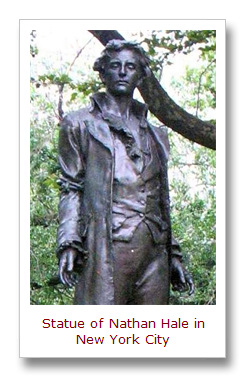
Is Nathan Hale’s legendary line “I only regret that I have but one life to lose for my country” a true quote, a misquote or pure fiction?


On September 22, 1776, during the Revolutionary War, a former school teacher named Nathan Hale was hanged by the British for being a rebel spy.

According to legend, Hale uttered a stirring, patriotic line just before his death:

       “I only regret that I have but one life to lose for my country.”

Hale was certainly a spy. But there’s no historical certainty about what he said just before he died.

In 1776, Hale was an officer in General George Washington’s Continental Army.

That September, after the British captured New York City, Washington asked for a volunteer to go behind the British lines to gather intelligence.

Hale volunteered. And, on September 12, wearing civilian clothes, he took a boat from Stamford, Connecticut to Long Island to carry out his secret mission.

A week later, he was detained and searched by British troops. They discovered he was carrying incriminating papers indicating that he was part of General Washington’s growing ring of spies.

British General William Howe quickly ordered Hale to be executed.

According to the eyewitness account recorded in the diary of British officer Frederick Mackenzie (sometimes spelled Mackensie), Hale did say some brave last words on the day he was hung.

But Mackenzie doesn’t mention the classic “I only regret…” quotation. Nor does any other eyewitness account.

Mackenzie’s diary does note:

“He behaved with great composure and resolution, saying he thought it the duty of every good Officer to obey any orders given him by his Commander-in-Chief; and desired the Spectators to be at all times prepared to meet death in whatever shape it might appear.”

Nearly five years later, on May 17, 1781, the Boston Independent Chronicle ran a story about Hale’s execution. It quoted him as saying:

“I am so satisfied with the cause in which I have engaged, that my only regret is, that I have not more lives than one to offer in its service.”

In the book The History of New England, published in 1799, author Hannah Adams wrote that Hale “lamented that he had but one life to lose for his country.”

Adams credited William Hull for her account. He was a former American general who may have been the source for the 1781 story in the Boston Independent Chronicle.

Hull claimed to have heard about Hale’s last words from a British soldier who witnessed the hanging.

In 1848, Hull’s daughter published his memoirs. Apparently, it is that book which first included the line that became famous.

According to Hull’s memoir, shortly before Hale was hung:

“…Few persons were around him, yet his characteristic dying words were remembered. He said, ‘I only regret that I have but one life to lose for my country.’”

It’s questionable whether Hale spoke those exact words. But it’s plausible that he said something like them.

Hale was a Yale graduate and a teacher. He was undoubtedly familiar with the play Cato, a tragedy about the Roman leader called “Cato the Younger,” written by the English playwright and poet Joseph Addison.

The play was written in 1712, but it was still highly popular in America in the late 1700s.

In Act IV, scene 4, Cato says:

“How beautiful is death, when earn’d by virtue!
Who would not be that youth? What pity is it
That we can die but once to serve our country.”

That last sentence, penned by Addison, is now widely believed to be the origin of the legendary patriotic quote (or misquote) later attributed to Nathan Hale.

Whatever Hale actually did say before being hanged, at age 21, he said it on today’s date in 1776.

*     *     *     *     *     *     *     *     *     *

Comments? Corrections? Post them on the Famous Quotations Facebook page.

Related reading…

September 22, 2009

SEPTEMBER 22 - “Slowly I turned…”

September 22 is the anniversary of the most widely known version of an old vaudeville routine – the “Slowly I turned” shtick.

In this classic comedy bit, the name of a certain place causes a husband to recall how his wife ran away with another man and how he took his revenge on the wife-stealer when he found him.

The Three Stooges made “Niagara Falls” that place in their short film Gents Without Cents, which was released on September 22, 1944.

Today, most people know what comes after “Niagara Falls,” even if they never saw that Stooges film:

“Niagara Falls! Slowly I turned, step by step, inch by inch...”

As he says these words the husband gets so worked up he starts demonstrating on an innocent listener how he smacked, poked, punched and otherwise took his revenge on the wife-stealer. When the poor listener is reeling from the blows, the husband suddenly realizes what he’s doing, stops and apologizes.

Ah, but then, the listener accidentally mentions the place name again – triggering another “Slowly I turned” rant and another beating.

In Gents Without Cents, the Stooges do a stage show in which Moe and Larry both get triggered by “Niagara Falls” and Curly is the recipient of their smacks, pokes and punches.

Other comedians, such as Joey Faye and Abbott and Costello, did their own versions of the routine before and after the Stooges, using other trigger words.

But, for some reason, the Three Stooges’ Niagara Falls version is the one that has stuck in our language and brains. Along with those eloquent words: “Nyuk! Nyuk! Nyuk!”

Here are some of the other famous quotes and phrases linked to SEPTEMBER 22:

“I only regret that I have but one life to lose for my country.” - The famed words of Nathan Hale before he was hung as a rebel spy by the British on September 22, 1776. Hale was a school teacher before the American Revolution and was probably inspired by a line he knew from Joseph Addison's play, Cato (1713): “What pity is it, That we can die but once to serve our country!”

“Thou, too, sail on, O Ship of State!” – The most quoted line from Henry Wadsworth Longfellow’s poem “The Building of the Ship,” which he composed on September 22, 1849.

Copyrights, Disclaimers & Privacy Policy


Copyright © Subtropic Productions LLC

All original text written for the This Day in Quotes quotations blog is copyrighted by the Subtropic Productions LLC and may not be used without permission, except for short "fair use" excerpts or quotes which, if used, must be attributed to ThisDayinQuotes.com and, if online, must include a link to http://www.ThisDayinQuotes.com/.

To the best of our knowledge, the non-original content posted here is used in a way that is allowed under the fair use doctrine. If you own the copyright to something posted here and believe we may have violated fair use standards, please let us know.

Subtropic Productions LLC and ThisDayinQuotes.com is committed to protecting your privacy. For more details, read this blog's full Privacy Policy.