August 25, 2014

“The Father, the Son and the Holy Ghost” become official


The fracturing of the Christian religion into various churches and doctrines with different beliefs started in the early centuries of Christianity.

One source of division was a debate between Christians who believed in Trinitarianism and those who believed in Arianism.

Trinitarianism was based in part on Matthew 28:19, a verse in the Bible which says:

     “Go ye therefore, and teach all nations, baptizing them in the 
        name of the Father, and of the Son, and of the Holy Ghost.”

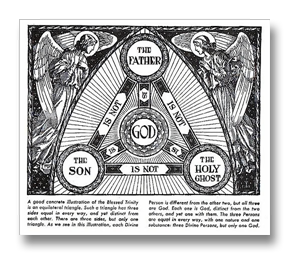
In the fourth century A.D., some Christian leaders used this and other Biblical verses to develop the doctrine of the Holy Trinity, or Trinitarianism.

Trinitarianism maintains that, although there is only one God, he has three forms: God the Father, God the Son (Jesus) and God the Holy Ghost, aka “the Holy Spirit.”

Another early Christian leader named Arius disagreed with that view. Arius and his followers, called Arianists, believed Jesus was the Son of God but was himself human, not divine like God.

The Roman Emperor Constantine I, who had converted to Christianity, was annoyed by this doctrinary dispute. So in 325 A.D. he convened a meeting of more than 300 Christian bishops in the Turkish city of Nicaea (now named Iznik) and charged them with clarifying what the official Christian beliefs would be.

The meeting came to be called the First Council of Nicaea.

On August 25, 325, after two months of discussion, the Council issued what is referred to as the original or first Nicene Creed.

It established the doctrine of the Holy Trinity as the official Christian doctrine and Trinitarianism was adopted by the Catholic Church, the Eastern Orthodox Church and several smaller Christian subgroups.

The First Council of Nicaea also condemned Arianism as heretical anathema and ordered all Arianist writings to be burned. Arius himself was banished from the Roman Empire and took refuge in Palestine.

Despite all that, some Christians refused to reject Arius’ teachings. Arianism continued to have its followers and, in one form or another, still does today.

In 336 A.D., Arius was pardoned by Constantine I and invited to come to Constantinople. While traveling there he died unexpectedly under suspicious circumstances.

According to a contemporary account: “his bowels protruded, followed by a copious hemorrhage, and the descent of the smaller intestines: moreover portions of his spleen and liver were brought off in the effusion of blood.”

Some historians theorize that Arius was poisoned by anti-Arianist Christian zealots.

If that’s what happened, I suspect Jesus would have disapproved.

*     *     *     *     *     *     *     *     *     *

Comments? Corrections? Post them on the Famous Quotations Facebook page.

Related reading…

August 03, 2014

“I’ll die young, but it’s like kissing God.”


On August 3, 1966, the brilliant, boundary-stretching and, unfortunately, drug-addicted American comedian Lenny Bruce was found dead in the bathroom of his home in Hollywood, California.

A syringe and other drug paraphernalia were on the floor next to him. The cause of death was ruled to be an accidental overdose of morphine.

Bruce was just 40 years old.

It was the sad fulfillment of a famous quote about the peril and pleasure of drug addiction that is widely credited to Bruce:

       “I’ll die young, but it’s like kissing God.”

Many books of quotations simply cite the quote as “attributed.”

Those that give a specific source for the attribution cite the 1970 book Play Power: Exploring the International Underground by Richard Neville.

Neville is himself a legendary 1960s counterculture celebrity.

He initially gained notoriety in Australia as editor of the underground magazine OZ.

In Play Power, Neville used the Bruce quotation at the end of a point he made about the unintended consequences of public hysteria over marijuana.

“When one discovers that cannabis is harmless, exposing society’s lie, heroin by analogy may seem tempting,” Neville wrote. “Moral: Tell the truth about pot and there will be fewer junkies.”

Neville then inserted Bruce’s “kissing God” quote, without giving any source information other than Bruce’s name.

It’s possible that Neville heard Bruce say the line in a conversation.

He mentioned in an interview in DUKE magazine that he’d met Bruce briefly in 1962, when the comedian came to Australia for an ill-fated tour that was shut down after one performance for “obscenity.”

I emailed Neville and asked him if Bruce used the “kissing God” quote when they met.

He emailed back saying he didn’t remember hearing it from Bruce himself.

“I can’t recall the first time I heard it,” Neville told me, “though I do remember the saying being quoted in the London OZ office in the late Sixties.”

I’ve been unable to find the “kissing God” quote in anything written by Lenny Bruce.

Nor could I find any evidence that he said it in any of his stand-up comedy routines.

However, a version of the quip is mentioned in the 1974 biography Ladies and Gentlemen, Lenny Bruce!, written by Albert Harry Goldman and Lawrence Schiller.

According to an anecdote recorded in that book, Bruce once told his friend, writer Terry Southern:

“You start off with one or two pills, then it’s three or four and pretty soon to get that flash, you gotta have a whole handful. An’ shit! Who wants to shoot without the flash? You understand? It’s like kissing God!”

On August 3, 1966, Lenny Bruce “kissed God” for last time.

*     *     *     *     *     *     *     *     *     *

Comments? Corrections? Post them on the Famous Quotations Facebook page.

Related reading, listening and viewing…

July 25, 2014

“Paris is worth a mass.” (“Paris vaut une messe.”)


From 1562 to 1598, a series of bloody wars was waged in France between Catholics and Protestant Huguenots, collectively called “The French Wars of Religion.”

This particular series of European religious conflicts ended with the Edict of Nantes, which was essentially a truce providing some basic religious freedoms to both Catholics and Protestants.

The Edict of Nantes was issued in 1598 by King Henry IV and it’s one of the reasons why he became popularly known as “le bon roi Henri” — “the good king Henry.”

Nine years earlier, Henry had became the legal heir to the throne, after King Henry III was assassinated by a fanatical Catholic monk.

Henry IV was a Huguenot, like his predecessor, when he inherited the crown.

And, although most of the country accepted him as King, many Catholics refused to recognize his authority — especially in the vitally important, Catholic-controlled city of Paris.

Henry decided to try to break the political and religious logjam and reunite the country by converting to Catholicism.

He did so in a very public ceremony at the basilica of Saint-Denis in Paris on Sunday morning, July 25, 1593.

That day, according to legend, he told a friend “Paris vaut une messe.” (“Paris is worth a mass.”)

This famous quote (sometimes given as “Paris veult une messe”) was not actually recorded at the time. It was attributed to Henry IV years later and is probably apocryphal.

However, Henry clearly did embrace the basic idea. He felt it was worth converting if it meant he could gain control of Paris and unite the country under his rule.

Henry’s conversion and his Edict of Nantes did unite the country and bring an end to the French Wars of Religion — but not to religious fanaticism.

In 1610, good King Henry IV was assassinated in Paris by the Catholic zealot François Ravaillac.

*     *     *     *     *     *     *     *     *     *    

Comments? Questions? Corrections? Post them on the Famous Quotations Facebook page.

Related reading…

April 11, 2014

“I didn’t fire him because he was a dumb son of a bitch, although he was…”


Two famous quotes by President Harry S. Truman are linked to the date April 11.

The first is something Truman said about a historic announcement he made on April 11, 1951.

On that date, Truman announced his decision to fire General Douglas MacArthur, the “Supreme Commander for the Allied Powers” in Korea, for disagreeing with his policy of limiting the expansion of the Korean War.

It was the culmination of a dispute that started the previous year.

In November and December of 1950, Mao Tse-tung (a.k.a. Mao Zedong), the new leader of the Communist People’s Republic of China, sent hundreds of thousands of Red Chinese troops to fight alongside North Koreans against American and South Korean forces.

MacArthur wanted to respond by attacking China, possibly with nuclear weapons.

Truman firmly squelched that idea.

But MacArthur, who’d enjoyed great popularity with the public since World War II and had a huge ego, decided to try to play a game of political chicken with Truman.

In late March, he wrote a letter to Republican Congressman Joseph W. Martin in which he clearly criticized the President’s policy and slyly played the Red scare card.

His letter suggested that China’s intervention in Korea should be met with “maximum counterforce” and said, in an obvious reference to Truman: “It seems strangely difficult for some to realize that here in Asia is where the Communist conspirators have elected to make their play for global conquest.”

As MacArthur expected, Martin made the letter public.

Truman was furious. And, after a series of discussions with the Joint Chiefs of Staff, he decided to relieve MacArthur of his command.

On the night of April 11, 1951, Truman officially announced his firing of MacArthur in a special broadcast to the American people.

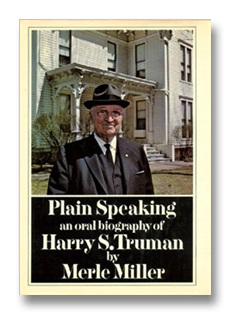
Truman’s famous quote about that decision came to light years later, in 1974, with the publication of the best-selling book Plain Speaking: An Oral Biography of Harry S. Truman.

The book, by Merle Miller, was based on taped-recorded interviews made with Truman in the 1960s.

In one chapter, Miller provided Truman’s response when asked why he decided to fire General MacArthur.

Truman’s salty answer soon became a famous quote

“I fired him because he wouldn’t respect the authority of the President…I didn’t fire him because he was a dumb son of a bitch, although he was, but that’s not against the laws for generals. If it was, half to three-quarters of them would be in jail.”

Of course, there’s another, even better-known quote that’s associated with Truman’s firing of MacArthur.

On April 19, 1951, eight days after he was relieved of duty, MacArthur made a high-profile “farewell address” to a joint meeting of Congress. That speech included the familiar line: “Old soldiers never die, they just fade away.”

There’s also a second Truman quotation that’s linked to the date April 11th, but it’s not about MacArthur. It’s Truman’s humorous, oft-cited explanation of the difference between a politician and a statesman.

On April 11, 1958, speaking to the Reciprocity Club in Washington, D.C., the retired president said:

“A statesman is a politician who’s been dead ten or fifteen years.”

To read the background on that famous quotation, see this previous post on This Day in Quotes.

*     *     *     *     *     *     *     *     *     *

Comments? Questions? Corrections? Post them on the Famous Quotations Facebook page.

Further reading about President Harry Truman and General Douglas MacArthur

February 13, 2014

“Each man kills the thing he loves.” (Sometimes with a straight razor.)


On February 13, 1898, the first edition of Oscar Wilde’s now famous poem “The Ballad of Reading Gaol” was published in London by publisher Leonard Smithers.

Those initial copies of the slim volume of poesy did not mention Wilde’s name. The author was given as “C.3.3.,” a reference to Wilde’s cell number while he was in the Reading prison from 1895 to 1897, serving a two year sentence for being a homosexual.

C.3.3. was prison shorthand for Block C, third floor, third cell.

Because of his highly-publicized conviction for “sodomy,” Smithers and Wilde decided to omit the poet’s real name on the first edition of “The Ballad of Reading Gaol,” fearing it might hurt sales.

After the first small run sold out and several subsequent editions also sold well, Wilde’s name finally appeared on the seventh edition.

The most famous and quoted line from the poem is “Yet each man kills the thing he loves.”

But “The Ballad of Reading Gaol” is not some sappy love ode. It is a dark rumination on murder, the harshness of prison life and the execution of a fellow prisoner of Wilde’s, referred to as “C.T.W.” in the poem.

C.T.W. was Charles Thomas Wooldridge, a former trooper in Her Majesty's Royal Horse Guards in London.

Wooldridge and his young wife Nellie, whose full maiden name was Laura Ellen Glendell, had a short, unhappy marriage. He suspected her of infidelity and abused her. She decided to live apart from him in Windsor.

In March of 1896, trooper Wooldridge begged Nellie to meet him at his barracks in London to discuss reconciliation.

She supposedly agreed, but didn’t show up. So he took a train to Windsor.

On on March 29, 1896, Charlie went to Nellie’s home and cut her throat with the straight razor he’d brought along.

He was quickly arrested, convicted of murder, then sent to the Reading Gaol, which is where Wilde met him.

Wilde apparently liked Charlie and viewed him as a tragic figure deserving of sympathy. But it was a short relationship. On July 7, 1896 Wooldridge was executed by hanging at age 30.

After Wilde was released from prison, he wrote “The Ballad of Reading Gaol.”

It starts with a dedication that says: “In Memoriam, C. T. W. Sometime Trooper of the Royal Horse Guards.”

Here, is a key part of the poem that reflects Wilde’s sympathetic view of Wooldridge:

“He looked upon the garish day
With such a wistful eye;
The man had killed the thing he loved,
And so he had to die.

Yet each man kills the thing he loves,
By each let this be heard,
Some do it with a bitter look,
Some with a flattering word,
The coward does it with a kiss,
The brave man with a sword!

Some kill their love when they are young,
And some when they are old;
Some strangle with the hands of Lust,
Some with the hands of Gold:
The kindest use a knife, because
The dead so soon grow cold.

Some love too little, some too long,
Some sell, and others buy;
Some do the deed with many tears,
And some without a sigh:
For each man kills the thing he loves,
Yet each man does not die.

He does not die a death of shame
On a day of dark disgrace,
Nor have a noose about his neck,
Nor a cloth upon his face,
Nor drop feet foremost through the floor
Into an empty space.”

The poem goes on in that way for quite a while. In fact, it’s much longer. But the excerpt above is enough to understand the main point Wilde was trying to make.

I get it. And I recognize the brutal nature of what was considered to be “justice” in the Victorian era. I especially sympathize with Wilde over the absurdly harsh treatment he received simply for being gay.

But I find it hard to feel sorry for Charles Wooldridge.

And, I am hereby dedicating this post on This Day in Quotes to poor Nellie.

*     *      *     *     *     *     *     *     *     *

Comments? Corrections? Post them on the Famous Quotations Facebook page.

Related reading and viewing…

Copyrights, Disclaimers & Privacy Policy


Copyright © Subtropic Productions LLC

All original text written for the This Day in Quotes quotations blog is copyrighted by the Subtropic Productions LLC and may not be used without permission, except for short "fair use" excerpts or quotes which, if used, must be attributed to ThisDayinQuotes.com and, if online, must include a link to http://www.ThisDayinQuotes.com/.

To the best of our knowledge, the non-original content posted here is used in a way that is allowed under the fair use doctrine. If you own the copyright to something posted here and believe we may have violated fair use standards, please let us know.

Subtropic Productions LLC and ThisDayinQuotes.com is committed to protecting your privacy. For more details, read this blog's full Privacy Policy.