November 09, 2015

“Business as usual”


It’s not uncommon to see credible sources claim that the phrase “business as usual” was coined by Winston Churchill.

For example, a glossary of World War I words and phrases on the BBC website says: “Business as Usual: Phrase coined by Churchill to suggest how British society should react to the wartime situation.”

Even some history books, such as A History of the World from the 20th to the 21st Century by J.A.S. Grenville, make that claim.

The truth is, Churchill helped popularize the phrase but he didn’t coin it.

It began appearing in newspapers and books as far back as the mid-1700s (as shown by this search using Google Ngram, a research tool that shows the appearance of words or phrases in thousands of digitized books).

The original use was literal. When a store reopened after some unusual event, like a fire, the owner would put up a sign saying “Open for business as usual.” Or, on some unofficial holiday, newspapers might report that banks would be open for business as usual.

Churchill’s use came early in World War I. On August 4, 1914, Great Britain officially that bloody fray by declaring war on Germany. At the time, Churchill was First Lord of the Admiralty, a top position in the British Navy.

He and other British military leaders, politicians and businessmen initially assumed that Germany could be defeated quickly with Britain’s existing naval and army forces. Thus, they felt there was no need for a mass recruitment of volunteers or other actions that would disrupt the country’s labor force and economy. Indeed, they argued against any such government “interference” on the home front.

On the day war was declared, British Cabinet Minister David Lloyd George met with a group of bankers and assured them that the policy of the British government was “to enable the traders of this country to carry on business as usual.”

Many prominent businessmen heartily endorsed that policy and began repeating “business as usual” as a slogan.

For example, Henry E.  Morgan, who worked as both an executive for the W.H. Smith publishing company and as an advertising consultant to retail store magnate Harry Gordon Selfridge, used it in a letter to the editor published in the Daily Chronicle on August 11, 1914. Some sources have wrongly credited Morgan with coining the phrase.

Around that time, Selfridge adopted “business as usual” as his catchphrase and he is often credited with coining it. Meanwhile, Harrods department store chain also began using the phrase in newspaper advertisements, leading some sources to credit Harrods with launching the phrase. Soon, other stores and shops began displaying “Business As Usual” signs to show their support for the government’s “non-interference” policy.

Winston Churchill further popularized the phrase by using it a speech he gave on November 9, 1914. As noted by many books of quotations, Churchill said in that speech:

“The British people have taken for themselves this motto – ‘Business carried on as usual during alterations on the map of Europe.’”

This “non-interference” policy was fully embraced by the British government under Prime Minister H. H. Asquith, as David Lloyd George told the bankers in August. Unfortunately, it turned out to be far too optimistic.

By 1915, the UK was forced to recruit hundreds of thousands of volunteers and in 1916 imposed a draft on single men aged 18 to 41. This soon led to serious labor shortages and other disruptions of the economy.

Churchill’s use of “business as usual” during World War I was remembered and repurposed during World War II, when he served as Prime Minister and lead Great Britain in it’s fight against Nazi Germany.

The famed speeches Churchill made during those years are known for their combination of defiance and hope.

In the early 1940s, when German planes were making devastating nightly bombing raids on London, store owners put up homemade notices and signs on their bombed shops that said “Business As Usual.” Like the speeches Churchill gave during World War II, they were a message of both defiance and hope.

In the decades following World War II, the phrase has been used to mean maintaining the status quo, sometimes in a matter of fact way but often with a negative connotation.

For example, in 1962, the famed “Port Huron Statement” adopted by the Students for a Democratic Society (SDS) condemned the typical college campus as “a place of commitment to business-as-usual.”

The following year, the phrase was used in a similar negative way by civil rights leader, Martin Luther King.

In his moving “I Have a Dream” speech on August 28, 1963 in Washington D.C., King said of the race riots that had recently swept America’s urban areas:

“Those who hope that the Negro needed to blow off steam and will now be content will have a rude awakening if the nation returns to business as usual.”

Today, “business as usual” continues to be used in both a positive and negative sense and as sarcasm, making it an unusually flexible idiomatic expression.

*     *    *    *    *    *    *    *    *    *

Comments? Corrections? Post them on the Famous Quotations Facebook page.

Related reading and listening…

October 27, 2015

“Not fade away…”


[An updated version of a previous post. Thanks to the readers who emailed corrections to me.]

On October 27, 1957, American Rockabilly and rock music pioneer Buddy Holly and his band the Crickets released their second 45 rpm single, as a follow-up to their first smash hit “Peggy Sue.” This new single featured “Oh Boy” on one side and “Not Fade Away” on the other.

“Not Fade Away” was actually the “B” side of the record. But it eventually became more widely known.

It’s a classic rock ode with a Bo Diddley beat about a guy whose love for a girl is “bigger than a Cadillac” – a love, the guy claims, that’s real and “not fade away.”

Holly was killed in a tragic plane crash a little over a year after “Not Fade Away” was released. (The date of his death, February 3, 1959, was memorably called “the day the music died” by Don McLean in his 1971 hit song “American Pie.”)

Although Holly’s song popularized “not fade away” as a hip phrase, it had been used in literature as far back as the early 1800s.

And, it’s likely a vernacular echo of an earlier phrase found in the King James Version of the Bible: “fadeth not away.”

In I Peter 5, Saint Peter, the apostle of Jesus who is considered to be the first Pope of the Catholic Church, gives some advice to leaders of the growing number of Christian congregations.

Among other things, he tells them they need to take care of their flocks and set good examples for them.

If they do, he explains, they will be rewarded with a crown of glory that won’t fade away when Jesus returns in the Second Coming to take true believers to heaven.

In verse I Peter 5:2-4 of the King James Version of the Bible, Peter’s words are given like this:

     “…Feed the flock of God which is among you, taking the oversight thereof, not by constraint, but willingly; not for filthy lucre, but of a ready mind; Neither as being lords over God's heritage, but being ensamples to the flock. And when the chief Shepherd shall appear, ye shall receive a crown of glory that fadeth not away.”

Of course, no one says “fadeth not away” nowadays unless they are quoting the Bible.

But the phrase “not fade away” is heard fairly often.

My favorite recent example was its use as the title of an episode of the AMC Network TV show “Fear the Walking Dead.”

And, in the decades since Buddy Holly’s death, the song “Not Fade Away” has certainly not, well, faded away.

It has been covered by many other great musicians and bands, including Bob Dylan, the Rolling Stones, Bruce Springsteen, Patti Smith, The Byrds, Tom Petty, James Taylor, Sheryl Crow and the Grateful Dead.

For more background on the song, see the in-depth post about it on the American Songwriter website.

EDITOR’S NOTE: Back in 2009, on the day when I was writing the first draft of this post, I heard that William Safire had died. Safire's “On Language” column in the New York Times Magazine and his many excellent books about the origins of famous quotations and phrases that grew out of it were among the inspirations that led me to create this blog. He was one of the great quote mavens of our time. May his legacy not fade away.

*     *     *     *     *     *     *     *     *     *

Comments? Corrections? Post them on the Famous Quotations Facebook group.

Related listening and reading…

October 21, 2015

The day Hemingway’s “For Whom the Bell Tolls” made the earth move…


On October 21, 1940,
Ernest Hemingway’s novel For Whom the Bell Tolls was first published by Charles Scribner's Sons.

It’s a classic war story about an American, Robert Jordan, who goes to Spain to fight with anti-Fascist rebels during the Spanish Civil War. Along the way, he falls in love with a rebel girl named Maria.

The title of the novel is taken from a famous line written by British poet John Donne: “...never send to know for whom the bell tolls; it tolls for thee.” 

Those oft-quoted words are from Donne’s book Devotions upon Emergent Occasions, published in 1624. They come at the end of a passage that includes another famous quote by Donne: “No man is an island.”

Hemingway’s novel For Whom the Bell Tolls was a huge bestseller that generated some famous lines of its own.

The first comes in Chapter 7. As Robert and Maria are about to kiss for the first time, Maria asks the somewhat unbelievably naïve question: “Where do the noses go?”

That quote was immortalized by the immensely popular 1943 film adaptation of the book, in which Ingrid Bergman, as Maria, says it to Gary Cooper, playing Robert Jordan.

In Chapter 13 of the novel, there’s another famous quote: “But did thee feel the earth move?” (Hemingway used “thee” and other antiquated terms of speech in the novel supposedly as a way of translating what was being said in Spanish.)

Jordan poses this question to Maria after they have sex. According to a flowery previous paragraph describing their coupling, it did move for Jordan. He supposedly “felt the earth move out and away from under them.”

Maria answers Jordan’s question in the affirmative. Later, when one of the rebel leaders asks Maria if something happened between her and Jordan, she says simply: “The earth moved.”

When the novel was published in 1940, the use of the phrase “feel the earth move” was not a yet a humorous reference to enjoyable sex.

But the use of the phrase in both the book and the movie made it familiar enough to make it that – and to give songwriter-singer Carol King the title and refrain of her hit song “I Feel the Earth Move” (1971).

In Chapter 43 of For Whom the Bell Tolls, there’s another oft-quoted line: “The world is a fine place and worth fighting for.”

It’s included in many books of quotations and one of its many admirers is Senator John McCain. He used the variation Worth the Fighting For as the title of his autobiographical book published in 2003.

Ironically, McCain’s campaign nemesis, President Barack Obama has named Hemingway’s For Whom the Bell Tolls as one of the books that have inspired him.  

I live near Key West, where Ernest Hemingway lived from late 1920s to the late 1930s.

He worked on some of his most famous novels and stories there, including For Whom the Bell Tools, A Farewell To Arms, To Have and Have Not and the short story “The Snows of Kilimanjaro.”

Hemingway’s former house in Key West, now the Hemingway Home and Museum, is a big tourist attraction that is famous for the dozens of “polydactyl” (six- and seven-toed) cats that hang out there.

They’re descendants of the polydactyl cats Hemingway had there in the Thirties.

As a Keys resident, I should probably like Ernest Hemingway more than I do. But the truth is his books and stories never really made the earth move for me.

Plus, I’m just not macho enough to appreciate the fine arts of bullfighting, big game hunting and killing beautiful big fish – three of Hemingway’s favorite sports.

Nor do I find it easy to overlook the way he treated his wives, lovers and kids.

But I really like his polydactyl cats.

*     *     *     *     *     *     *     *     *     *

Comments? Corrections? Post them on the Famous Quotations Facebook page.

Related reading…

■

October 13, 2015

“There is no room in this country for hyphenated Americanism.”


It’s difficult to pigeonhole Teddy Roosevelt.

He was a Republican for most of his political career, including his two terms as President of the United States from 1901 to 1909.

Then, in 1912, he decided the Republican Party had become too cozy with big corporate interests.

So he left the GOP and founded the Progressive Party (nicknamed “the Bull Moose Party” after Roosevelt told reporters he was fit to run for president again and feeling as “strong as a bull moose”).

Some of statements Teddy uttered during his long political career make sound him like a right-wing conservative. Some make him sound like a left-wing liberal.

On October 12, 1915, he gave a controversial speech to the Knights of Columbus in New York City that managed to combine Tea Party-style anti-immigrant rhetoric with comments that FOX News commentators would likely attack as liberal, anti-business and soft on the issue of illegal aliens.

This was the speech that launched the famous and still controversial term “hyphenated American.”

“There is no room in this country,” Roosevelt bellowed, “for hyphenated Americanism…German-Americans, Irish-Americans, English-Americans, French-Americans, Scandinavian-Americans or Italian-Americans. There is no such thing as a hyphenated American who is a good American. The only man who is a good American is the man who is an American and nothing else.”

Those words sound like something Rush Limbaugh or Donald Trump might say.

And, many conservatives would certainly applaud the part of the speech in which Roosevelt said immigrants to the United States should be required to learn English.

They might find it harder to embrace other parts of Roosevelt’s “hyphenated Americans” speech.

Like the part when he said:

“Any discrimination against aliens is a wrong, for it tends to put the immigrant at a disadvantage and to cause him to feel bitterness and resentment during the very years when he should be preparing himself for American citizenship. If an immigrant is not fit to become a citizen, he should not be allowed to come here. If he is fit, he should be given all the rights to earn his own livelihood, and to better himself, that any man can have.”

This speech and others that Roosevelt gave on immigration and immigrants continue to generate controversy.

People on both sides of the current debate over “illegal aliens” have used excerpts from his speeches to support their views.

Ironically, there’s an element of truth to both uses of his quotes — because it’s just as difficult to pigeonhole Teddy Roosevelt today as it was when he was alive.

*     *     *     *     *     *     *     *     *     *

NOTE TO HISTORY BUFFS: You can read the story the New York Times published on October 13, 1915 about Roosevelt’s “hyphenated Americans” speech by clicking this link.

*     *     *     *     *     *     *     *     *     *

Comments? Corrections? Post them on the Famous Quotations Facebook page.

Related reading…

October 10, 2015

“Doubtless God could have made a better berry, but…”


The Izaak Walton League is one of America's oldest conservation groups. It was founded in 1922 by sport fishermen who wanted to preserve fish and wildlife habitat for future generations.

The League took its name from the avid English angler Izaak Walton (1593-1683).

By profession, Walton was an “ironmonger” (a dealer in iron and hardware). During his time off, he loved to fish. He also enjoyed writing.

Walton’s best known work is The Compleat Angler, one of the earliest and most celebrated books ever written about recreational fishing.
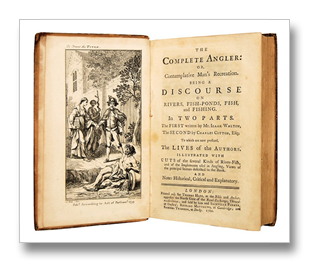
It was first published on October 10, 1653 and has been in print ever since.

There’s a famous quotation The Compleat Angler that’s included in many books of quotations.

But it’s not about fishing. And, it wasn’t coined by Walton himself.

It’s an observation about strawberries and God that Walton credited to “Dr. Boteler,” who is generally believed to be the English physician, Dr. William Butler. (Variant spellings of names and words were common back then.)

The famed quote is in this passage comparing the pleasures of angling to those ruby fruits:

“No life, my honest scholar, no life so happy and so pleasant as the life of a well-governed angler; for when the lawyer is swallowed up with business, and the statesman is preventing or contriving plots, then we sit on cowslip-banks, hear the birds sing, and possess ourselves in as much quietness as these silent silver streams, which we now see glide so quietly by us. Indeed, my good scholar, we may say of angling, as Dr. Boteler said of strawberries, ‘Doubtless God could have made a better berry, but doubtless God never did’; and so, if I might be judge, God never did make a more calm, quiet, innocent recreation than angling.”

The strawberries referred to in The Compleat Angler were not the big ones modern consumers are familiar with.

Those weren’t developed until the early 1800s.

In Walton’s time, the strawberries eaten in Europe were either wild strawberries or cultivated varieties of wild strawberries that were smaller than today’s varieties.

The large strawberries we buy today were “made” by humans through the process of selective breeding.

Of course, if you’ve ever eaten wild strawberries when they are perfectly ripe, you know that man still hasn’t made a better berry.

*      *      *      *      *      *      *      *      *      *

Comments? Corrections? Post them on the Famous Quotations Facebook page.

Related reading and viewing…

Copyrights, Disclaimers & Privacy Policy


Copyright © Subtropic Productions LLC

All original text written for the This Day in Quotes quotations blog is copyrighted by the Subtropic Productions LLC and may not be used without permission, except for short "fair use" excerpts or quotes which, if used, must be attributed to ThisDayinQuotes.com and, if online, must include a link to http://www.ThisDayinQuotes.com/.

To the best of our knowledge, the non-original content posted here is used in a way that is allowed under the fair use doctrine. If you own the copyright to something posted here and believe we may have violated fair use standards, please let us know.

Subtropic Productions LLC and ThisDayinQuotes.com is committed to protecting your privacy. For more details, read this blog's full Privacy Policy.