August 28, 2015

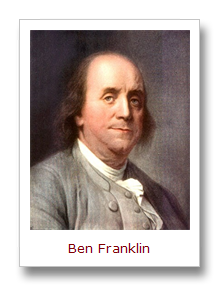
The backstory on “Snug as a bug in a rug.” (Spoiler Alert: Ben Franklin didn’t actually coin it.)


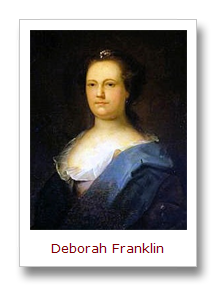
In 1771, Ben Franklin’s common-law wife, Deborah Read Franklin shipped a live gift to young Georgiana Shipley, the daughter of British friends in London.

It was an American gray squirrel that Deborah thought would make a nice pet for the girl.

Georgiana named it Mungo.

Mungo was also referred to as “Skugg.” That was a name commonly used for squirrels at the time, the way “Pooch” is used for dogs and “Puss” for cats.

About a year after Mungo became Georgiana’s pet, he escaped from his cage and was killed by a dog.

The Franklins heard about this misfortune and felt bad for little Georgiana. So, Ben wrote a letter to her to express his sympathy and try to cheer her up.

It is this letter, dated September 26, 1772, that led to the widespread belief that Franklin coined “snug as a bug in a rug,” which became an idiomatic way of saying someone or something is comfortable, warm and cozy.

The letter said, in part:

To Georgiana Shipley
Dear Miss,
London, Sept. 26. 1772

I lament with you most sincerely the unfortunate End of poor Mungo: Few Squirrels were better accomplish’d; for he had had a good Education, had travell’d far, and seen much of the World. As he had the Honour of being for his Virtues your Favourite, he should not go like common Skuggs without an Elegy or an Epitaph. Let us give him one...

Here Skugg
Lies snug
As a Bug
In a Rug...

If you wish it, I shall procure another to succeed him. But perhaps you will now choose some other Amusement.

Remember me affectionately to all the good family, and believe me ever your affectionate
friend,

B. FRANKLIN

Franklin’s letter is certainly the most famous use of the saying “snug as a bug in a rug.”

However, as noted by the indispensable Phrase Finder website, the excellent book Who Said That First? and other authoritative sources, it’s not the origin.

The phrase had previously been used by Francis Gentleman in his satirical play The Stratford Jubilee, published in England in 1769.

Gentleman was an Irish-born playwright, actor and critic who spent most of his working years in London. He’s also known for writing the proto-science fiction tale A Trip to the Moon in 1764, under the pseudonym “Sir Humphrey Lunatic.”

In The Stratford Jubilee, a male character says he’s heard a certain widow “has the mopus’s” (a slang term for having money). If she does, he boasts, he plans to “have her, as snug as a bug in a rug.”

This has been cited as the first appearance of “snug as a bug in a rug” in print. But it’s possible that its use in the play indicates it was already part of the common vernacular in England.

It seems probable that Franklin heard it during one of his visits there. Indeed, he was in London in 1769, so he may have seen or read Gentleman’s play.

The word snug was originally a nautical term, meaning to make a ship or things on a ship safe and secure. Thus, in the 1700s, “snug as a bug in a rug” was probably used with the concept of being secure or securing something in mind — which is slightly different than the more modern sense of being comfortable, warm and cozy.

At any rate, poor Mungo the squirrel wasn’t comfortable, warm and cozy when Ben Franklin wrote his letter. He was a cold, dead Skugg.

R.I.P., Mungo. This post’s for you.

*     *     *     *     *     *     *     *     *     *

Comments? Corrections? Post them on the Famous Quotations Facebook page.

Related reading…

August 12, 2015

“How does it feel to be one of the beautiful people?”


The phrase “beautiful people” had been used prior to the 1960s.

For example, in Oscar Wilde’s play An Ideal Husband, a social comedy first performed in 1895, one of the characters says at a gathering of high society partygoers: “I like looking at geniuses, and listening to beautiful people.”

And, in 1941, William Saroyan titled one of his plays The Beautiful People.

But it wasn’t until the 1960s that “beautiful people” became an expression that had a generally recognized social meaning. In fact, there were two different Sixties terms about “beautiful people.”

One version was the beautiful people,” a name applied to glamorous celebrities, wealthy “jet setters” and other fashion trendsetters.

That version is generally credited to Diana Vreeland, the influential editor of Vogue magazine. Vogue started using the term “the beautiful people” in 1962 in articles about celebrities, at Vreeland’s suggestion, and it quickly caught on.

Another version, without the word the, was popularized in the mid-1960s by the young people commonly known as “the Hippies.” In Hippie parlance, “beautiful people” were people who were cool and spiritually “enlightened.” (As in: “They’re really beautiful people, man.”)

Being one of those “beautiful people” didn’t require wealth or fame. You could become one by taking a psychedelic drug like LSD, or by getting your enlightenment from some hip form of religion, such as transcendental meditation.

In 1967, the Beatles made a sly reference to the Hippie version of the term and subtly mocked the Vogue-style “beautiful people” in their song “Baby You’re a Rich Man.” It starts with the famous line:

      “How does it feel to be one of the beautiful people?”

As noted by many websites and books about the Beatles, “Baby You’re a Rich Man” was actually made from two songs originally written separately by John Lennon and his fellow Beatle Paul McCartney.

The opening verses were from a song Lennon wrote and initially called “One of the Beautiful People.” Around the same time, McCartney wrote a song that repeated the words “Baby you’re a rich man” in the chorus.

At some point, Lennon and McCartney decided to combine their two songs into one, something they had done before in other famous Beatle songs, such as “A Day in the Life.”

Lennon and McCartney recorded their combo composition with the other two Beatles, George Harrison and Ringo Starr, on May 11, 1967. John sang lead and played the clavioline, an early electronic instrument that gave the song a distinctive aural character.

The finished song was released with the title “Baby You’re A Rich Man” on July 7, 1967, on the B-side of the 45rpm record that featured “All You Need Is Love” on the A-side.

But it wasn’t until August 12, 1967 that “Baby You’re A Rich Man” entered Billboard's Hot 100 chart. Unlike “All You Need Is Love,” which zoomed to #1 on August 19, 1967, “Baby You’re A Rich Man” was not a huge hit in itself. It peaked at #34.

Both songs were included on the Beatles’ Magical Mystery Tour album, which was released that November. Magical Mystery Tour hit #1 on Billboard’s Top LPs chart on January 6, 1968 and remained the number one selling album in the US for eight weeks.

In the years since then, John Lennon’s in-joke question “How does it feel to be one of the beautiful people?” has become a famous quote cited by many books and websites.

And, most old Beatles fans (like me), and any younger Beatles fans worth their salt, are familiar with the rest of the lyrics to “Baby You’re A Rich Man.”

“How does it feel to be one of the beautiful people?”
For a refresher, or just for the pleasure of it, click the link to the video at right and follow along...

“How does it feel to be one of the beautiful people?
Now that you know who you are,
What do you want to be?
And have you traveled very far?
Far as the eye can see.

How does it feel to be one of the beautiful people?
How often have you been there?
Often enough to know.
What did you see when you were there?
Nothing that doesn’t show.

Baby you’re a rich man,
Baby you’re a rich man, too.
You keep all your money in a big brown bag, inside a zoo.
What a thing to do!
Baby you’re a rich man,
Baby you’re a rich man, too

How does it feel to be one of the beautiful people?
Tuned to a natural E,
Happy to be that way.
Now that you’ve found another key,
What are you going to play?

[Chorus repeats]

*     *     *     *     *     *     *     *     *     *    

Comments? Corrections? Post them on the Famous Quotations Facebook page.

 Further reading, listening and viewing…

July 31, 2015

“The Final Solution of the Jewish Problem” (“Endlösung der Judenfrage”)


“The Final Solution” is one of the most chilling phrases associated with Adolf Hitler and Nazi Germany.

It’s a euphemism for genocide.

“The Final Solution” was immortalized by a memo sent on July 31, 1941 by Hermann Göring (often spelled Goering in English), head of the Gestapo, to Nazi SS General Reinhard Heydrich.

The memo was drafted for Göring by Adolf Eichmann, head of the Nazi “Department for Jewish Affairs.”

The Nazis had previously considered several plans for getting rid of Europe’s Jewish population, such as mass sterilization and deportation to the island of Madagascar (the so-called “Madagascar Plan”).

Ultimately, those previous options were deemed impractical. Hitler wanted another option.

The memo Göring signed on July 31st ordered Heydrich to devise and implement a new plan for dealing with “the Jewish problem.”

Several versions of that phrase were used in the memo. But one in particular became infamous: “Endlösung der Judenfrage” — the “Final Solution of the Jewish Problem.” (This is also often translated as “Final Solution of the Jewish Question,” since the German word frage can mean either “question” or “problem.”)

Göring’s memo to Heydrich said:

    “In completion of the task which was entrusted to you in the Edict dated January 24, 1939, of solving the Jewish Problem by means of emigration or evacuation in the most convenient way possible, given the present conditions, I herewith charge you with making all necessary preparations with regard to organizational, practical and financial aspects for a total solution of the Jewish Problem [Gesamtlösung der Judenfrage] in the German sphere of influence in Europe…

     I further charge you with submitting to me promptly an overall plan of the preliminary organizational, practical and financial measures for the execution of the intended final solution of the Jewish Problem [Endlösung der Judenfrage].”

On January 20, 1942, Heydrich met with top officials from various ministries of Hitler’s Third Reich government at the Wannsee Conference.

There, the hideous intent of Göring memo was fully set in motion.

Over the next few years, the Nazis killed millions of Jewish men, women and children at mass extermination camps such Belzec, Sobibor, Treblinka and Auschwitz.

Fortunately, the defeat of the Nazis and the death of Hitler in 1945 brought an end to implementation of “the Final Solution of the Jewish Problem.”

But by the end of World War II, a total of approximately six million Jews had been killed — two-thirds of the Jews living in Europe before the war began.

*     *     *     *     *     *     *     *     *     *

Comments? Corrections? Post them on the Famous Quotations Facebook page.

Related reading and viewing…

July 27, 2015

As American as apple pie, cherry pie – and violence...


Apple trees are not native to America. They originated in Central Asia and were grown in Asia and Europe long before European colonists brought them to North America.

However, as explained in a post by the eminent word and phrase expert Barry Popik on his site, American-grown apples and American-style apple pies eventually became renowned for having a special sweetness and flavor.       

That led to the term “American apple pie,” which was used to distinguish American-style apple pies from pies made in other countries.

By the 1920s, the phrase “as American as apple pie” was floating around. By the 1940s it had become a common idiomatic expression.

There’s no famous quotation or date to cite for the origin of “as American as apple pie.” The exact origin is unknown.

But there is a notorious variation that’s linked to the date July 27.

On July 27, 1967, the black activist H. Rap Brown gave a rancorous speech at a press conference in Washington, D.C. that is widely cited as the origin of his well-known quote:

     “Violence is as American as cherry pie.”

In a way, it was the origin. However, that seven-word aphorism is the shortened, popularized version of what Brown said in his speech.

What he actually said that day was:

     “I say violence is necessary. Violence is a part of America’s culture. It is as American as cherry pie. Americans taught the black people to be violent. We will use that violence to rid ourselves of oppression if necessary. We will be free, by any means necessary.”

Ironically, at the time, Brown was Director of the Student Nonviolent Coordinating Committee (SNCC).

His fiery remarks at the July 27 press conference were, in part, a reaction to an announcement President Lyndon Johnson made that day.

Johnson announced that he was creating a special government commission formally titled “The National Advisory Commission on Civil Disorders.” It later came to be popularly known as The Kerner Commission, after its chair, Governor Otto Kerner of Illinois.

Johnson asked the 11-member Commission to determine the causes of the violent race riots that had swept through major American cities during the past few years, most recently in Newark and Detroit, and to recommend ways to stop such riots from happening in the future.

Brown decided to respond to this news by holding a press conference at SNCC’s Washington headquarters.

He scoffed at the idea that the causes of the riots were a mystery. “Rebellions are caused by conditions,” he said.

Then he made his famous comments about violence being necessary and as American as cherry pie and topped that off by adding: “If you give me a gun and tell me to shoot my enemy, I might just shoot Lady Bird.” (Referring to President Johnson’s wife, Claudia, whose popular nickname was “Lady Bird.”)
 
Brown went on to call President Johnson a “white honky cracker” and “a mad wild dog” and said that if America’s cities didn’t “come around” they “should be burned down.”

None of his comments that day gained the lasting notoriety of his cherry pie aphorism.

It’s not clear why he chose cherry pie instead of apple pie. But in his controversial 1969 autobiography Die Nigger Die!, Brown helped popularize his version of the saying by using it in the pithier form that’s often mistakenly attributed to his July 27, 1967 speech.

In the book, Brown wrote (using a lower case “a” for America, to show his disdain):

     “This country was born on violence. Violence is as american as cherry pie. Black people have always been violent, but our violence has always been directed toward each other. If nonviolence is to be practiced, then it should be practiced in our community and end there. Violence is a necessary part of revolutionary struggle.”

As I write this, the President of the United States is a black man who is serving his second term in office.

H. Rap Brown (who changed his name to Jamil Abdullah Al-Amin while in prison for armed robbery in the 1970s) is now serving a life sentence in prison for murder.

He was convicted of killing African-American police officer Ricky Kinchen in 2000, during a shootout in Georgia that occurred when Kinchen tried to serve a warrant on him.

On July 19, 2013, President Barack Obama held a press conference at the White House to express his views on a Florida jury’s recent decision to acquit George Zimmerman of murder for shooting and killing the young black teenager Trayvon Martin.

The President acknowledged that race relations in America are better than they were when he was Trayvon’s age.

But he noted that racism in America clearly has not been eliminated.

More recent events in Ferguson, Missouri and elsewhere have seemed to give further credence to that view.

And, the continuing occurrence of gun-related homicides in the United states, affecting people of all races, seem to validate the view that violence is indeed still as American as cherry — or apple — pie.

*     *     *     *     *     *     *     *     *     *    

Comments? Corrections? Post them on on the Famous Quotations Facebook page.

Related reading and viewing…

July 07, 2015

The day Leo Durocher said “Nice guys finish last.” (Or something like that.)


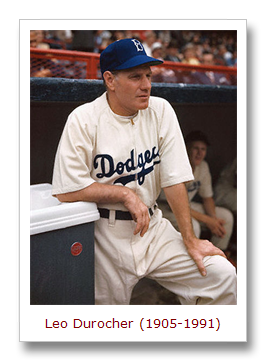
The famous sports quote “Nice guys finish last” has long been attributed to legendary baseball player and manager Leo Durocher. But for decades there has been a debate about whether he actually said it.

Most sources agree that the basis for the attribution comes from remarks “Leo the Lip” made on July 6, 1946, when he was managing the Brooklyn Dodgers.

That day, he was dissing the New York Giants and their manager Mel Ott to some reporters, during batting practice at the old “Polo Grounds” stadium. One of the reporters was sportscaster Red Barber. Another was Frank Graham, sportswriter for The New York Journal-American.

Graham’s column, published the following day, used the headline “Leo Doesn’t Like Nice Guys.” It also noted what Durocher said about “nice guys” — which does not include the famous quote.

Graham reported that Red Barber had asked Durocher “Why don’t you be a nice guy for a change?”

According to Graham, Durocher replied:

“Nice guys! Look over there. Do you know a nicer guy than Mel Ott? Or any of the other Giants? Why, they’re the nicest guys in the world! And where are they? In seventh place! Nice guys! I’m not a nice guy – and I’m in first place.” After pacing up and down the visitors’ dugout, the Dodger manager waved a hand toward the Giants’ dugout and repeated, “The nice guys are all over there, in seventh place.”

In his excellent book The Quote Verifier, quotation expert Ralph Keyes says: “When Graham’s original column was reprinted in Baseball Digest that fall, Durocher’s reference to nice guys finishing in ‘seventh place’ had been changed to ‘last place.’…Before long Leo’s credo was bumper-stickered into ‘Nice guys finish last.’”

Over the years, some books of quotations have given Durocher credit for the “bumper sticker” version of the famed quote, while others cite it as “attributed” or as a paraphrase of what he said.

Durocher himself helped confuse the facts. Initially, he denied saying “Nice guys finish last.” But after it became famous, he embraced it. He even used it as the title of his autobiography (first published in 1975). And, in that, he gave a possibly revisionist version of what he said on July 6, 1946, which differs from what sportswriter Graham originally reported.

Here’s Durocher’s recollection from his book:

[T]he Giants, led by Mel Ott, began to come out of their dugouts...I called off his players’ names as they came marching up the steps behind him, “Walker, Cooper, Mize, Marshall, Kerr, Gordon, Thompson. Take a look at them. All nice guys. They’ll finish last. Nice guys. Finish last...Give me some scratching, diving hungry ballplayers who came to kill you...That’s the kind of guy I want playing for me.”

So, was Durocher’s version correct or was Graham’s? I don’t know, but I’ll add a couple of other pieces to the puzzle, based on my own recent Internet searches of newspaper archives.

In an article published on August 12, 1946 in the Uniontown, Pennsylvania Morning Herald, sports editor Jimmy Gismondi wrote that Dodgers fans “back up their manager [Durocher] when he leaps from his dugout to scream at an ump. ‘Nice guys don’t win pennants,’ the Dodger fans say. And sometimes we think they’re right. How’s Mel Ott doing these days?”

I also found an Associated Press article dated August 13, 1946, written by AP Sports Editor Frank Eck. In it, he said: “Brooklyn fans like their baseball rough. They remember when their heroes were second division duds six straight years in the thirties. But now they have a rough and tumble group to cheer and they love Durocher for saying: ‘Nice guys don’t win pennants.’”

So those articles clearly suggest that “Nice guys don’t win pennants” was a saying commonly used by Durocher and Dodgers fans at the time.

Then I found two news stories from 1948 commenting on a recent article Leo Durocher had written. Durocher’s article was published in the April 1948 issue of Cosmopolitan magazine. The title of the article was “Nice Guys Finish Last.”

Was that title chosen by Durocher based on a quote he coined — or was it created by an editor at Cosmopolitan, who may be the real coiner of the line that Durocher later claimed as his?

I don’t know the answer to that either. If you do, please shoot me an email or post a comment on the Famous Quotations Facebook page. You’ll be clearing up a longstanding quotation mystery.

*     *     *     *     *     *     *     *     *     * 

Comments? Questions? Corrections? Post them on the Famous Quotations Facebook Page.

Related reading…

Copyrights, Disclaimers & Privacy Policy


Copyright © Subtropic Productions LLC

All original text written for the This Day in Quotes quotations blog is copyrighted by the Subtropic Productions LLC and may not be used without permission, except for short "fair use" excerpts or quotes which, if used, must be attributed to ThisDayinQuotes.com and, if online, must include a link to http://www.ThisDayinQuotes.com/.

To the best of our knowledge, the non-original content posted here is used in a way that is allowed under the fair use doctrine. If you own the copyright to something posted here and believe we may have violated fair use standards, please let us know.

Subtropic Productions LLC and ThisDayinQuotes.com is committed to protecting your privacy. For more details, read this blog's full Privacy Policy.