Showing posts with label W.C. Fields. Show all posts

March 03, 2020

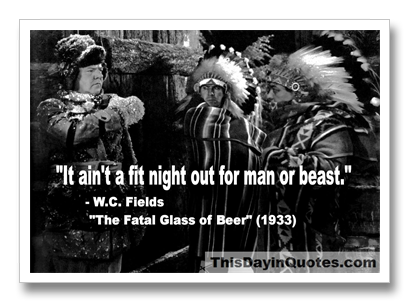
“It ain’t a fit night out for man or beast!”


I have a nostalgic fondness for one the most famous movie quotations uttered by the great comic actor W.C. Fields: “It ain’t a fit night out for man or beast!”

As a kid growing up in Dayton, Ohio in the 1950s, I often heard my father and his old World War II Army buddies say those words to each other on snowy or rainy nights.

Every time they said it, they’d chuckle.

I’d chuckle, too.

But at the time I didn’t actually know where they got the line or why it was funny to them.

It wasn’t until my college days that I saw the W.C. Fields movie that popularized the line — The Fatal Glass of Beer and realized they were quoting him.

That famous Fields two-reel “short subject” was first released to movie theaters nationwide on March 3, 1933. My Dad and his friends had seen it and other Fields films at local movie theaters in Dayton when they were young.

It was produced by Mack Sennett, the Canadian-born Hollywood mogul who produced many classic silent and early “talkie” comedies from 1911 until the mid-1930s, including the Keystone Cops films, and films by legendary comedians like Fields, Charlie Chaplin and Fatty Arbuckle.

If you’ve seen The Fatal Glass of Beer then you know the line “It ain’t a fit night out for man or beast” is used repeatedly in it for comic effect.

If you haven’t seen the film, you can watch it on YouTube and other sites. It’s a classic! 

The movie is set in the Yukon during winter.

W.C. Fields plays a local prospector named Mr. Snavely, who lives in a remote, rustic cabin with his wife.

Six different times in the movie, Fields opens the cabin door, looks out, then intones: “It ain't a fit night out for man or beast.”

Every time he does, a gust of wind blows a cloud of snow into his face.

The audience can see that it’s obviously a bucketful of fake snow being thrown at Fields from off screen. It’s clearly hokey, as intended.

The Fatal Glass of Beer was, in part, a send-up of earlier, badly-produced films and vaudeville shows.

It also mocks the moralistic tone of some early movies and older anti-drinking temperance shows.

The title of the film comes from a faux temperance song Fields sings during the first few minutes, at the request of his friend, a local Canadian Mountie played by Richard Cramer.

Fields accompanies himself by seeming to play what the Mountie calls a “dulcimer.” It’s actually a zither and Fields strums it while wearing thick furry mittens and singing off-key.

The song, credited to vaudeville comedian Charlie Case, tells the tale of a young country boy who goes to the big city and visits a bar, where a group of rowdy city boys talk him into drinking “the fatal glass of beer.”

That single drink immediately causes the poor boy to have delirium tremens, go wild and crazy and break a Salvation Army worker’s tambourine.

The moral of the song, as given in the lyrics, is don’t drink alcohol and “Don’t go ‘round breaking people’s tambourines.”

Yes, the song and movie are as kooky as that sounds. It’s almost as surreal as a Monty Python skit. Indeed, I view it as a forerunner of the kind of creatively wacky humor the Pythons are known for.

The Fatal Glass of Beer wasn’t a big hit when it came out. But it eventually became a cult classic, giving my father and millions of other people a funny line to say when the weather is nasty.

By the way, Fields says “man or beast,” not “man nor beast.” The latter is a common misquote.

As I recall, my late father said it correctly. I think he was as much of a W.C. Fields fan as I eventually became.

This one’s for you, Dad.

RELATED POST: “Any man who hates dogs and babies can’t be all bad.”

*     *     *     *     *     *     *     *     *     *

Comments? Corrections? Post them on the Famous Quotations Facebook page.

W.C. Fields – further reading and viewing…

February 17, 2016

“Any man who hates dogs and babies can’t be all bad.”


To paraphrase Firesign Theatre, everything most people know about some famous quotations is wrong.

A notable example is the famous line “Any man who hates dogs and babies can’t be all bad.”

Most people think that’s a quote by W.C. Fields.

However, Fields didn’t say it. (Nor did he say any of the common variations of the line, such as those using “kids” or “children” in place of the word babies.)

It’s actually a famous misquote based on something that was said about Fields in 1939 by Leo Rosten, a witty professor who later became a successful scriptwriter and author.

On February 16, 1939, a dinner was held in honor of W.C. Fields at the Masquers Club in Hollywood, the night before the premiere of his latest movie You Can’t Cheat an Honest Man.

Rosten was in Hollywood at the time doing some research on the movie industry and was invited to attend.

After dinner, Rosten was asked to say something about Fields. He ad-libbed:

“The only thing I can say about Mr. W. C. Fields, whom I have admired since the day he advanced upon Baby LeRoy with an icepick, is this: Any man who hates babies and dogs can’t be all bad.”

Rosten’s quip brought down the house and was mentioned in an article in the February 27, 1939 issue of Time magazine.

Although the line was credited to Rosten by Time, he was little-known in 1939. His career and eventual fame as a screenwriter and author began in the 1940s.

Thus, like many other famous misquotes, Rosten’s quip was soon attributed to a more famous person — in this case, to Fields himself. Eventually even Bartlett’s Familiar Quotations attributed it to Fields.

That annoyed Rosten and he worked to correct the misattribution. Today, although the attribution to Fields persists, many books and online sources give Rosten credit for his quip.

However, quotation mavens William Safire and Ralph Keyes have also pointed out that the essence of Rosten’s line was not original.

As Keyes explained in his excellent book Nice Guys Finish Seventh:

In November, 1937 — nearly two years before the Masquers banquet — Harper’s Monthly ran a column by Cedric Worth about a New York cocktail party which took place in 1930. This party was dominated by a man who had a case against dogs. After leaving, Worth found himself in an elevator with a New York Times reporter. As the elevator made its way to the ground the reporter observed, “No man who hates dogs and children can be all bad.”

To be accurate, therefore, reference books should attribute “No man who hates dogs and children can be all bad,” to the Times reporter. His name was Byron Darnton. Byron who? That’s just the point. Who’s heard of Byron Darnton? Yet most of us know the name W.C. Fields. This is why Fields routinely gets credit for someone else’s words. He probably always will.

I searched several online databases of newspapers and books and couldn’t find any uses of Darnton’s line (or anything similar) prior to 1937. My guess is that Darnton probably does deserve credit for the first version of the saying about a man who hates dogs and children.

And, although most people have not heard of him, there is now an entry about Byron Darnton on Wikipedia.

He’s also mentioned in a book and website by Doral Chenoweth about war correspondents who were killed in action during World War II.

So, Byron Darnton is not forgotten. But I suspect that most people will continue to “know” that W.C. Fields said “Any man who hates dogs and babies can’t be all bad.” 

RELATED POST: “It ain’t a fit night out for man or beast!”

*     *     *     *     *     *     *     *     *     *

Comments? Corrections? Post them on the Famous Quotations Facebook page.

Related reading and viewing…

Copyrights, Disclaimers & Privacy Policy


Copyright © Subtropic Productions LLC

All original text written for the This Day in Quotes quotations blog is copyrighted by the Subtropic Productions LLC and may not be used without permission, except for short "fair use" excerpts or quotes which, if used, must be attributed to ThisDayinQuotes.com and, if online, must include a link to http://www.ThisDayinQuotes.com/.

To the best of our knowledge, the non-original content posted here is used in a way that is allowed under the fair use doctrine. If you own the copyright to something posted here and believe we may have violated fair use standards, please let us know.

Subtropic Productions LLC and ThisDayinQuotes.com is committed to protecting your privacy. For more details, read this blog's full Privacy Policy.