Showing posts with label October 16. Show all posts

October 16, 2016

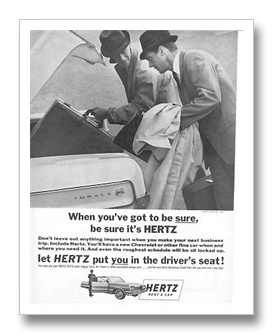
“Let Hertz put you in the driver’s seat!”


The real life “Mad Men” who formed the Norman, Craig & Kummel (NCK) advertising agency in 1955 share the credit for a number of classic advertising slogans and campaigns that most people still remember.

One is the Maidenform bra series of ads that used variable headlines based on the formula “I dreamed I (did or was something) in my Maidenform bra.” Another is “Ajax: Stronger than dirt.”

In 1959, NCK was selected to be the new advertising agency for the fast-growing rental car company Hertz.

The NCK ad gurus soon developed a new ad concept and slogan: “Hertz puts you in the driver’s seat.”

According to the trademark application filed by Hertz, that slogan was first used in commerce on September 2, 1959.

It wasn’t bad. But it did seem a bit more like a demand than an offer.

So the NCK copywriters did some thinking and tweaking and created a more friendly-sounding, request-oriented variation — the world-famous advertising catchphrase almost everyone came to know:

       “Let Hertz put you in the driver’s seat.”

The paperwork Hertz filed when it trademarked that version said it was first used in commerce on October 16, 1959.

In the early 1960s, print ads, signs and television commercials featuring the line were everywhere.

The TV commercials, which pioneered some early special effects, were especially memorable.

Gravity-defying people floated down from the sky into the seats of their rental cars, as viewers heard a cheery vocal group sing “Let Hertz put YOU in the driver’s seat” in a swinging jingle.

AdAge magazine has listed that series of ads as one of the “Top 100 Advertising Campaigns of the Century.”

It helped make Hertz the largest rental car company in the world.

Then in 1963 Hertz’s smaller rival, Avis, started it’s own memorable ad campaign.

Those ads noted that Avis was “only No. 2” in the car rental business. Not as big as Hertz.

What that meant, the ads suggested, was that Avis was more motivated to please customers than Hertz.

This cleverly-snarky concept was encapsulated by copywriters at the Doyle Dane Bernbach agency in the famous ad slogan: “We try harder.” (Also listed in the AdAge Top 100.)

It was a jiu-jitsu move that turned Hertz’s position as the largest car rental company against it and succeeded in gaining more attention and customers for Avis.

By 1966, an
article in Time magazine noted that Hertz “is being at least nibbled by ‘We’re only No. 2’ Avis...Avis has upped its revenues by 34% in 1966, compared with Cadillac-sized Hertz's gain of 18%.”

The article also noted the Hertz had unceremoniously dumped Norman, Craig & Kummel and hired a new ad agency.

Their new agency never came up with anything as well remembered as “Let Hertz put you in the driver’s seat.” And, ironically, Hertz has continued to use the slogan off and on in more recent decades.

The Hertz vs. Avis ad slogan war and the firing of NCK the agency business are a reminder that the advertising business in the 1960s was both extremely creative and extremely rough, as dramatized by the hit TV show
Mad Men.

It still is, of course.

But I doubt if the ad biz of today will ever be viewed as being anywhere near as cool as it was in the era depicted by Mad Men.

*     *     *     *     *     *     *     *     *     *

Comments? Corrections? Post them on my quotations Facebook group.

Related reading, listening and viewing…

vvvvvvvvvvvvvvvvvvvvvvvvvvvvvvvvv

October 16, 2009

OCTOBER 16 - Castro said “History will absolve me,” but it doesn’t seem likely

On October 16, 1953, Fidel Castro made a four-hour speech, but it wasn’t one of his long stem-winders to his followers.

It was a speech he gave as a prisoner, while being tried in court for leading a small group of rebels in an attack on the Moncada military barracks in Cuba on July 26th.

The remarks Castro made during his trial included his famous quotation: “History will absolve me.” (“La historia me absolver.”)

The Moncada Barracks attack was an attempt to start an insurrection against the Cuban dictator Fulgencio Batista. It failed at the time and the men involved were either killed or captured by Batista’s soldiers. But it turned out to be the beginning of the “Cuban Revolution.”

The historical record makes it pretty clear why the revolution happened. Fulgencio Batista was a ruthless dictator. And, he got rich taking cuts and bribes from the U.S. corporations that ran most of Cuba’s major industries and from the American mobsters who ran most of the hotels and casinos in Havana. Meanwhile, most Cubans were poor, uneducated, ill-housed and disenfranchised.

In his remarks at his October 16, 1953 trial, Castro reviewed the many political crimes of Batista and his illegitimate presidency. The entire speech is famous among Marxists, but most books of quotations just give the “History will absolve me” line.

Batista made the mistake of not executing Castro after he was found guilty at the trial. Instead, Fidel was put in prison and then – in an even bigger blunder – Batista allowed him to be released in 1955, thinking he was no longer a serious threat.

The following year, Fidel, his brother Raul Castro, and Che Guevara began organizing disgruntled Cuban peasants into a growing revolutionary army. A few years later they succeeded in driving Batista out of the country (along with the American corporations and the mob).

For a brief time, it seemed like a victory for the Cuban people and potentially for democracy, since Castro had pledged to restore a democratic government.

Then, of course, Castro became a Communist, made himself the semi-godlike ruler of the country and brutally crushed any dissent.

History may absolve Castro for ousting the ruthless dictator Batista. But I doubt if any honest historical accounts absolve Castro for becoming a ruthless dictator himself.

Here are some of the other famous quotes and phrases linked to October 16:

“I shot an arrow into the air, It fell to earth, I knew not where.” - The well known and often parodied lines from Henry Wadsworth Longfellow’s poem “The Arrow and the Song,” which he composed on October 16, 1845.

“Believe it or not.” - In 1918, artist and sportswriter Robert Ripley started publishing an illustrated feature about sports accomplishments and oddities in the New York Globe. He called it Champs & Chumps. After a while, he started including stories about non-sports-related oddities. Eventually, Ripley abandoned the sports angle entirely and, on October 16, 1919, his feature was retitled with the famed phrase we know today – Believe It or Not.

Copyrights, Disclaimers & Privacy Policy


Copyright © Subtropic Productions LLC

All original text written for the This Day in Quotes quotations blog is copyrighted by the Subtropic Productions LLC and may not be used without permission, except for short "fair use" excerpts or quotes which, if used, must be attributed to ThisDayinQuotes.com and, if online, must include a link to http://www.ThisDayinQuotes.com/.

To the best of our knowledge, the non-original content posted here is used in a way that is allowed under the fair use doctrine. If you own the copyright to something posted here and believe we may have violated fair use standards, please let us know.

Subtropic Productions LLC and ThisDayinQuotes.com is committed to protecting your privacy. For more details, read this blog's full Privacy Policy.