Showing posts with label September 5. Show all posts

September 05, 2015

The Birth — and Death — of “the Hippies”


Credit for the origin of the term “hippies” is generally given to San Francisco journalist Michael Fallon.

Fallon coined the term in an article published in the San Francisco Examiner on September 5, 1965.

It was the first of a series of articles he wrote about the “new generation of beatniks” who hung out in the Haight-Ashbury district of San Francisco, at places like the Blue Unicorn Café on the corner of Ashbury and Hayes.

It’s likely that Fallon came up with hippies as variation of the jazz buffs’ term hipsters.

When he wrote his series of articles, beatnik was the common, somewhat-derogatory name applied to  counterculture types by people who weren’t themselves beatniks.

That term was coined in 1958 by journalist Herb Caen in his “Bagdad-by-the-Bay” column in the San Francisco Chronicle.

The headline for Fallon’s first article about hippies actually used Caen’s more familiar term.

Some online sources give the headline as “A New Haven for Beatniks,” though more authoritative sources say it was “A New Paradise for Beatniks.”

During the next couple of years, the term hippies was picked up by other journalists, by the media in general and by many hippies themselves.

It also became an epithet in the mouths of critics of the Sixties counterculture.
For example, by 1967 — “The Summer of Love” — California Governor Ronald Reagan began using an oft-quoted joke in his speeches, comparing hippies to Tarzan, Jane and Cheetah.

“We have some hippies in California,” Reagan deadpanned. “For those of you who don’t know what a hippie is, he’s a fellow who dresses like Tarzan, has hair like Jane, and smells like Cheetah.” 

By the fall of 1967, many hippies were tired of the term and all the media hype about them.

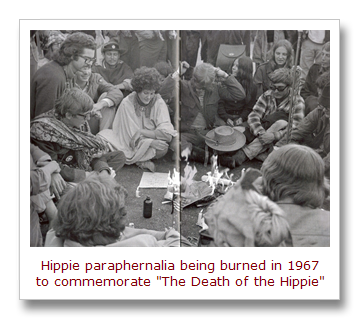
In October of 1967, a group of counterculture leaders organized a mock funeral event in San Francisco, called the “The Death of the Hippie,” to try to symbolically put an end to the term and the hype.

Some of the event’s organizers thought that the term freebie should be used to replace hippie.

That didn’t quite catch on — at least not as a replacement for the name commonly used for those of us who “dressed like Tarzan” and had “hair like Jane” back in those days. (My late father called us “He-She’s,” God bless him.)

September 5th is also the anniversary of On the Road, the most famous book by the coiner of the term “Beat Generation,” the grand-daddyo of “the beats,” Jack Kerouac.

It was first published on September 5, 1957 and includes a famous quote about “the mad ones” that might seem applicable to both the Beatniks and the Hippies. (See this post for more about the Kerouac quote.)

*     *     *     *     *     *     *     *     *     *

Comments? Corrections? Post them on the Famous Quotations Facebook page.

Related reading…

September 05, 2013

Kerouac’s “mad ones” continue to “burn, burn, burn like fabulous yellow roman candles…”


On September 5, 1957, the first edition of Jack Kerouac’s seminal book On the Road was published by Viking Press.

This semi-autobiographical novel, written in a loose, stream-of-consciousness (and sometimes probably semi-conscious) manner, had a profound and lasting effect on American literature and culture.

It’s not one of those books that generated a lot of famous, pithy quotes.

But there is a line in On the Road that’s included
in many books of quotations and cited by thousands of websites.

It’s a long, lyrical run-on sentence that epitomizes the “Beat” style of writing Kerouac helped create.

And, in a way, it epitomizes Kerouac’s rejection of mid-Twentieth Century, middle-class mores in favor of a wilder, non-conformist approach to life:  

       “They danced down the streets like dingledodies, and I shambled after as I’ve been doing all my life after people who interest me, because the only people for me are the mad ones, the ones who are mad to live, mad to talk, mad to be saved, desirous of everything at the same time, the ones who never yawn or say a commonplace thing, but burn, burn, burn like fabulous yellow roman candles exploding like spiders across the stars and in the middle you see the blue centerlight pop and everybody goes ‛Awww!’”

On the Road cemented Kerouac’s status as one of the literary gods of the “Beat Generation”

In fact, he coined that term, according to his friend and fellow Beat writer John Clellon Holmes and Kerouac himself.

Holmes popularized the term “Beat Generation” in magazine articles and books he wrote in the 1950s. But he credited it to Kerouac.

Kerouac later confirmed that it was his creation. In an interview published in the June 1959 issue of Playboy magazine, he recalled:

       “Holmes and I were sitting around trying to think up the meaning of the Lost Generation’s subsequent existentialism. And I said, ‘You know, this is really a beat generation,’ and he leapt up and said, ‘That’s it, that’s right!’”

On September 5, 1957, the day On the Road was officially released,
a review of the novel appeared in the New York Times. It was written by critic Gilbert Millstein, who’d received an advance copy.

He predicted:

      “Just as, more than any other novel of the Twenties,
The Sun Also Rises came to be regarded as the testament of the Lost Generation, so it seems certain that On The Road will come to be known as that of the Beat Generation.”

Millstein turned out to be right.

On the Road has achieved immense and long-lasting fame. Dozens of editions have been published over the decades, in dozens of different languages.

Millions of people have read about and been inspired by Kerouac’s depiction of the “mad ones” who “burn, burn, burn like fabulous yellow roman candles.”

Unfortunately, Kerouac burned himself out early, in an ending that was not fabulous.

After years of heavy alcoholism, he died at the age of 47 in 1969, from internal hemorrhaging caused by cirrhosis of the liver.

*     *     *     *     *     *     *     *     *     *

Comments? Corrections? Post them on the Famous Quotations Facebook group.

Related reading, viewing and listening…


Copyrights, Disclaimers & Privacy Policy


Copyright © Subtropic Productions LLC

All original text written for the This Day in Quotes quotations blog is copyrighted by the Subtropic Productions LLC and may not be used without permission, except for short "fair use" excerpts or quotes which, if used, must be attributed to ThisDayinQuotes.com and, if online, must include a link to http://www.ThisDayinQuotes.com/.

To the best of our knowledge, the non-original content posted here is used in a way that is allowed under the fair use doctrine. If you own the copyright to something posted here and believe we may have violated fair use standards, please let us know.

Subtropic Productions LLC and ThisDayinQuotes.com is committed to protecting your privacy. For more details, read this blog's full Privacy Policy.